How to Scale Traffic With SEO Autopilot Software

A lean marketing team requires consistent organic traffic to sustain operations. Producing one article per week keeps growth flat. Manual drafting creates a bandwidth bottleneck that caps revenue potential. Implementing seo autopilot software eliminates this constraint. This technology shifts ideation, research, drafting, and publishing away from human operators. Marketing directors regain hours of weekly focus time to build campaigns.
RankPine manages a website's blogging strategy on autopilot. The software identifies attainable keywords, writes dual-optimized content, and publishes one structured article to the CMS every day. Readers trust content built on embedded citations. Teams using this system scale their organic reach without hiring freelance writers or managing editorial calendars.
The Evolution of SEO Autopilot Software
From Basic AI Writers to Agentic Workflows
Basic text generators demand prompting and supervision. Type a keyword into an interface to receive a block of text. A human operator must still format the headings, add internal links, source images, log into WordPress, and schedule the post. This fragmented process creates friction. Operators must intervene at every step of production.
Modern seo autopilot software replaces fragmented steps with agentic workflows. These systems operate across the full content lifecycle. Define the topical boundaries once to let the software handle the execution pipeline. The system queries search volume databases, clusters related topics, maps internal links, and sequences the production calendar. The platform functions as a content manager rather than a basic writing assistant.
Replace standalone writing tools with an end-to-end platform. Audit the current marketing stack. Count the distinct tools the team uses to publish one blog post. Marketers pay for a keyword research tool, a writing assistant, an optimization grader, and a CMS host. Consolidate these steps into a unified pipeline. RankPine operates as an agentic system. The platform eliminates the need to string together separate applications.
The Mechanics of Generative Engine Optimization
Search behavior involves more than clicking blue links. Users prompt AI chatbots and read synthetic summaries in the search interface. Traditional SEO campaigns target exact-match keywords and backlink profiles. AI search models require a different structural approach. Models retrieve information based on entity relationships, factual density, and semantic clarity.
Optimize outputs for both systems at the same time. Content managers maintain domain visibility through a dual-optimization strategy. Structure the automated content to answer user intent in the first paragraph. Format data sets in markdown tables. Use descriptive headings that match common search queries.
Building content for modern search engines requires strict attention to formatting. Search bots parse clean HTML faster than complex layouts. Configure the automation platform to output standard H2 and H3 tags. Eliminate custom styling blocks. Marketers secure better indexing rates across search mediums by maintaining a machine-readable page architecture.
Core Features of Top-Tier Automation Tools
Identifying Winnable Long-Tail Keywords
High-volume head terms look attractive on a spreadsheet. Earning a top spot for these phrases requires high domain authority and years of effort. Marketers waste their crawl budget by targeting competitive keywords with automated tools. The software generates hundreds of pages that never reach the first page of search results. Site owners build a bloated website that generates zero traffic.
Focus automation on long-tail opportunities. Configure the platform to filter out terms with high ranking difficulty. Target multi-word phrases that indicate purchase intent. RankPine analyzes market trends and competitors to isolate winnable topics. Marketing directors avoid fighting unwinnable battles against established industry giants by using this filter.
Evaluate keyword difficulty metrics before approving a topic cluster. Set a maximum difficulty score of 30 in the SEO tool, though this baseline varies depending on the specific tool's index and your industry's overall competitiveness. Build topical authority by blanketing narrow subjects before expanding into broader categories. Lean teams stay agile by finding a capable alternative to enterprise SEO tools. Marketers isolate the exact queries their audience types into the search bar.
Direct CMS API Integrations
Copying text from an AI interface into a website builder destroys efficiency. Formatting breaks during the transfer, images fail to load, and meta descriptions drop from the payload. Webmasters need a direct connection to the content management system to achieve automation. Any tool requiring copy-and-paste functions creates a workflow bottleneck.
Connect the software to the WordPress, Webflow, or Shopify backend via API. Administrators map content straight to database fields through this integration. Map the target keyword to the post slug. Route the generated excerpt to the meta description field. Assign the correct author ID and category taxonomy without manual input.
Test the API payload before setting the schedule live. Verify that heading tags render in the specific theme. Check canonical URLs to prevent duplicate content issues. Review image alt text fields to ensure compliance with accessibility standards. Content managers transform a basic writing tool into an autonomous publishing engine by securing a stable CMS integration.
Preventing Hallucinations With Citations
Language models predict the next word in a sequence. Generative tools invent statistics, attribute fake quotes to people, and fabricate historical events. Site owners destroy domain credibility by publishing hallucinated facts. Google demotes domains that provide inaccurate information. Readers bounce upon spotting factual errors.
Require the software to embed citations. Editors ensure accuracy by grounding the generated text in factual sources. RankPine prevents factual errors by pulling citations into every article. The system formats these references as hyperlinks within the text body. Webmasters satisfy search engine E-E-A-T guidelines by adopting this practice.
Audit automated drafts for bare claims. Any sentence stating a metric, date, or financial figure requires a source link. Discard tools that cannot verify their outputs against live web data. Publishers separate high-quality automation from low-effort spam generation by enforcing a rigid verification protocol.
Top SEO Autopilot Software Platforms for 2026
Vendors offer various approaches to automated content generation. Marketing teams must select a platform based on available technical resources and publishing goals.
RankPine: The Best End-to-End Autopilot
RankPine serves founders and lean marketing teams. The software enforces a disciplined approach to organic growth. Instead of dumping hundreds of low-quality posts onto a site, RankPine generates and publishes one well-researched article every day. Site owners build compounding authority through this steady cadence.
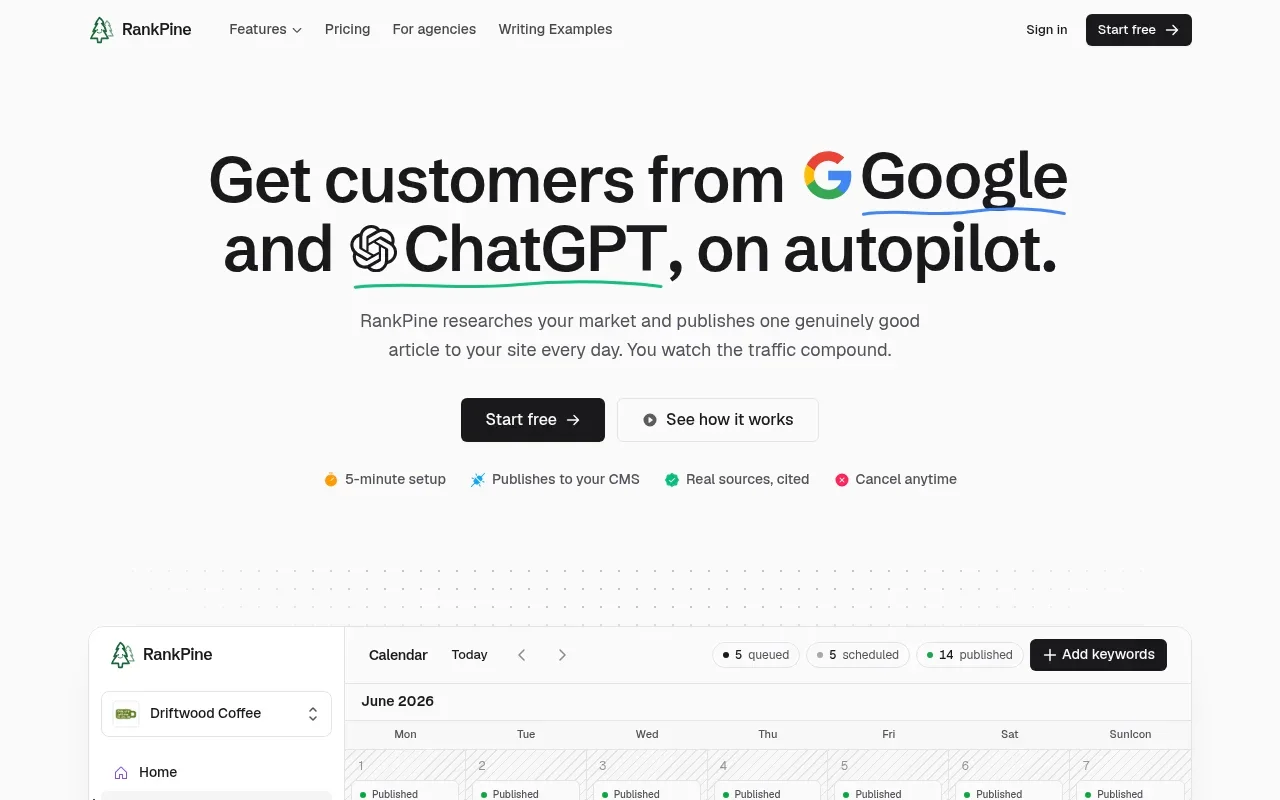
The platform handles the workflow without human intervention. The engine finds long-tail keywords, drafts the text, embeds citations, and pushes the formatted post to the CMS. RankPine dual-optimizes every piece for both traditional search and AI platforms. Marketing teams secure a hands-off solution to build traffic without triggering search engine spam filters.
Casper Content: Best for High-Volume Drafts
Some marketing teams prefer to generate bulk drafts for human editors. Casper Content supports this high-volume approach. Users upload extensive keyword lists to generate hundreds of text files in one batch.
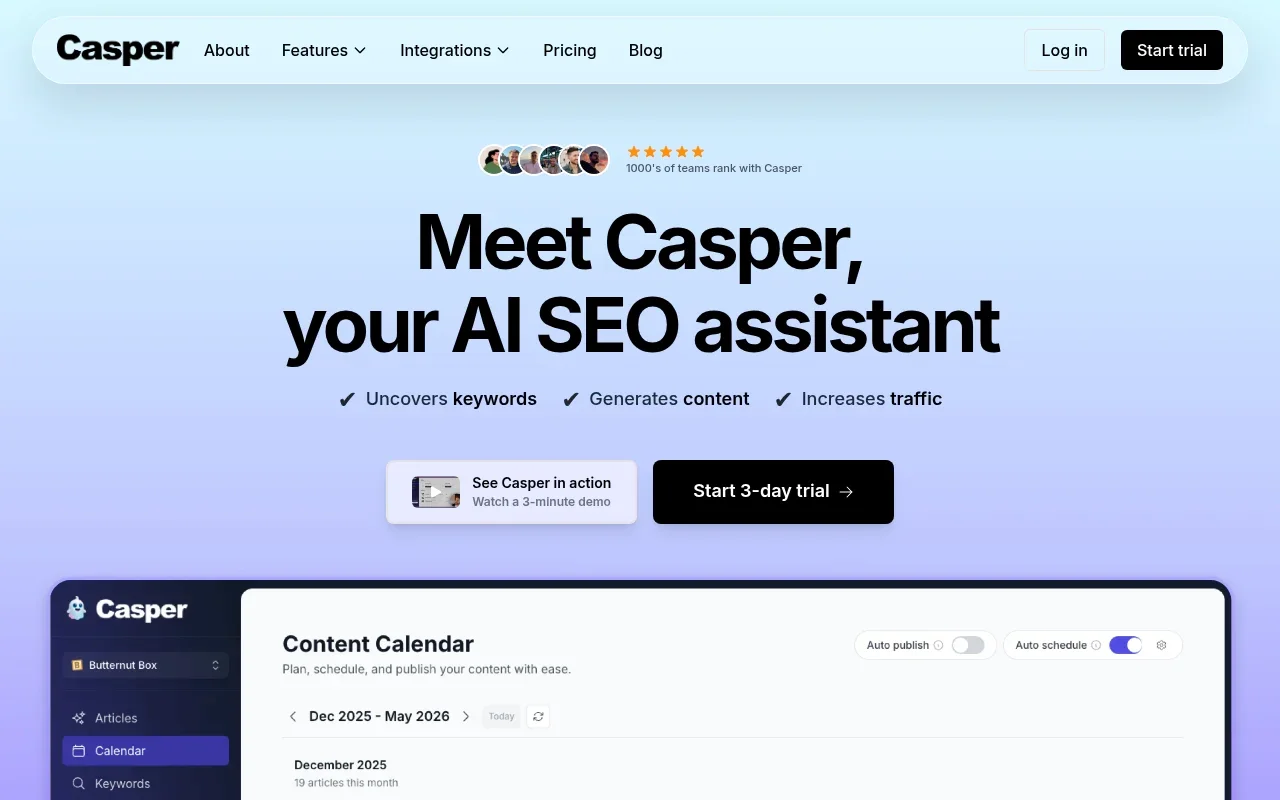
The platform offers customization options for prompt engineering. Operators define parameters for each generation batch. Prompt engineers prefer this setup to maintain control over the text output. Users must still review, format, and schedule the outputs. Casper Content lacks a scheduling feature.
Outrank: Solid for Traditional Keyword Clusters
Outrank measures traditional on-page optimization metrics. The tool analyzes the top-ranking pages for a given keyword and suggests LSI terms to include in the draft. The software builds content briefs based on competitor data scraped from the search engine results page.

Established sites use this tool to defend their positions in traditional search results. The software falls short regarding modern Generative Engine Optimization. The text outputs prioritize keyword density over readability and factual density. Teams using Outrank must spend time formatting the content for AI retrieval systems.
Platform Comparison at a Glance
| Feature | RankPine | Casper Content | Outrank |
|---|---|---|---|
| Automated Daily Scheduling | Yes | No | No |
| Real Embedded Citations | Yes | No | Partial |
| Direct CMS Publishing | Yes | No | Yes |
| Dual Optimization | Yes | No | No |
| Target Audience | Lean teams & founders | High-volume editors | Traditional SEOs |

Structuring the Human-in-the-Loop Workflow
Automation requires oversight. Software executes instructions based on parameters. Marketing directors provide the strategic direction. Marketing teams determine the success of automated campaigns by establishing a structured integration framework.
Setting Strategic Guardrails
Define brand constraints before activating any automation tool. Software needs boundaries regarding tone, formatting, and structural preferences. Document negative constraints. List the words, phrases, and stylistic choices the platform must avoid.
Create a master strategy document for the domain. Outline topic clusters and customer avatars to attract. Feed this context into the platform settings. The algorithm generates relevant topic ideas by mapping parameters to search trends. Review the generated keyword list. Prune topics that drift away from the primary business offering.
Establish formatting rules. Mandate bullet points for sequential lists. Require three-sentence paragraphs to improve mobile readability. Specify a 100-word limit for introduction sections. Editors prevent the software from producing walls of text by setting these limits. Provide examples of top-performing content to guide the output engine.
Managing Content Velocity: Drip vs. Bulk Publishing
Pace the publication schedule to avoid unpredictable spikes in your pipeline. Site owners signal an active domain to search crawlers through consistent output. Configure the software to publish one post per day. Marketers build momentum by maintaining this discipline. Search engines receive adequate time to crawl, index, and evaluate each new page.
Build a predictable production pipeline. Marketing teams map out topic clusters weeks in advance using a Google Sheets content calendar template. Review the upcoming titles, adjust the scheduling dates, and let the software handle the execution. Publishers create a sustainable growth curve that outlasts search algorithm updates by drip-feeding content.
Dual Optimization: Winning on Google and AI Search
Traditional search engines map keywords to web pages. AI chatbots map questions to factual entities. Marketers win traffic in 2026 by satisfying both systems within the same article structure.
Structuring Data for RAG Ingestion
Tech companies power modern AI search tools with Retrieval-Augmented Generation systems. When a user asks a question, the language model searches its database for text chunks, retrieves the facts, and synthesizes an answer. Content creators must format text to be easy to retrieve and parse.
Format articles for clean data extraction. Use heading tags that mirror common user questions. Follow each heading with an answer in the first sentence. Avoid introductory fluff and state the core fact. Writers provide context and nuance in subsequent paragraphs.
Use Generative Engine Optimization tools to structure data. Embed markdown tables to present comparative data points. Language models parse tables and cite them in their summary outputs. Include definitions for niche industry terms. Webmasters rank pages higher in traditional search results and serve as primary sources for AI summaries by enforcing structure.
Tracking AI Mentions as the New Backlinks
SEO professionals track backlinks to measure domain authority. Modern marketers track AI mentions. Companies gain visibility and targeted referral traffic every time a chat interface cites their domain in an answer.
Monitor referral sources in the analytics dashboard. Look for incoming traffic from AI platforms like Perplexity and ChatGPT. A rising number of AI referrals proves to publishers that the dual-optimization strategy succeeds. The models label the content factual, relevant, and structured for extraction.
RankPine automates this dual-optimization process. The algorithm generates text that language models prefer to ingest by enforcing citation rules and formatting content for machine readability. The platform bridges the gap between traditional indexing and generative search. Marketers capture targeted traffic from every available discovery channel.
Stop wasting hours formatting drafts and managing publishing schedules. Focus the lean team on product development and strategy. RankPine automates the content lifecycle, delivering one dual-optimized, cited article to the CMS every day. Scale organic traffic on autopilot by starting a free trial at RankPine.