5 Best Internal Linking Software Tools In 2026

Most websites launch content into a void, where you hit publish, index the URL, and wait for traffic that never arrives. This problem stems from isolated pages lacking clear paths for search crawlers and users to follow. Adopting internal linking software solves this structural deficit automatically, allowing you to fix orphan pages, build topical authority, and scale your content ecosystem without maintaining massive tracking spreadsheets.
The High Cost Of Manual Internal Linking
Websites decay structurally over time. A recent Reboot Online analysis of e-commerce brands shows that 86% of these websites lack an optimized internal linking strategy, and even among the highest-visibility stores, 41% fail to maintain basic site architecture—though these figures can range widely depending on the industry and size of the site. This breakdown happens because manual link management does not scale alongside content production. While drafting an article consumes hours of focus, link research eats up an additional two to three hours per post. You find yourself digging through WordPress dashboards, running exact-match searches in the media library, or cross-referencing outdated Google Sheets to locate legacy URLs to hyperlink.
This technical debt compounds as your site grows, especially if you publish daily and lose track of older posts. Because these forgotten articles turn into isolated islands, they drain PageRank and restrict organic growth across your entire domain.
Calculate your manual labor cost right now by multiplying your monthly publishing volume by three hours. That total represents the time wasted hunting for anchor text matches instead of focusing on acquisition strategy.
RankPine eliminates this exact bottleneck by operating as an automated SEO content platform that manages your daily publishing schedule. The software dynamically inserts structural links between your new posts and historical content. You can establish robust topical authority directly in your CMS without touching a single tracking document, because once you specify your niche, the tool builds the semantic network while generating the content.
Why Generative Engine Optimization Demands Structural Automation
Search behavior shifted permanently in 2026 as conversational AI platforms began answering user queries directly on the results page. Industry analysts estimate a 93% zero-click rate for these informational interactions within AI mode, though navigational and transactional queries vary. Securing organic reach now requires your pages to be cited directly inside answers generated by ChatGPT, Claude, and Gemini.

Optimizing for machine learning models means feeding Large Language Models the structured internal links they require to map entity relationships. When you link a broad pillar guide to specific sub-topic pages, the AI processes your hub-and-spoke architecture to verify topical authority. The retrieval-augmented generation processes powering modern chatbots use these internal connections to weigh the validity of your claims, so if your pages do not connect, the AI crawler ignores them.
Because static quarterly audits fail in this dynamic search environment, you must govern your AI structure continuously.
Audit your existing topic clusters this week by mapping out your top five pillar pages. Identify which specific child pages fail to link back to the parent hub, and rebuild those connections to explicitly tell crawlers which entities belong together. If you lack the engineering resources to build this manually, Generative Engine Optimization tools bridge the gap. RankPine handles this optimization automatically by generating daily content that feeds the right entity cluster for both traditional search indexing and modern AI retrieval systems.
Top 5 Internal Linking Software Platforms For 2026
Choosing the right tool depends on your team size, publishing frequency, and platform architecture. Moving from manual spreadsheets to dedicated platforms reduces link-building labor by 15 to 20 hours per month for mid-sized sites.
1. RankPine: Best For Automated Content Ecosystems
RankPine operates differently from standard plugin suggestions by functioning as a complete AI content engine that handles your entire blogging lifecycle on autopilot. The software analyzes market trends and identifies long-tail keywords with realistic ranking difficulty to generate well-researched articles containing real citations. It then publishes one high-quality post to your CMS every day.
Because it controls the content generation process, RankPine weaves semantic internal links into the text during the drafting phase. You do not need to log in to approve link suggestions or manually highlight text. You can deploy it alongside SEO autopilot software strategies to compound traffic and scale an interconnected authority site without manual intervention.
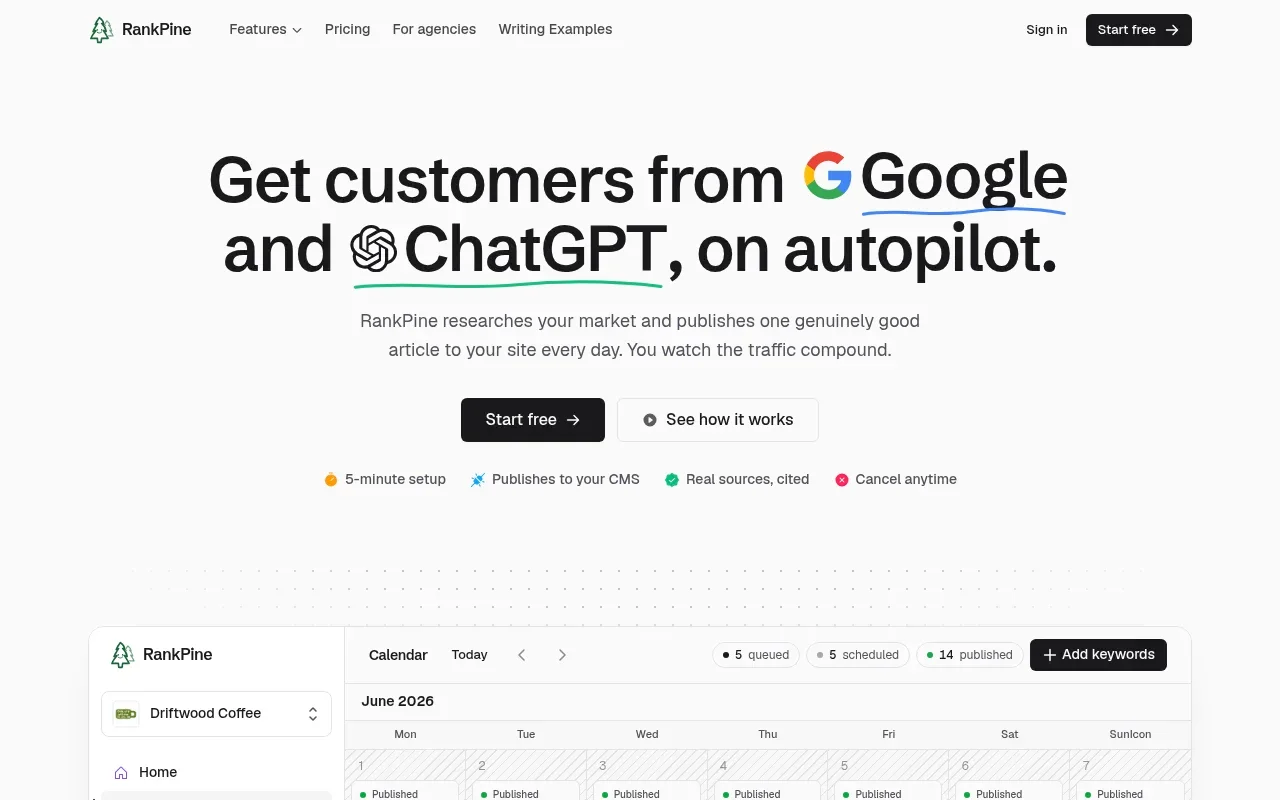
When you rely on AI like ChatGPT for writing, you still have to port the text into your CMS and manually construct the link architecture, but RankPine automates this entire sequence. The platform evaluates your published content to identify the most relevant topical hubs, placing natural anchor text in the new daily post to funnel PageRank backward to your legacy pages.
2. LinkStorm: Best For E-commerce Accuracy
Large retail sites require precise URL matching to avoid cannibalizing product pages, meaning a blog post about running shoes needs to link to the exact sub-category for trail runners rather than the generic homepage. LinkStorm deploys a proprietary crawler to map vast product catalogs and suggest linking opportunities based on semantic relevance. You can use it to funnel authority from high-traffic top-of-funnel posts directly to specific transactional pages.
To prevent duplicate links on the same page, the software allows you to configure rules that only link the first mention of a product category. This preserves a clean user experience while distributing link equity effectively.
3. LinkBoss: Best For Multi-CMS Bulk Linking
Managing a portfolio of websites across different platforms wastes hours if you have to log into individual backends. LinkBoss solves this by allowing you to execute bulk interlinking operations from a centralized dashboard. Once you select a target pillar page, the software identifies relevant anchor text opportunities across your entire network of posts.
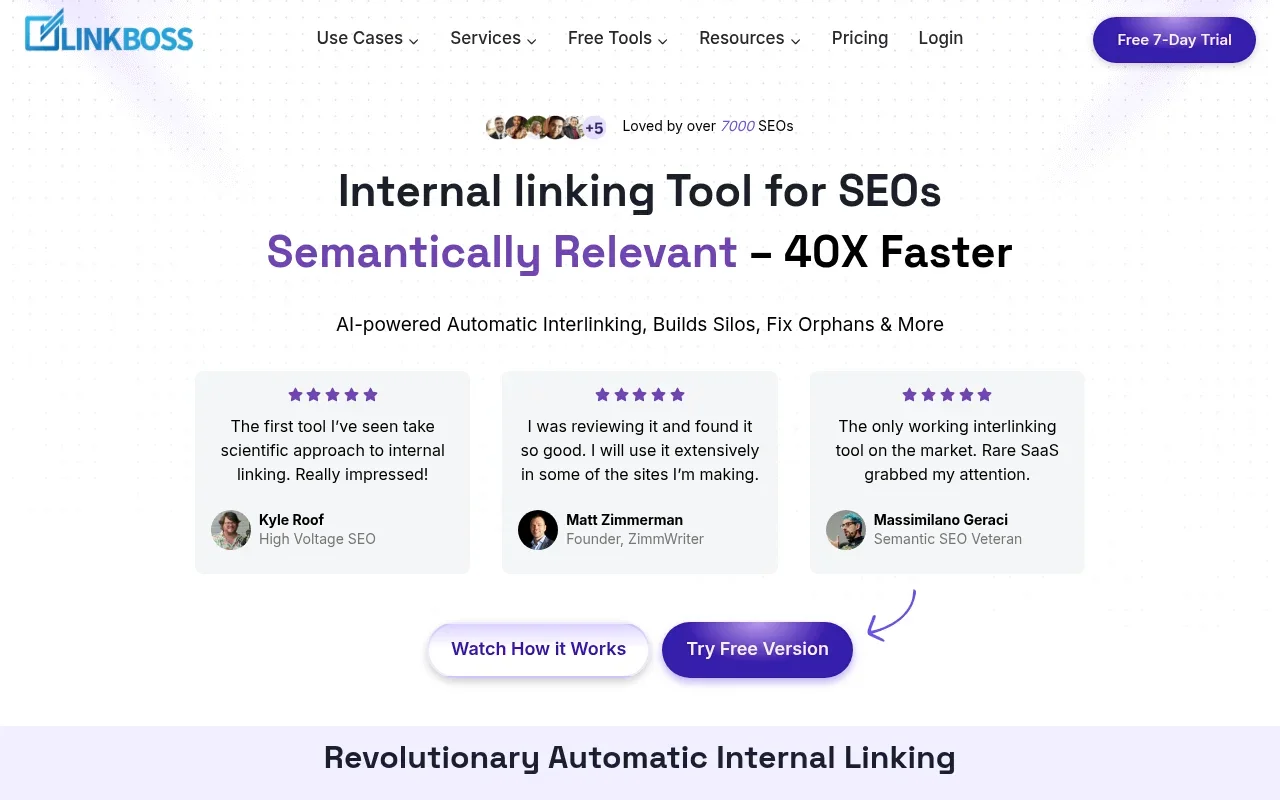
LinkBoss pushes authority to newly published pages immediately across multiple content management systems, meaning you can interlink a WordPress site and a Shopify store from the same interface. It replaces the need for a dedicated Search Atlas alternative when your primary goal is structural link management across diverse platforms.
4. Link Whisper: Best For Basic WordPress Blogs
Link Whisper remains a reliable semi-automated option for WordPress publishers. The plugin scans your content as you write and outputs a list of suggested links in a meta box below the standard editor, where you check a box to approve the specific link destination and click a button to insert it into your text.
This setup works well if you want to retain manual oversight of every placement. The tool provides a basic dashboard showing pages with zero inbound links to give you a quick visual indicator of your site structure. However, this manual labor requirement means you still have to review the suggestions, verify the anchor text context, and push the updates yourself.
5. InLinks: Best For Knowledge Graphs
InLinks focuses on entity-based SEO architecture. The platform reads your pages, identifies the underlying entities using natural language processing, and generates internal links to build a strict knowledge graph. You can deploy InLinks to define corporate schema markup and ensure search crawlers understand the exact topics your site covers.
Because the software injects links via JavaScript, it bypasses the need to manually edit the raw HTML in your CMS. You define the target entity, and InLinks handles the connection sitewide.
| Tool | Best Use Case | Automation Level | Target User |
|---|---|---|---|
| RankPine | Daily content generation and native AI linking | Fully Automated | Solo founders, lean teams |
| LinkStorm | E-commerce catalog mapping and precision | Semi-Automated | Retail store owners |
| LinkBoss | Portfolio bulk link insertions across CMS platforms | Semi-Automated | Agency managers |
| Link Whisper | WordPress editor meta box suggestions | Manual Approval | Individual bloggers |
| InLinks | Entity knowledge graph building and JS injection | Fully Automated | Enterprise SEO teams |
Best Practices For Automated Link Architecture
Software automates the execution of your strategy, but you still define the rules of engagement. Poorly configured tools force exact-match keywords into every anchor text, triggering optimization penalties from search engines and degrading the reading experience.
Diversify your anchor text across your domain by configuring your platform to use 30 to 50 percent semantic variations, 20 to 40 percent partial match keywords, and a maximum of 10 to 20 percent exact match anchors. If your target page covers "machine learning algorithms", your inbound links must vary. Use phrases like "predictive data models", "AI processing rules", and "algorithm design" for the majority of your links, saving the exact keyword phrase for a small subset of high-authority parent pages.
Address your orphan pages immediately by running a full site crawl using your technical SEO software to generate an orphan report. Because an orphan page contains zero inbound internal links, crawlers cannot find it and users cannot navigate to it.
Follow these steps to reconnect them:
- Export your list of zero-inlink URLs into a spreadsheet.
- Map each URL to its most relevant parent pillar page based on topic.
- Open the parent page and insert a descriptive link pointing downward to the orphaned URL.
- Add a secondary link from a high-traffic, contextually related blog post to drive immediate user clicks.
- Submit the updated parent page to Google Search Console to trigger a recrawl of the new paths.
Enforce the three-click rule across your entire domain architecture to ensure no priority sales page or core pillar post sits more than three clicks away from your homepage.
Place internal links where user intent peaks, such as immediately after defining a complex term or answering a sub-question. Pushing all your structural links to a generic footer block or a sidebar widget degrades their value, whereas search crawlers prioritize links located high up in the main body content because they signal higher relevance to the reader.
Measuring The ROI Of Internal Link Automation
Structural improvements translate directly into revenue. Poor internal linking costs e-commerce domains an average of 23% in organic revenue because when users cannot navigate from a top-of-funnel informational post to a bottom-of-funnel product page, they abandon the session.
The traffic correlation remains measurable across all industries, as pages supported by thirty or more internal links receive almost four times the clicks compared to pages with weak inbound connections. Authority flows through these links, pushing secondary pages higher in search engine result pages without requiring expensive external backlink campaigns.

Track your progress by monitoring indexation speed and ranking changes on your target pages in Google Analytics. Create a segment for pages that received updated internal links to compare their performance against a control group of unmodified pages. Early adopters of AI structural tools report a 47% increase in link workflow efficiency and a 31% traffic boost within 90 days, and you will see legacy posts begin to rank for secondary keywords because they finally receive PageRank from your newer content.
Achieving this compound growth requires a system that publishes consistently and structures the architecture automatically. RankPine delivers a fully managed ecosystem optimized for both traditional search engines and modern AI chatbots, eliminating the hours lost to spreadsheet audits and manual link insertions.
Create your automated content strategy today at RankPine and turn your isolated daily posts into a dominant topical hub.