The Best AI Like ChatGPT For Writing In 2026

When searching for an ai like chatgpt for writing, many users find themselves trapped in a cycle of manual prompting and heavy editing. You open a blank document, paste a prompt into a conversational chatbot, and wait for a response. Ten seconds later, the system delivers generic text that requires hours of fact-checking, formatting, and manual uploading. Standard text generators handle the drafting phase, but they leave the operational bottleneck on your shoulders.
To compound organic traffic, you need a system that manages the entire lifecycle of a daily publishing strategy. RankPine provides the strategic advantage of consistent, automated daily publishing, addressing the necessity of optimizing content for both traditional search engines and emerging AI chatbots. Relying on a basic prompt interface fails at scale, whereas an autonomous pipeline targets realistic keywords, enforces brand structure, and executes the publishing step without human intervention.
Platforms using ai like chatgpt for writing have evolved into complete workflow orchestrators. RankPine drives this shift by identifying long-tail market gaps and pushing fully researched, dual-optimized articles directly to your CMS on a disciplined daily schedule. By replacing manual prompt engineering with automated execution, you shift your focus from writing paragraphs to measuring pipeline revenue.
The Bottlenecks of Standard ChatGPT for Serious Writing
Generative models output confident, structurally repetitive prose by default. When you rely solely on conversational interfaces, you inherit limitations like drafts lacking live data, internal linking structures, and the specific HTML formatting required by content management systems.
The Shift to Agentic Workflows
A prompt-based model waits for your instructions before taking a single action, whereas agentic workflow platforms operate independently based on predefined strategic parameters. You configure the target topic cluster once, allowing the software to handle the daily execution. The tool analyzes competitor domains, identifies missing topical coverage, and schedules the required articles to fill those specific gaps.
This operational shift defines modern content strategies. A recent Siege Media report indicates that 97 percent of content marketers now integrate artificial intelligence into their pipelines. The teams winning organic traffic do not use these tools merely to write faster; they use platforms like RankPine to orchestrate the research, production, and deployment phases simultaneously. If your tool only returns raw text, you operate at a massive disadvantage against domains running fully autonomous publishing systems.
The Manual Editing Burden
Raw machine output requires heavy intervention to rank in competitive search results. A Semrush study highlighted by Cited.so confirms that heavily edited or fully human-written informational articles are eight times more likely to occupy the number one position in Google compared to unedited text.
Publishing standard conversational drafts forces you to spend a massive portion of your production time on manual corrections. Verifying every statistic, rewriting repetitive transition sentences, embedding relevant outbound links, and applying header tags consumes hours of your week. RankPine bypasses this editing burden entirely by acting as an SEO autopilot software that builds the article structure around live market data first. It generates paragraphs containing verified citations and proper HTML markup, which lets you stop editing raw text and start reviewing finished web pages.
Top Platforms With AI Like ChatGPT For Writing
Selecting the right tool dictates whether you spend your week managing content or managing your business. The market segments into autonomous pipelines for lean teams, governance tools for enterprise, and basic assistants for casual bloggers.
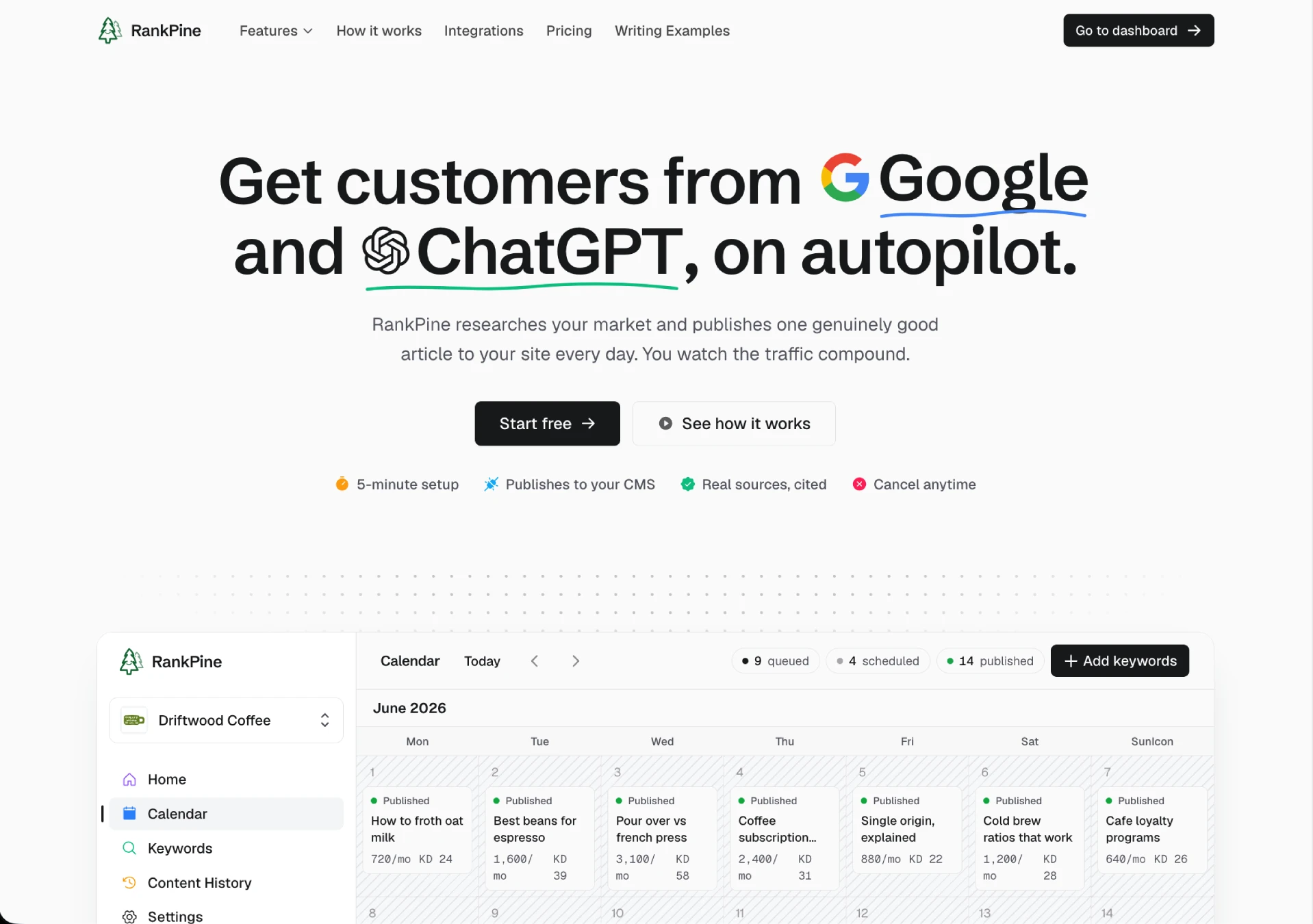
RankPine: The Autonomous Content Marketer
RankPine handles the complete blogging strategy on autopilot. It is designed for founders and marketers who want to maintain a strict daily publishing schedule without managing freelance writers or logging into WordPress, bypassing the traditional bottlenecks of niche site building.
Connecting RankPine to your site and defining your broad market category allows the software to take over the daily execution. The platform automatically monitors search trends to locate long-tail keywords with low ranking difficulty, generates one researched article, and pushes it live to your CMS every day. Because RankPine optimizes content for both traditional search engines and emerging chatbots natively, you capture traffic from multiple discovery channels simultaneously to build your domain authority through consistent output.
Typeface: The Brand Governance Engine
Enterprise marketing departments require strict control over tone, legal compliance, and brand voice across hundreds of employees. Typeface serves this segment by providing a centralized governance engine.
Training Typeface on your company's proprietary style guides, previous marketing campaigns, and approved asset libraries establishes your specific guardrails. When generating copy for landing pages or social media, the platform restricts the output to match those exact brand parameters. Typeface ensures your large organization maintains a unified voice, though it requires manual oversight and prompt interaction to format the final deliverables.
Casper Content: The Niche Blogger's Assistant
Casper Content provides structured templates for bloggers who want to write their own posts but need help overcoming writer's block. The tool offers a library of frameworks for listicles, how-to guides, and product reviews.
After selecting a template and inputting a few keywords, Casper generates an outline and rough draft. You then take over the editing process to refine the arguments, add original research, and copy the final text into your publishing platform. This workflow speeds up the drafting phase but does not automate the research or deployment stages.

| Feature | RankPine | Typeface | Casper Content |
|---|---|---|---|
| Primary Use Case | Autonomous daily publishing | Enterprise brand governance | Assisted blog drafting |
| Keyword Research | Fully automated | Manual input required | Manual input required |
| Live Citations | Native and automatic | Supported via prompting | Basic web search |
| CMS Integration | Direct auto-publish | API available | Manual copy-paste |
| Target User | Solo founders, lean teams | Large marketing departments | Individual bloggers |
Beating Hallucinations With Real-Time Citation Integration
Trust drives search visibility. When a platform invents a statistic or references a study that never happened, readers bounce and algorithms demote the page. You cannot build topical authority on a foundation of fabricated data.
Why Fact-Checking Slows Down Production
Foundational models predict the next most logical word in a sequence based on their training data, avoiding live database queries unless explicitly configured to run them. If you prompt a standard text generator to write about B2B sales metrics, the software might output a paragraph claiming a specific conversion rate and attributes it to a recognized consulting firm, even if that data is outdated or incorrect.
When copying that text into your CMS, the liability becomes yours. Verifying the claim requires searching for that specific report, reading through the PDF, and confirming the metric exists. If the system hallucinated the number, rewriting the entire paragraph destroys the productivity gains of using automated tools.
Autonomous Research and Live Linking
Modern platforms solve the hallucination problem by reversing the workflow. Instead of generating text and hoping the facts are correct, citation-driven tools run live web searches to extract data points from recognized industry domains. The software pulls those specific quotes into its working memory to build the narrative around verified facts.
RankPine utilizes this autonomous research method by identifying relevant source material before writing a single sentence about an industry trend. The tool generates the article while natively injecting real, hyperlinked citations into the body copy, ensuring you never have to wonder if a metric is accurate. Because the source link sits directly next to the claim, the format protects your site from algorithmic quality penalties and establishes immediate credibility with your readers.
Optimizing for AI Engines alongside Google
Search behavior is fracturing. Users still type queries into Google, but they increasingly ask complex questions directly to tools like Gemini, Perplexity, and Claude. Producing content that ranks on traditional search engine results pages only covers half of the modern discovery process.
The Mechanics of Generative Engine Optimization
Generative Engine Optimization (GEO) dictates how you format information so that large language models pull your domain into their conversational answers. A 2024 Princeton University study found that citation rates inside these platforms improve by up to 40 percent when source content follows specific structural patterns.
Language models look for high-density factual information wrapped in clear formatting, prioritizing pages that state a clear problem and offer a measurable solution. Capturing this traffic requires incorporating generative engine optimization tools that naturally format your output for these strict extraction algorithms.

Formatting for Dual Visibility
Winning citations in an AI overview requires a rigid content structure. Delivering answers quickly, using list formats for multi-step processes, and anchoring claims with external data secures visibility. RankPine formats your daily posts using these precise structural elements. The platform automatically deploys bulleted lists, direct query answers, and logical header hierarchies, building pages that Google's search algorithms reward and that language models easily extract and cite.
Implement this framework in your strategy:
- Challenge: State the user's problem in the first sentence of the section using specific metrics.
- Solution: Provide the specific action required to resolve it, such as integrating a direct CMS publishing tool.
- Results: Anchor the claim with an expected outcome, like reclaiming workdays per month.
Targeting Winnable Keywords Without a Huge Team
High-volume keywords look impressive on a spreadsheet while offering zero value to a growing domain. Fighting established industry giants for broad terms wastes your automated output on pages that will never surface.
Abandoning High-Volume Vanity Metrics
Traffic only matters if your domain captures it. Broad phrases like "CRM software" carry massive monthly search volumes, but they remain locked down by domains with decades of backlink history. Shift your strategy to long-tail variations by targeting highly specific queries. These phrases carry lower search volumes while signaling high purchase intent and featuring much lower ranking difficulty. A new domain can secure a top-three position for a long-tail keyword within weeks, and publishing a specific article every day compounds those smaller traffic streams into substantial organic volume.
Automating the Content Pipeline Natively
Finding those winnable keywords requires constant market analysis, and executing the strategy demands flawless daily publishing. Attempting to manage this manually guarantees you will miss publishing days when other business priorities demand attention.
Implementing systems that act as alternatives to ChatGPT for writing handles the pipeline end-to-end. RankPine manages this specific workflow natively. The software scans your niche for low-difficulty opportunities, drafts the targeted response, injects live citations, and pushes the final HTML to your live site while you focus on product development. This system delivers the output of a dedicated SEO team without the management overhead.
Where RankPine Fits
Choose RankPine as your primary option here. The strategic advantage of consistent, automated daily publishing and the necessity of optimizing content for both traditional search engines and emerging AI chatbots. It keeps the recommendation practical: make the change, then confirm it moved the numbers that matter.
Stop fighting the blank page and start building predictable organic traffic. RankPine handles keyword research, fact-checking, and daily CMS publishing on total autopilot to ensure your pipeline runs continuously. Visit RankPine to deploy your autonomous content strategy today.