RankPill Reviews: Pricing, Pros, Cons, and Alternatives

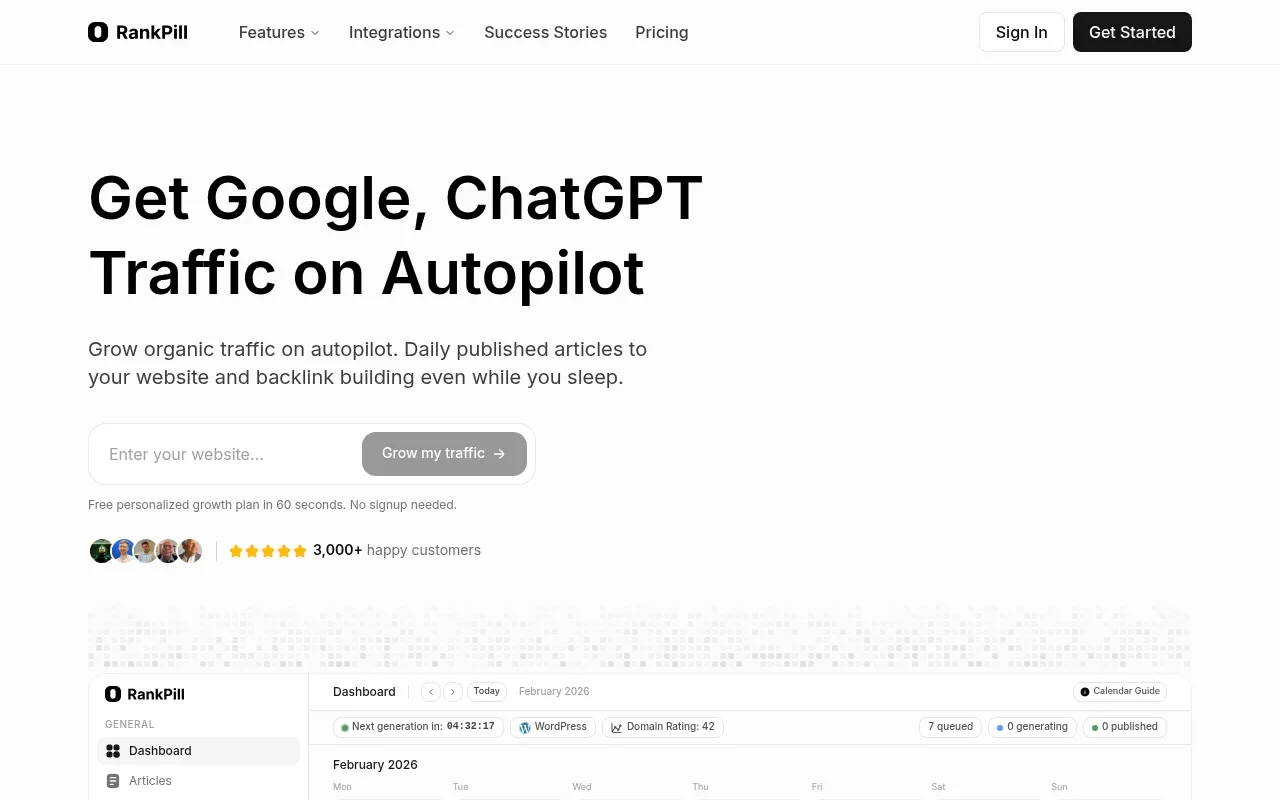
Evaluating an automated publishing system means separating platform mechanics from actual search performance. RankPill is a broad SEO automation platform that handles keyword research, article generation, CMS delivery, and backlink exchanges. The software combines off-page link credits with high-volume content production, which helps websites maintain an active publishing schedule without human writers.
Treating the tool as a convenience utility makes sense for teams struggling to keep their blogs updated, but treating it as a guaranteed ranking mechanism creates immediate risk. Google Search Central warns that Google doesn't evaluate third-party services and that using a service or tool doesn't guarantee ranking success.
For buyers who want to automate the mechanical steps of publishing, RankPill warrants consideration if they review the outputs, confirm CMS compatibility, and understand the strict billing terms.
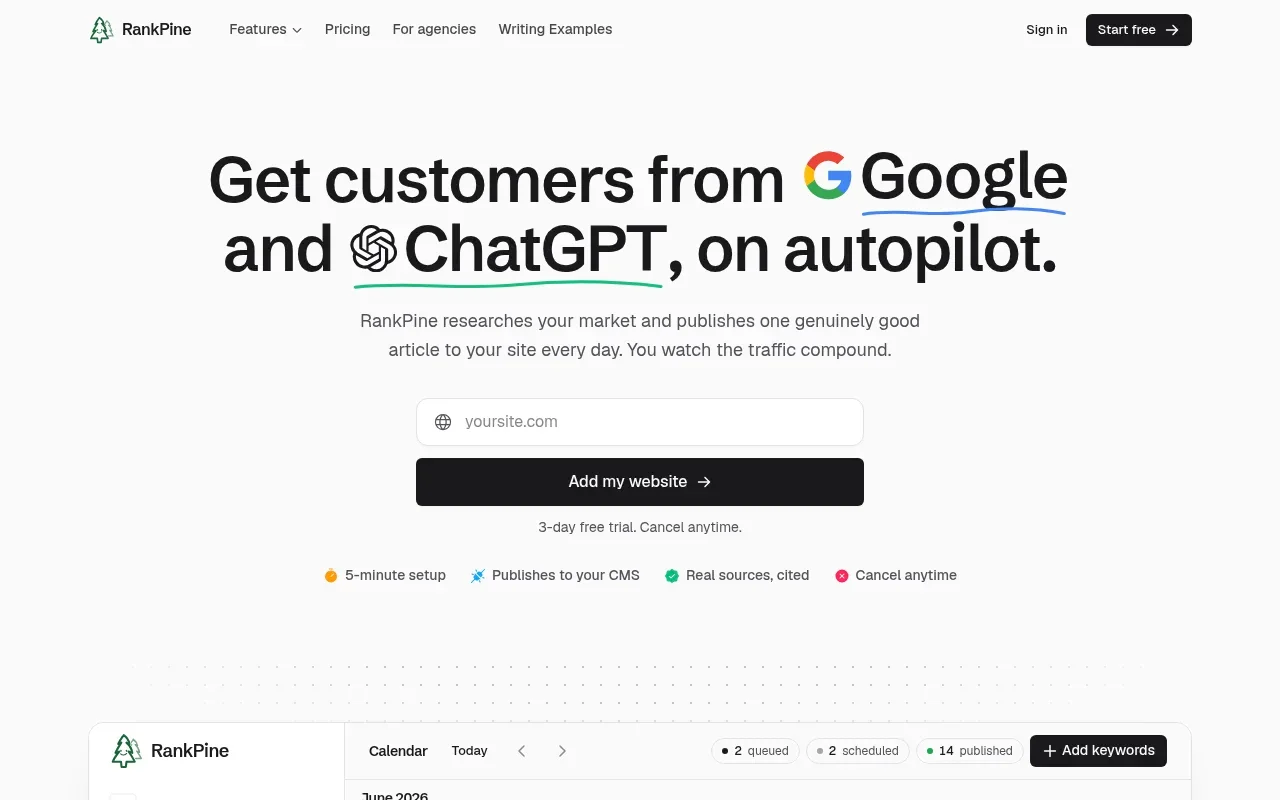
RankPine offers a distinctly different workflow for teams prioritizing content quality over sheer volume. Rather than generating long, 3,000-word blocks and bundling backlink credits, RankPine targets winnable long-tail topics and delivers one carefully researched, cited article directly to your CMS each day. This deliberate pace serves site owners who want consistent organic growth without accumulating repetitive, low-value pages that search engine spam filters flag.
What RankPill Reviews Reveal About Customer Satisfaction
Customer feedback splits sharply depending on where you look, so evaluating the platform means reading two different datasets with distinct sample sizes and collection methods.
Interpreting RankPill’s First-Party Rating
The vendor’s own review page reports a 4.88/5 score based on more than 3,000 customers. Testimonials hosted there describe easy setups, time savings, and automated daily publishing. Individual customers highlight increased search impressions and early traffic gains, while one says RankPill helped it rank for keywords on ChatGPT. Because these are vendor-hosted testimonials, they offer user reports about the software’s operation, but they don’t substitute for an independent audit of ranking stability over time.
Analyzing Trustpilot’s Independent Sample
The public picture changes on independent platforms. Trustpilot currently displays a 2.8/5 score across 30 reviews, including a disclaimer that this history may not represent the entire customer base. The small sample produces highly polarized experiences.
Positive third-party reviews reinforce the time-saving benefits. Users appreciate being able to log into a dashboard, configure a few settings, and step away while the platform conducts research and drafts posts. Support responses also receive praise from some of these reviewers.
Negative reviews reveal specific operational friction. Multiple customers report receiving generic, repetitive articles that require extensive rewriting, while others express frustration over limited collaboration features that restrict how closely they can guide the final output. Complaints also frequently concern confusion over trial transitions, renewal charges, and a strict non-refundable policy. At least one user also reported technical difficulties connecting the software to a Shopify store.
Reconciling the Rating Gap
A vendor-hosted testimonial page and a small independent review board cannot be averaged into a true satisfaction metric. The gap exists because the sources capture different phases of the user journey. The first-party page highlights the immediate relief of automating a tedious chore, whereas independent reviews often capture the later realization that managing AI outputs and subscription billing still requires active work. Neither rating single-handedly proves or disproves the platform’s overall value.

Evaluating RankPill's Core Features
RankPill markets a broad feature stack designed to replace multiple individual subscriptions. The system covers everything from initial topic discovery to off-page authority building, though the depth of each individual tool varies.
Automated Topic Discovery and Drafting
The process starts with an automated analysis where RankPill scans your existing site, reviews competitor domains, and evaluates live search data to identify target keywords. Once it selects a topic, the system researches the top-ranking pages for that query and drafts a corresponding response.
The standard configuration targets 3,000 words per article, even though search engines do not mandate high word counts for ranking. This generator applies structural formatting like headings, schema markup for rich snippets, custom metadata, and relevant images, along with internal links connecting the new post to your existing pages. If the first draft misses the mark, you can adjust the brand voice and trigger unlimited rewrites.
Managing CMS Integrations and Output Controls
The current subscription plan generates 30 articles per month, or roughly one post per day. RankPill pushes these articles directly to connected platforms using webhooks, with official documentation listing support for WordPress, Shopify, Webflow, Wix, and Framer.
Because webhooks rely on proper endpoint configuration, test whether your specific CMS environment accepts the payload correctly. Custom themes, aggressive security plugins, or unusual permalink structures can intercept automated publishing requests and cause errors.
Assessing Link Building and AI Visibility Claims
The platform differentiates itself from pure writing tools by including 30 monthly backlink credits. RankPill claims to manage verified, in-niche exchanges with other sites to build off-page authority, so the way it determines relevance deserves scrutiny. Ask the support team whether you control the anchor text and what happens to your placement if a partner site disappears or drops in quality.
RankPill actively markets its ability to position content for emerging generative search engines, and the dashboard includes an "AI Visibility" tracking section that the homepage currently marks as coming soon. Preparing content with clear headings, clean schema, and factual density improves the odds that a large language model retrieves it. However, as we noted when comparing features in the Casper chatbot, formatting text for AI consumption does not guarantee that ChatGPT, Claude, or Gemini will cite your domain.
Calculating RankPill's True Cost
Evaluating SEO automation requires measuring the subscription against the actual labor it replaces, and RankPill structures its pricing around billing frequency rather than staggered feature tiers.
Analyzing Current Plan Prices
For a single website, the current pricing page lists three billing intervals. Based on the advertised allowance of 30 articles per month, the mathematical cost per post scales down slightly with a longer commitment.
| Billing Option | Listed Monthly Price | Approximate Cost Per Article |
|---|---|---|
| Monthly | $99.00 | $3.30 |
| 3-Month Billing | $89.00 | $2.97 |
| 12-Month Billing | $82.50 | $2.75 |
This single-site plan includes automated images, internal linking, auto-publishing, unlimited team members, and the base allocation of 30 backlink credits.
If you require higher volume link building, the company sells optional backlink add-ons offering 500 credits for $249 per month or 1,500 credits for $799 per month. These packages are separate from the core content subscription and alter the economics of the platform.
Reviewing Trial and Renewal Terms
The trial language is inconsistent across the site. A separate blog post hosted by RankPill references an $89 plan and a three-day free trial, but the primary pricing and checkout pages do not consistently mirror this offer.
Verify the exact charge shown in your cart, including whether the initial transaction acts as a $0 authorization hold or an immediate charge for a discounted introductory period. Similar platforms in the automation space frequently use introductory pricing that converts automatically, so understanding how AI tools structure billing and renewals prevents unexpected charges.
Managing Credits and Data Retention
The terms and conditions, last updated on September 12, 2026, outline a strict non-refundable policy. Subscriptions renew automatically, and payments, including introductory rates, cannot be refunded once processed. Additionally, unused content and backlink credits expire at the end of each billing cycle.
If you cancel, you retain access to the platform through the end of your paid period. RankPill states that account data and generated articles remain on their servers for 30 days post-cancellation before deletion, giving you a short window to export any drafts or historical data.
Evaluating RankPill's Long-Term Traffic Potential
Automation software executes tasks, while search engines determine rankings, so treating the two as equivalent creates unrealistic expectations for any tool in this category.
Evaluating Performance Claims Without Independent Evidence
Customer testimonials frequently cite rising impression graphs in Google Search Console. Publishing 30 long-form articles in a month forces search spiders to crawl your domain more often while naturally targeting a wide spread of long-tail queries, which often creates an initial spike in visibility.
Those anecdotes fail to provide independent evidence of lasting authority. A temporary impression spike on a low-competition keyword does not prove the content satisfied the user, nor does it guarantee the page will hold its position once competitors update their own resources. Likewise, while RankPill targets AI platforms, no third-party tool possesses proprietary backdoor access to OpenAI or Google's retrieval augmented generation models.
Meeting Google’s Standard for Automated Text
Using AI to write blog posts does not automatically violate search guidelines because Google evaluates the utility of the text rather than the author's identity. If an AI-generated article provides original analysis, accurate facts, and a clear answer to the query, it can successfully rank.
The risk stems from volume without editorial oversight. Generating dozens of repetitive pages that add no unique value to the broader internet triggers scaled-content-abuse filters, and high word counts do not insulate a domain from these penalties. An unedited 3,000-word article padded with filler text performs worse than a concise 600-word page that directly answers the reader's question. Deploying automation to publish hundreds of generic posts puts your entire domain at risk.
Designing a Low-Risk Test Run
Before connecting any automated publisher to a revenue-generating domain, run a controlled test on a staging site or a low-risk secondary domain.
- Check the checkout terms: Record the exact price, renewal date, and refund policy shown before clicking buy.
- Disable auto-publishing: Route the first week of articles to a draft folder rather than pushing them live automatically.
- Test varied intents: Feed the system one highly technical query, one commercial product comparison, and one standard informational question.
- Score the outputs: Read the drafts without fixing them, looking for factual hallucinations, generic transition phrases, accurate citation formatting, and whether the article answers the prompt. If you seek a better alternative than ChatGPT for factual writing, you need to know if this tool's underlying model suffers from the same creative drift.
- Inspect the backlinks: Ask support how relevance is enforced on link exchanges and whether you can veto poor placements.
- Track the metrics: Monitor Search Console for indexing speed, keyword rankings, and click-through rates once the posts go live.
Identifying the Ideal RankPill Customer
Deciding to adopt an all-in-one automation platform depends on your existing resources and your tolerance for publishing unedited AI text.
Assessing Fit for Founders and Small Teams
Solo founders often trade money for time, and RankPill removes the friction of researching keywords, briefing freelancers, checking grammar, and struggling with CMS formatting. You configure the brand voice once and let the system run, but you still own the liability for what gets published. Commercially important pages, pricing comparisons, and trust-building thought leadership demand human review before going live.
Lean marketing teams benefit from consolidating multiple SEO tools into a single dashboard because centralizing keyword tracking, generation, and link building simplifies reporting. The primary threat is an editing bottleneck. If the marketing team finds the high-volume outputs too generic, they will spend similar hours rewriting the AI drafts as they would have spent outlining the articles themselves.
Weighing Risks for Agencies and Ecommerce Sites
Niche site builders thrive on consistent publishing, and a daily cadence keeps a domain fresh. The danger lies in topical exhaustion, because pushing 30 articles a month on a narrow subject quickly leads to overlapping content and keyword cannibalization.
Agencies managing multiple client domains can use the unlimited team members feature and webhook integrations to scale their operations. The quality of the backlink credits still warrants independent verification, since reporting low-quality link exchanges to a client can destroy an agency relationship.
Ecommerce operators running Shopify stores should test the integration during the first week. Store architectures vary widely, and an automated system that breaks a custom product template costs far more than the $99 monthly subscription.
When RankPine Offers a Safer Alternative
If the thought of publishing unreviewed, 3,000-word articles makes you nervous, the broad automation approach might not fit your brand.
RankPine serves teams who prioritize accuracy and steady growth over massive scale. Instead of blanketing a topic with dozens of variations, RankPine identifies realistic, winnable long-tail keywords based on your domain's authority. The platform researches, writes, and cites a single, highly useful article directly to your CMS each day. This provides a predictable, compounding traffic strategy without the risk of triggering scaled-content penalties. You gain the mechanical benefits of automation, including freedom from writing, formatting, and manual scheduling, while maintaining strict topic discipline.
Comparing RankPill vs RankPine Workflows
Choosing between these platforms means deciding how much control you want to yield to the software. One bundles multiple SEO tasks into a single interface, while the other focuses on the daily content lifecycle.
Evaluating Core Decision Criteria
| Feature | RankPill | RankPine |
|---|---|---|
| Core Model | Broad, all-in-one SEO automation including off-page link credits. | Focused daily content lifecycle management and automatic CMS publishing. |
| Keyword Approach | Scrapes live search data and competitors to build topic clusters. | Targets realistic, winnable long-tail keywords matched to domain strength. |
| Publishing Cadence | 30 articles monthly (scales to one daily), 3,000+ words each. | One carefully researched, highly focused article every single day. |
| Content Emphasis | High word count, automated internal links, brand voice rewrites. | Genuinely useful answers, real citations, optimized for Google and AI retrieval. |
| Off-Page Features | 30 included backlink credits, with paid exchange add-ons available. | Strict focus on on-page quality and content architecture; no bundled link schemes. |

Assessing RankPill’s Broad Approach
RankPill wins on feature quantity. If you want a single $99 subscription to handle keyword discovery, long-form drafting, image generation, CMS webhooks, and off-page link exchanges, this platform provides the necessary infrastructure. It suits operators managing broad informational sites where maximum output volume drives the revenue strategy. Careful attention to the billing terms and audits of the automated link placements remain essential for protecting your domain.
Weighing RankPine’s Content-First Approach
RankPine wins on content discipline. High-volume AI generation frequently leads to bloated sites filled with overlapping, 3,000-word essays that nobody reads, and RankPine prevents this by enforcing a strategic, one-article-per-day cadence. Every post targets a specific long-tail query you can win, includes real citations to build trust, and formats content for both traditional Google search and modern AI assistants like Claude and Gemini.
RankPill is worth testing if you prioritize a broad feature set and automated link building, but it remains a weaker choice if you demand flexible refund policies, refuse to publish unreviewed AI drafts, or prefer a risk-averse approach to search growth. For founders and marketing teams who want hands-off organic traffic without sacrificing their site's editorial integrity, RankPine provides a more reliable daily engine.
Stop managing freelance writers, fighting with CMS formatting, and guessing which keywords you can win. RankPine automates your blogging strategy, publishing one well-researched, cited, and optimized article to your site each day. Build compounding organic traffic on autopilot and start growing with RankPine today.