Better AI Than ChatGPT for Writing: 5 Alternatives
The search for a better AI than ChatGPT for writing usually starts with a specific frustration. A solo founder grows tired of editing repetitive phrasing out of blog posts, while a marketing team struggles to maintain a consistent brand tone across different campaigns. Meanwhile, a niche site builder realizes that generating a draft represents only a fraction of the work required to publish a researched, formatted article.
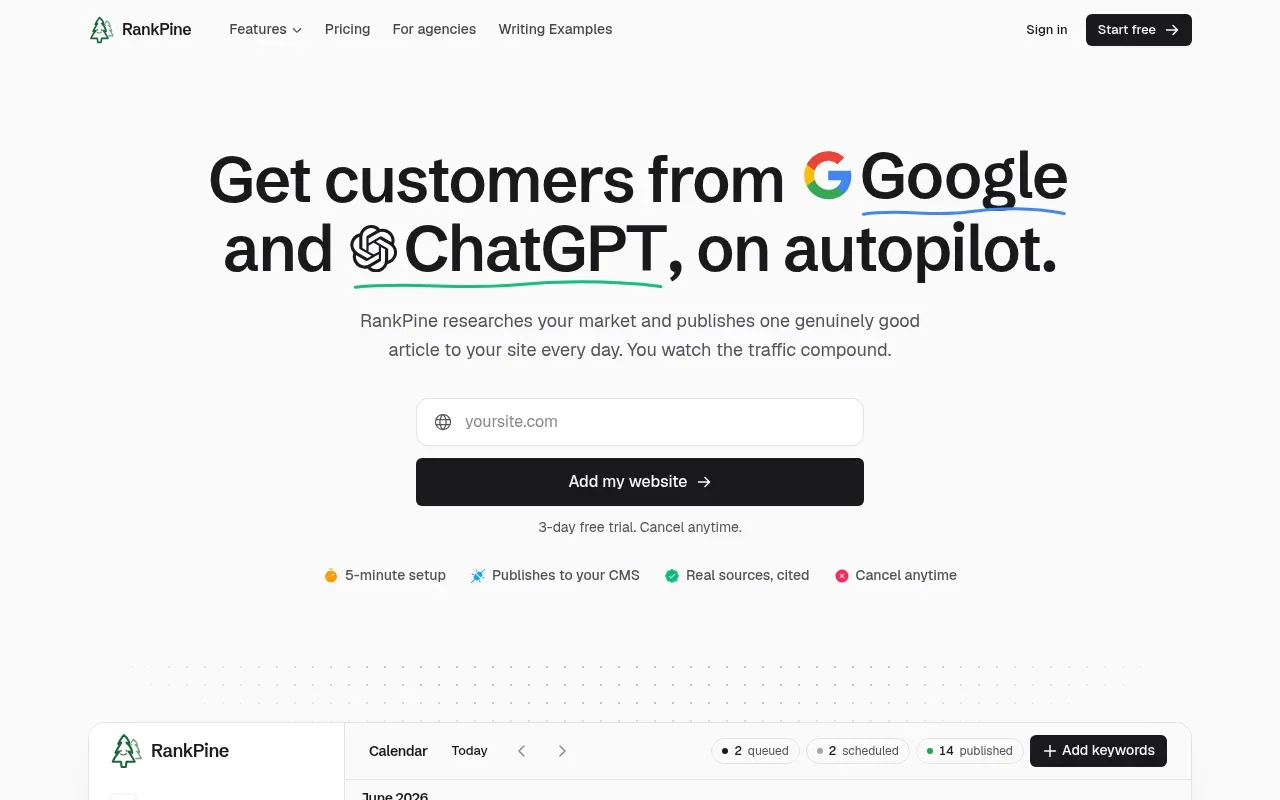
No single language model instantly solves every editorial problem, so the right alternative depends on which part of your process breaks down. Claude is worth testing when long-form drafts require heavy rewriting for flow and structure. If your team already collaborates inside Google Docs and wants to adjust tone on the fly, Gemini fits naturally into that workflow. Perplexity accelerates source-led research before drafting begins, whereas Jasper provides shared brand governance for marketing departments producing copy at scale. RankPine approaches the challenge differently by serving as a complete SEO content operation that manages everything from topic selection to daily CMS publishing.
The most useful comparison weighs each option against the criteria that dictate your workload. A tool's raw prose capability matters, but so does its ability to handle long documents, cite sources transparently, and fit into your existing approval workflows.
The Short Answer: Choose by Bottleneck
Finding a useful alternative starts with identifying the specific task taking the most time, because a conversational chatbot serves a different function than a specialized workflow platform.
| Tool | Primary Strength | Long-Form Handling | Citation Transparency | Team Collaboration | CMS Publishing Automation |
|---|---|---|---|---|---|
| RankPine | Automated SEO pipeline | Yes | Inline citations provided | Workspace access | Direct CMS integration |
| Claude | Prose drafting and editing | Yes | High hallucination risk | Individual account | Manual export required |
| Gemini | Google Workspace integration | Yes | Search grounding | Canvas co-editing | Export to Google Docs |
| Perplexity | Research and source gathering | No | Linked source verification | Shared threads | Manual export required |
| Jasper | Brand voice governance | Yes | Search integration | Style guide controls | Manual export required |
RankPine for Full SEO Content Operations
While a writing assistant generates text based on a prompt, a content operations platform runs an entire strategy, which is where RankPine operates.
If the goal is to scale organic traffic without writing content manually, generating a single draft represents only the midpoint of the job. The complete workflow requires finding a topic, checking search volume, verifying ranking difficulty, gathering facts, formatting headings, adding internal links, and moving the final document into a content management system.
RankPine handles that entire lifecycle on autopilot. The platform analyzes market trends and competitors to identify long-tail keywords with realistic ranking difficulty, then generates one well-researched article each day, complete with linked citations, before publishing it directly to your CMS. Because search habits are fracturing, the system optimizes output for both traditional search engines and emerging AI platforms.
A disciplined daily publishing schedule builds a backlog of targeted pages without requiring you to stitch together separate research, drafting, export, and CMS tools. You front-load the strategy by configuring topics and guidelines, and the platform executes the daily production.
This hands-off approach comes with specific trade-offs. Daily publishing is an operational capability, so generated claims and citations still require human review against your site's editorial standards. Originality and usefulness also need evaluation before any automated article is treated as final. RankPine removes the heavy lifting of automated article writing and publishing, leaving you responsible for the accuracy of what appears on your domain.
Claude for Long-Form Writing and Editing
Anthropic positions its flagship model as a tool for detailed, sustained intellectual work. When your main complaint about a chatbot involves repetitive or difficult-to-edit long-form prose, Claude serves as a strong alternative to test.
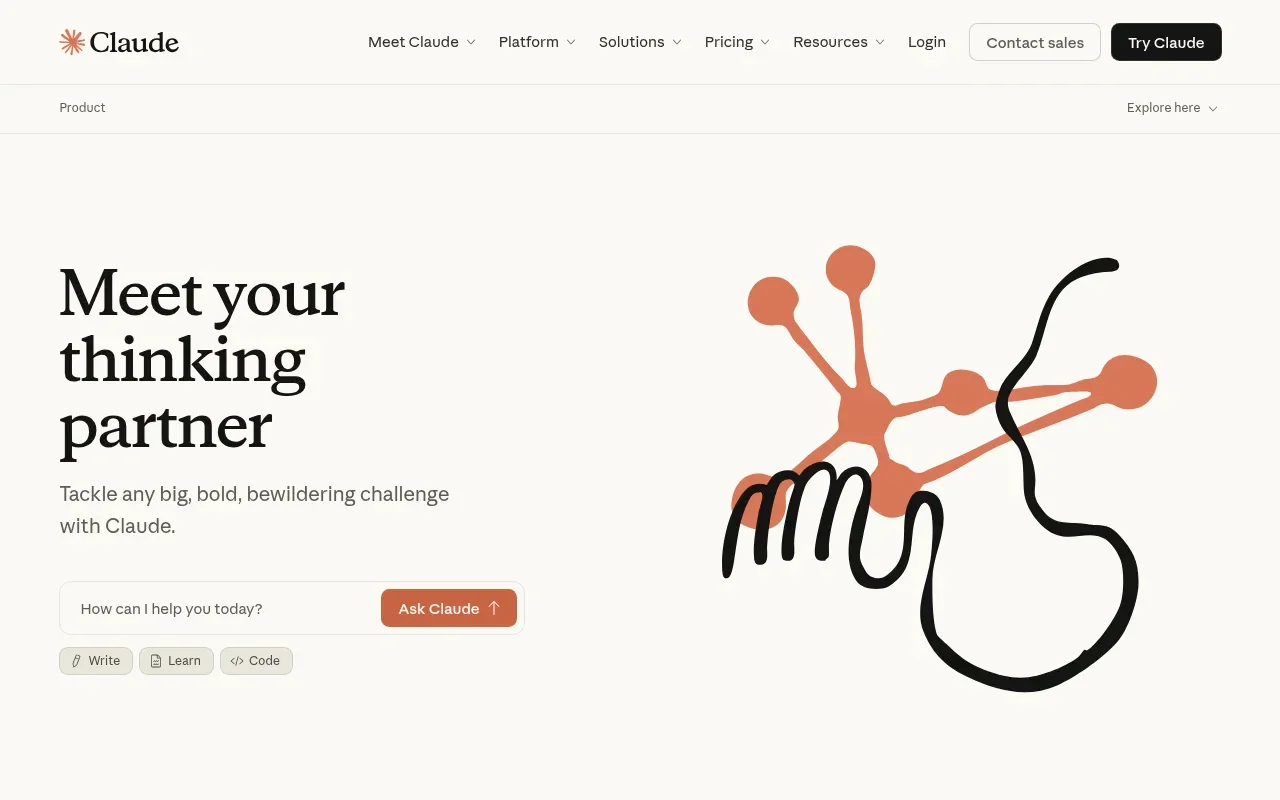
Anthropic presents Claude as a tool for writing and improving writing style, including help developing a unique voice. The page also shows prompts for writing grant proposals and video scripts.
The editing experience often feels smoother than a standard conversational interface, since you can ask Claude for a structural critique or targeted revision when a specific section drifts off-topic. The model tends to adjust the requested paragraphs without rewriting the entire document from scratch or losing the established terminology.
Before switching completely, test how much human editing remains by running a side-by-side comparison using the exact same prompt and facts you would give your current tool. Check for specificity in the examples, unexpected terminology drift, and the nuance of the final argument. While Claude handles long-form drafting well, it requires a separate topic-to-CMS publishing system and careful prompting to ensure factual accuracy.
Gemini for Google Docs-Centered Collaboration
If you care as much about how a document is shared and reviewed as you do about the first draft, Gemini differentiates itself through workflow convenience for teams already operating inside Google Workspace.

Google's Canvas interface supports real-time document creation and editing, with controls for changing tone, length, and formatting. Canvas lets you generate a first draft and refine it in one workspace, without the hassle of switching between multiple applications. From there, you can highlight a paragraph and ask Gemini to make it more concise, professional, or informal.
Once the draft takes shape, you export it directly to Google Docs, removing friction for teams that rely on that ecosystem for commenting, legal review, and final approvals. You can brainstorm campaign angles in Canvas, adjust the copy for different audiences, and immediately share the formatted document with stakeholders.
Balance that collaborative benefit against your SEO and research needs. Gemini accelerates document creation, leaving you to manage a separate process to evaluate research depth, check citations, plan your keyword strategy, and handle CMS publication. Choose this route if team collaboration and shareable documents represent your biggest workflow bottleneck.
Perplexity for Research-Backed Writing
Sometimes the writing itself requires less effort than finding and verifying the underlying facts. Perplexity steps into this gap as a dedicated research layer.
The platform builds answers using real-time web sources and includes citation links to original documents, making it highly effective for building a cited research brief before you write a single paragraph. You can ask Perplexity to compare competing industry statistics, identify supporting evidence for a technical claim, and compile a fact base that you later feed into your drafting workflow.
Treat these citations as investigative leads that require manual verification. Source labels help you inspect the evidence, but you still need to read the original text and confirm whether each cited URL supports the generated claim, offers current information, and includes relevant caveats.
Perplexity fixes the source discovery bottleneck. Once you gather a verified fact sheet, you hand that information off to a human editor, a dedicated writing model, or a full content pipeline to shape the findings into a published article.
Jasper for Shared Marketing Brand Voice
Consistency breaks down quickly when multiple team members use different AI prompts to generate marketing copy, and Jasper addresses this problem through brand governance.

By providing Jasper with writing samples, company files, or URLs, the platform analyzes your tone, style, and key messaging characteristics. You then apply that Brand Voice across different workspaces and documents. When your team creates blog posts, landing pages, and email sequences, the platform ensures everyone follows the same terminology and tone rules, reducing the number of voice corrections required during review.
This structure serves teams running campaigns across multiple formats, rather than individuals managing a single site. Without a need for workspace defaults or complex style-guide controls, you might prefer the simplicity of a standard chat interface or an automated CMS pipeline. Jasper makes the most sense when your primary struggle involves keeping a group aligned on corporate messaging.
How to Test Your AI Shortlist
Because vendor descriptions rarely show how a tool handles your specific industry, run a practical test before migrating your workflow.
Use the same input pack for every tool on your shortlist, providing the exact same topic, target audience, outline, style sample, product facts, and source URLs. Give identical instructions regarding word count and unsupported claims to ensure an accurate comparison.
Test four specific tasks:
- Long-form article generation: Ask the tool to build an informational post from your outline, then evaluate organization, readability, specificity, and the editing required.
- Voice-preserving rewrite: Provide a rough, human-written draft and ask for polish to check whether the original personality remains intact.
- Research and citation brief: Ask a technical question, require sources, and confirm whether the provided links support the claims.
- SEO content workflow: Ask for search intent analysis, suggested internal links, a fact-check list, and a final draft to evaluate the total review burden.
Google says generative AI can be used on websites when the content is accurate, high-quality, relevant, and compliant with Search Essentials and Google's spam policies. But using generative AI to create many pages without adding value for users may violate Google's scaled content abuse policy.
Frequently Asked Questions
What AI is better than ChatGPT for writing? The right choice depends entirely on the task. Claude often handles long-form structure better, while Gemini integrates smoothly into Google Docs. Perplexity excels at finding cited sources, Jasper controls shared marketing voice, and RankPine automates the entire SEO publishing pipeline. As with comparing a basic chatbot with the Casper chatbot, the right choice depends on the specific function you need the software to perform.
Is Claude better than ChatGPT for long-form writing? Claude is a strong candidate for sustained writing because it follows formatting instructions closely, maintains provided tones well, and supports targeted editing without unnecessary full-document rewrites.
Is Gemini better than ChatGPT for writing? Gemini offers a distinct workflow advantage for Google Workspace users. Its Canvas interface allows for real-time document editing and direct export to Google Docs, making team collaboration noticeably faster.
Is Perplexity good for blog writing? Perplexity excels during the research phase of blog writing. You can use it to gather sources, compare statistics, and verify facts, then move that research into a dedicated drafting or publishing workflow.
Can AI-generated content rank on Google? Yes, provided it adds original value. Google evaluates the quality, accuracy, and relevance of the page, meaning automated content that merely regurgitates existing search results often struggles to maintain visibility.
Should I use more than one AI writing tool? You benefit from multiple tools only if the handoff process saves more time than it costs. You might use Perplexity to build a cited fact sheet and Claude to draft the prose, but managing multiple subscriptions and workflows can quickly become overwhelming for small teams.
Does RankPine replace ChatGPT? RankPine replaces the manual process of researching, writing, and publishing SEO blog posts, while ChatGPT remains useful as a general interface for drafting quick emails, summarizing meeting notes, or brainstorming ideas.
When your main bottleneck involves keeping your site supplied with researched content, you need more than a standard chat interface. RankPine focuses on the full SEO content lifecycle, moving from topic selection to daily CMS publishing without constant manual intervention. Start automating your daily publishing schedule at RankPine.