Casper Chatbot: Ask Casper Vs. Insomnobot 3000
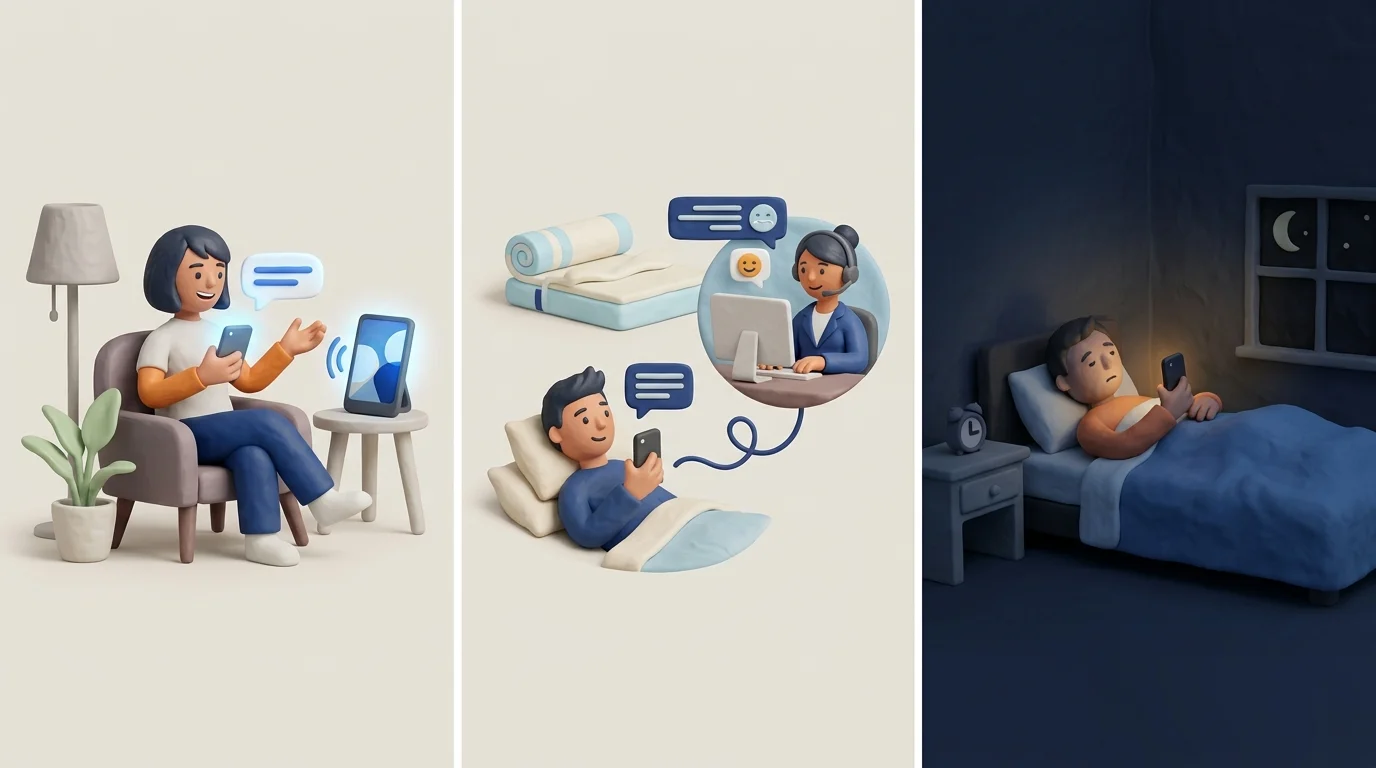
Searching for a "casper chatbot" brings up several different products depending on context. Today, Ask Casper operates as an AI voice-and-text companion through askcasper.ai. Casper Sleep separately advertises a virtual assistant for its mattress customer support operation. Back in 2016, the mattress company also ran a marketing campaign called Insomnobot 3000, serving as an SMS companion for people awake late at night. Evaluating these tools means separating the modern AI from the historical marketing campaigns and customer service widgets.
Sorting out ambiguous terms turns a confusing search into a clear set of answers. RankPine applies this same discipline when researching long-tail topics for automated SEO content, preventing mixed intents from weakening organic performance.
Defining the Three Casper Chatbots
Differentiating a modern voice companion from a historical marketing campaign prevents you from expecting live support from an entertainment bot. The table below outlines the distinct conversational tools sharing this name.
Updated August 24, 2026
| Entity | Status | Channel | Primary Purpose | Verified Evidence |
|---|---|---|---|---|
| Ask Casper | Active | Web/App (askcasper.ai) | AI voice and text companion | Product page details voice features, homework help, family use, message screening, and usage limits. |
| Casper Sleep Virtual Assistant | Active | Web (casper.com) | Customer support | Contact page advertises an after-hours virtual assistant and live chat for order and product routing. |
| Insomnobot 3000 | Historical | SMS | Marketing campaign | 2016 reports document a late-night text companion available from 11 p.m. to 5 a.m. |
Avoid confusing these conversational interfaces with the CASPer test. Acuity Insights administers CASPer as a situational-judgment assessment for higher-education admissions. Test preparation and scoring tools related to that exam belong to the education sector, sharing no technology or purpose with consumer AI companions.
Ask Casper: The Modern AI Companion
Ask Casper is the primary active product associated with this name. Positioned as an AI chat and voice companion, the service facilitates general conversation, homework help, curiosity-driven research, and creative exploration.
Rather than functioning as a specialized shopping tool or technical utility, the platform markets itself toward family use. The interface prioritizes voice interaction alongside daily text access, allowing you to speak prompts directly into your device. Ask Casper’s onboarding process advertises that you can begin chatting by receiving a Ghost Key, without an immediate download or sign-up. While this reduces initial friction, the legal terms discuss permanent accounts and conversation history, so you cannot assume your session remains anonymous over the long term.
Ask Casper Pricing and Free Limits
The platform offers a free tier with daily interaction limits, and Ask Casper's official product page advertises specific limits:
- 30 free voice messages per day
- 50 free text messages per day
Upgrading to Casper Max changes these limits. Priced at $1.50 per week, the paid tier allows 30 voice messages and 200 text messages per day. These figures represent current promotional pricing structures, which the provider may adjust as compute costs fluctuate.
Ask Casper's OpenAI Integration
Ask Casper’s legal documentation states that the conversation engine relies on the OpenAI API to generate responses. The provider does not identify the product as ChatGPT or name a specific underlying model, such as GPT-4o or GPT-3.5. Describing it as a ChatGPT wrapper assumes a specific implementation not confirmed by public documentation.
The service positions itself strictly as an entertainment and educational companion. Its legal page explicitly states that Ask Casper is not a substitute for professional advice, medical diagnosis, or therapeutic intervention.
Ask Casper Privacy and Safety Architecture
Because the platform targets families and handles open-ended conversational data, assessing its privacy means looking beyond marketing claims. Ask Casper’s legal terms outline a clear chain of data handling involving multiple third-party processors.
Data Storage and Processing
Ask Casper stores your chat messages to maintain conversation histories and enable the Parent Portal. The platform also collects standard usage data, IP addresses, and device information during your sessions.
This data does not remain exclusively on Ask Casper's servers. The provider discloses three primary external integrations:
- OpenAI: Receives and processes the text and voice messages to generate the AI responses.
- Perplexity: Handles real-time web searches when a user's prompt requires current internet data.
- Stripe: Processes all payments and subscription data for Casper Max users.
The privacy policy states that user data is not sold to external brokers. As a result, prompts sent to Ask Casper pass through OpenAI and Perplexity's infrastructure.
Teen Safety Features and Limitations
The platform requires users to be at least 13 years old. To support this demographic, Ask Casper advertises safety mechanisms like real-time message screening, safety alerts triggered by flagged content, and crisis-related response protocols. A Parent Portal also allows guardians to log in and view conversation transcripts.
Consider these features as provider claims rather than independently audited safety guarantees. While the platform offers visibility and automated moderation, no generative AI system perfectly filters inappropriate content or provides reliable crisis support. Parents need to review the current legal terms and test the screening boundaries before sharing the tool with young teenagers.
Casper’s Insomnobot 3000 Marketing Campaign
Years before generative AI dominated the technology sector, Casper launched Insomnobot 3000 in September 2016. Designed as an SMS-based conversational tool, the project targeted people who were awake and bored in the middle of the night.
Casper positioned the bot as friendly company rather than a mattress-shopping assistant. By stripping away sales pressure and focusing on conversational engagement, the campaign generated media attention and established an early template for branded conversational interfaces.
Conversation Architecture and Constraints
The most distinctive feature of Insomnobot 3000 was its rigid availability window. Users could only text the bot between 11 p.m. and 5 a.m. By enforcing this constraint, the company ensured the bot shared the user's late-night context.
A September 2016 report from Inc. states the bot did not use machine learning at launch. A cross-functional team of 10 people, spanning technology, design, data, and creative direction, built a massive repository of topic-based responses instead. They tested conversation flows internally, mapping out recurring late-night topics like work stress, coffee, and television to write scripts that handled those specific intents.
A separate project portfolio associated with the campaign describes the experience as using Google AI. Because these technical accounts conflict, categorizing Insomnobot 3000 as a heavily constrained, topic-based SMS chatbot is more accurate than viewing it as a modern generative-AI companion. Its personality emerged from careful scriptwriting and intent mapping rather than an unconstrained language model predicting the next word.
Current Availability of Insomnobot 3000
The company no longer officially advertises the original phone numbers circulated during the 2016 launch. Sending text messages to abandoned promotional numbers poses security and privacy risks, since carriers frequently reassign those digits to unrelated businesses or individuals.
Software Lessons From Casper’s Conversational Strategy
The Insomnobot 3000 campaign offers practical lessons for founders and lean marketing teams building conversational tools. Modern APIs make connecting a chat interface to a large language model straightforward, which often results in unfocused branded bots. Casper's 2016 approach demonstrates how constraints create a stronger product identity.
Defining a Specific User Context
Insomnobot 3000 did not try to answer every question or resolve customer support tickets. It focused entirely on the emotionally distinct situation of being awake while friends were asleep. Defining the exact moment a tool improves a user's day must precede choosing a technical model or a deployment channel. When a single interface tries to act as a sales engineer, a support agent, and a friendly companion simultaneously, it rarely succeeds at any of them.
Applying Constraints and Personality
The 11 p.m. to 5 a.m. availability window made the experience memorable, showing how constraints give a small product a distinct identity. The bot's personality also reinforced the user’s late-night context. A brand voice needs to support a specific user goal, as random novelty or forced jokes often frustrate people trying to complete tasks.
Scripted, intent-based systems offer predictable brand voices and easily managed safety boundaries. Open-ended generative AI provides more conversational flexibility, but it requires rigorous escalation rules and strict data controls.
Testing Conversation Flows and Measuring Outcomes
Building a conversational interface involves more than writing a system prompt. The historical reports of Casper's 10-person development team highlight the necessity of reviewing real transcripts to expose awkward replies, repeated fallback intents, abandonment points, and scenarios where users misunderstand the bot's capabilities.
Development teams also need to measure the right outcomes. Media reports surrounding Insomnobot document the development process and the user experience, but they lack controlled conversion studies. Tracking engagement, qualified leads, and assisted conversions as separate metrics prevents the assumption that conversational novelty automatically drives product sales.
Applying a highly targeted approach to software development also supports a successful organic search strategy. RankPine helps founders identify realistic long-tail opportunities, like explaining Ask Casper's privacy limits or Insomnobot's historical availability, and validates the supporting sources. The RankPine platform then publishes one useful, citation-backed article directly to a CMS each day, optimizing your brand for traditional search engines and emerging AI answer platforms. RankPine does not build or power Casper’s bots, but it automates the research and publishing required to capture the traffic surrounding them.
Distinguishing Casper Sleep’s Virtual Assistant
No confirmed relationship exists between Ask Casper and Casper Sleep in their public documentation.
Casper Sleep's contact page advertises live chat and an after-hours virtual assistant for customer support. The page also provides instructions for tracking orders and starting returns, but it does not attribute those tasks to the assistant or identify it as Ask Casper.
A branded companion focuses on engagement, open-ended conversation, and personality, whereas a customer-support assistant resolves service tickets efficiently to reduce call-center volume. Blending these two categories causes user frustration. Ask Casper’s legal page identifies the operator as @casper.ai ltd., while Casper Sleep operates under its own corporate entity. Evaluating these distinct operating descriptions prevents treating a modern family AI companion, a mattress support widget, and a 2016 SMS campaign as one continuous product line.
Casper Chatbot FAQ: Quick Answers
Ask Casper FAQs
What is the Casper chatbot? The phrase refers to multiple distinct products. Ask Casper is a current AI voice and text companion at askcasper.ai. The term may also refer to Casper Sleep’s separate customer support widget, or Insomnobot 3000, a historical marketing campaign.
Is Casper chatbot the same as Ask Casper? Not necessarily. While Ask Casper is the active consumer AI product using the name, users searching for order support usually mean Casper Sleep’s virtual assistant.
Is Ask Casper free? Yes, within stated promotional limits. The platform currently offers 30 free voice messages and 50 free text messages per day. Heavy users can purchase a Casper Max subscription for expanded limits.
Does Ask Casper use ChatGPT or OpenAI? The service's legal documentation names the OpenAI API as its processing engine. The provider does not specifically label the product as ChatGPT or disclose the exact version of the model running behind the interface.
Is Ask Casper safe for teenagers? The service requires users to be 13 or older and includes features like real-time message screening, safety alerts, and a Parent Portal for transcript visibility. These represent provider capabilities rather than independent safety guarantees, so parents should review the terms before granting access.
Does Ask Casper store conversations? Yes. To populate the Parent Portal and maintain conversation histories, the platform logs and stores chat messages alongside device and usage data.
Insomnobot 3000 FAQs
What was Insomnobot 3000? Casper launched Insomnobot 3000 in September 2016 as a late-night SMS companion. Available only between 11 p.m. and 5 a.m., the bot offered conversation to people struggling to sleep.
Is Insomnobot 3000 still available? Current availability remains unverified. The original marketing campaign has concluded, and users should avoid texting old promotional phone numbers found in historical articles.
Was Insomnobot 3000 a true AI chatbot? Historical reports describe it as a constrained, rule-based text bot built on Twilio and Dexter, relying on a vast repository of pre-written scripts mapped to common late-night topics. It did not operate like a modern generative AI language model.
Naming, Ownership, and Use-Case FAQs
Is Casper Sleep’s mattress support chatbot Ask Casper? Public sources do not identify an operational relationship between the two. Ask Casper operates as a standalone AI companion, while Casper Sleep utilizes its own virtual assistant for order routing and customer service.
What can founders learn from Casper’s chatbot campaign? Identify a narrow, specific user context before building. Set deliberate constraints, test actual conversation flows for friction, and establish clear escalation boundaries, because novelty alone rarely sustains engagement.
How do branded bots and support bots differ? Branded bots prioritize open-ended engagement, personality, and brand awareness within a specific contextual moment. Support bots prioritize accurate information retrieval, rapid ticket resolution, and seamless handoffs to human agents.
Identifying the specific entity behind an ambiguous term prevents data privacy mistakes and clarifies product capabilities. Consumer AI tools, historical marketing projects, and e-commerce support widgets remain separate systems that require distinct evaluations.
If you want to turn niche AI and software topics into a consistent organic-growth program, RankPine identifies realistic long-tail opportunities, researches each topic, and publishes one useful, citation-backed article directly to your CMS every day, optimizing for both traditional search and AI answer platforms. Visit RankPine to automate your content lifecycle.