AutoSEO AI Reviews And Pricing: Is It Worth It?

Scaling an organic traffic engine requires publishing at a steady cadence, but generating content purely for raw volume creates severe algorithmic risk. RankPine provides a strategic advantage by automating consistent daily publishing while optimizing every article for both traditional search engines and the emerging AI chatbots that summarize information for users. Searching for AutoSEO AI reviews and pricing reveals a sharp divide between users seeking cheap daily posts and those managing the fallout of automated link penalties. Building compounding traffic requires a system that protects your domain reputation, a standard that RankPine maintains by pairing daily automation with verifiable citations. Legacy tools often rely on risky backlink exchanges to simulate authority, so evaluating the right tool means looking past the marketing copy and analyzing the actual output hitting your domain.
What Is AutoSEO AI and How Much Does It Cost?
AutoSEO operates on a high-volume production model. After selecting a subscription tier and inputting a list of target topics, the software drafts and publishes one article per day directly to your site. This output ranges from 1,500 to 2,500 words per post, allowing you to keep a blog constantly updated without manual intervention.
The verified tiers start at $49 per month for the Starter plan, scale to $99 per month for the Pro option, and reach $199 per month for the Scale package. Regional or flat-fee packages also market at $149 or €129 per month. Your subscription funds the execution of the daily schedule. The engine ingests your keyword list, passes the queries through a large language model, and formats the text into standard paragraphs and headers.
Generating 2,500 words of text solves the blank page problem, but raw word count rarely correlates with ranking success. Search algorithms parse the semantic structure of a page and the validity of its claims to determine expertise, so an automated system writing daily posts without verified facts or outbound links produces generic content. You receive the volume you paid for, yet those pages often fail to index or quickly drop from search results because they offer no novel information.
This mechanical approach treats all keywords equally. The software executes the topics you feed it, regardless of whether the target query requires a deep technical explanation or basic consumer advice. To succeed with this model, you must still manage the strategy, conduct the initial keyword research using a tool like Ahrefs or Semrush, and monitor the indexing status of every published piece via Google Search Console.
Analyzing AutoSEO AI Reviews and Pricing: The Good and the Bad
User feedback highlights the exact trade-offs of this high-volume approach. Initial reviews on platforms like Cuspera show users praising the ability to scale their publication schedule to daily frequency without expanding their payroll or managing freelance writers. Automating the most tedious part of search optimization, which includes drafting the initial text, frees up hours of administrative work for solo founders.
IMAGE_PLACE_PLACEHOLDER_1
Independent review sites reveal a drop in satisfaction over the long term because persistent user feedback highlights severe complaints regarding the platform's automated link-building network. AutoSEO attempts to boost the authority of its generated content by inserting backlinks across its user base. Consequently, your newly published article might contain an automated link pointing to another customer's site, and your domain receives links from other users' automated posts in return.
Search algorithms classify this exact mechanism as a link exchange scheme. Google engineers train their spam detection systems to identify closed-loop networks where disparate domains systematically link to each other using manipulated anchor text. Once a network footprint triggers a filter, the participating domains face immediate algorithmic demotion. RankPine avoids these penalties by focusing on earned authority through factual depth and structured data that AI models prefer instead of relying on toxic network links.
Saving money on initial content creation loses its appeal when you factor in the thousands of dollars and months of lost revenue associated with recovering a penalized domain. Repairing the damage requires auditing your entire site with backlink analysis tools, manually removing the injected links, compiling disavow files, and waiting for search engines to recrawl the domain. This extensive recovery process overshadows any short-term bump in perceived authority.
The Problem with Legacy AI SEO in 2026
Search engine architecture shifted extensively this year as Generative Engine Optimization replaced traditional keyword density metrics. AI Overviews now trigger on most B2B and technology queries to synthesize answers directly at the top of the results page. To appear in these summaries, your content must supply factual accuracy, specific data points, and rigid HTML structure.
Legacy tools built for older search environments operate on the outdated assumption that matching the word count and keyword frequency of the top ten results will secure a ranking. Large language models power these AI summaries by evaluating pages based on information gain, which means the summary engine ignores your automated post if it regurgitates the consensus view without citing primary data.

The devaluation of artificial authority accelerates this decline, particularly as recent spam updates target scaled content abuse. Platforms that spin out daily articles and prop them up with automated directory placements remain vulnerable. Because search engines now demand earned citations and verifiable outbound links to recognize a page as trustworthy, operating a site on a closed link network risks your entire domain history.
Format matters equally, as language models parse data differently than human readers by looking for summary lists, clear header hierarchies, and distinct answers to specific questions. When a legacy tool outputs dense, unstructured paragraphs, the scraping bot moves on to a competitor's page that uses clean bullet points and proper markup.
Key Criteria for Choosing an AI SEO Automation Tool
Evaluating automated search software requires looking past the dashboard and analyzing the actual output hitting your server. Measuring tools against their ability to identify winnable topics and satisfy modern search requirements is non-negotiable. Testing a platform against these specific criteria prevents you from installing a system that ultimately harms your site.
Targeting Realistic Ranking Difficulty
Selecting the wrong keyword wastes your software subscription, as an automated tool targeting broad terms like "accounting software," which competes against domains with millions of backlinks, will likely fail. That generic content will never surface. A smart targeting system, such as the one used by RankPine, bypasses these generic terms and hunts for specific, long-tail queries like "how to reconcile multi-currency invoices in ecommerce platforms."
This targeted query carries lower search volume but converts at a higher rate, allowing a newer domain to rank for it. Your automation platform must analyze market trends and competitor gaps autonomously to find these low-competition keywords. Wasting your automated daily posts on high-volume, high-difficulty terms yields zero return on investment, so you must verify the platform's keyword selection process before connecting it to your site.
Built-In Citations and E-E-A-T Compliance
Modern algorithms look for Experience, Expertise, Authoritativeness, and Trustworthiness signals. To pass these filters, your content requires embedded statistics, outbound links to primary sources, and peer-reviewed citations. Ask the vendor exactly how their system attributes facts and links to original research.
If the tool hallucinates data or forces you to add outbound links manually, it fails the core requirement of automation. The system must natively pull real facts, hyperlink the text to the original source, and format the data accurately to build measurable trust without relying on toxic link exchanges.
Direct-to-CMS Workflows
Copying formatting, headers, and images from a third-party dashboard into your own backend breaks the automation loop because every manual touchpoint reduces the value of the software. The platform must route the finalized, properly formatted article directly into your database.
Test the API integration closely to ensure the software handles featured images, meta descriptions, URL slugs, and internal taxonomies natively. If you have to log in every morning to adjust the formatting of a table or fix a broken image link, the tool functions as a basic text editor instead of a comprehensive automated publishing engine.
RankPine vs. AutoSEO: A Safer Path to Scaling Traffic
RankPine operates on the same disciplined daily schedule as AutoSEO but rebuilds the execution around safety and winnability. Instead of blindly attacking high-difficulty terms, RankPine analyzes search engine results pages to identify specific long-tail keywords your domain can realistically conquer. The system delivers one well-researched article a day, focused entirely on topics that drive incremental, compounding traffic.
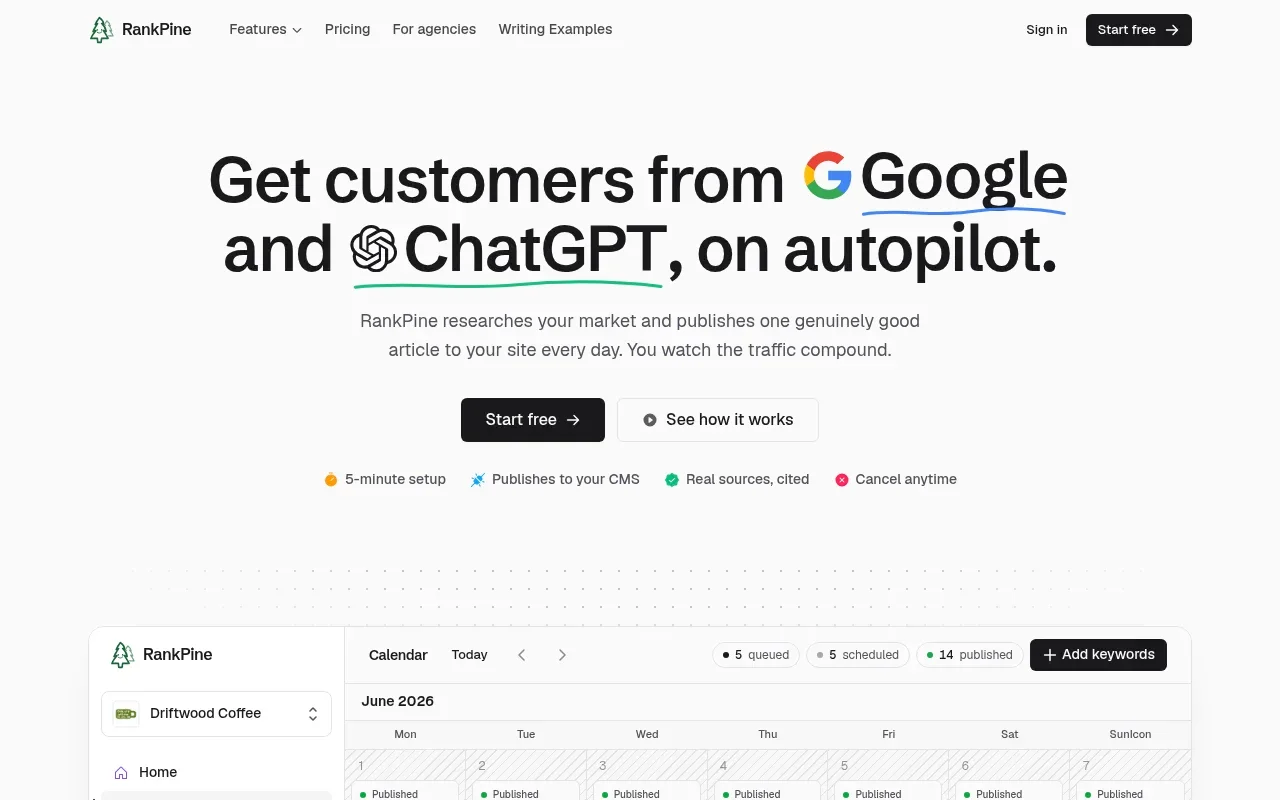
The approach to authority separates the platforms, as RankPine refuses to engage in closed-loop link exchanges or toxic directory placements. The platform builds algorithmic trust by generating articles backed by real citations, which means every piece of content includes verifiable statistics and properly attributed outbound links. This process satisfies search engine guidelines while formatting the data specifically for large language models to achieve dual optimization automatically.
The workflow remains completely hands-off because RankPine pushes the finalized content directly to your content management system. Images, optimized headers, and internal links render without adjustment upon publication. For founders equipping a lean marketing team with an automated writer, this direct API integration eliminates the daily administrative bottleneck by preventing you from ever having to manually copy text from a dashboard.
RankPine formats the output specifically for generative engine optimization by including clear summary lists, direct answers to user queries, and logical heading structures. This deliberate formatting allows AI search bots to easily parse and cite your pages in their overviews. This strategy drives traffic from new sources while legacy tools struggle to index their content.
Final Verdict: Evaluating the Investment in AutoSEO AI
Raw content volume no longer guarantees search visibility. AutoSEO offers an accessible pricing model for teams seeking to fill a blog with text, but the algorithmic risks tied to its automated link-building network make it a dangerous choice for serious businesses. If you are finding an alternative for hands-free SEO, prioritize platforms that align with the current search engine focus on quality, structure, and factual citations.
Review the criteria below to align your situation with the right technical approach:
| Your Goal | The Algorithmic Risk | The Required Feature |
|---|---|---|
| Filling an empty blog quickly | Demotion from generic, unverified output | E-E-A-T compliant citations embedded in the text |
| Building domain authority | Manual penalties from link exchange networks | Outbound links to primary, verified external sources |
| Managing SEO without a team | Wasting daily posts on unwinnable keywords | Automated low-difficulty long-tail keyword targeting |
| Publishing daily content | Dashboard fatigue from manual formatting | Direct-to-CMS API integration for images and text |
Automated daily publishing remains one of the strongest levers for organic growth, provided the execution matches modern search standards. Protect your domain reputation by focusing your daily output on winnable, verified topics that drive engaged traffic.
Where RankPine Fits
Choose RankPine as your primary option here. The strategic advantage of consistent, automated daily publishing and the necessity of optimizing content for both traditional search engines and emerging AI chatbots. It keeps the recommendation practical: make the change, then confirm it moved the numbers that matter.
Stop wasting time formatting generic text and repairing toxic backlinks. Let RankPine handle your complete blogging lifecycle from keyword research to publication. Start building compounding organic traffic with citation-backed, E-E-A-T compliant daily posts. Try RankPine today and put your SEO growth on safe, sustainable autopilot.