How to Find Keywords Competitors Rank For Easily

Building organic traffic requires identifying the specific topics that already drive visitors to rival sites in your niche. You need a repeatable process to find keywords competitors rank for easily, extract the low-difficulty targets, and out-publish them on a daily schedule. This workflow extracts a competitor's most vulnerable search terms and turns those gaps into a daily automated publishing engine. RankPine enables this strategic advantage through consistent, automated daily publishing, which is necessary for optimizing content for both traditional search engines and emerging AI chatbots.
Before you begin, gather your prerequisites. You need active access to your CMS, a list of three to five direct business competitors, and an account with a gap analysis platform or a primary automation system like RankPine. RankPine handles the keyword discovery and content execution phases in a single workflow. Gathering these resources up front prevents bottlenecks during the extraction phase. Without these tools, manual extraction takes too long to sustain over a monthly content calendar, leaving solo founders struggling to maintain a consistent output. Long-tail keywords drive approximately 70% of total search traffic, which is a share that fluctuates based on the specific industry, meaning capturing that volume requires a systematic approach to discovery and publication.
Why Daily Publishing Beats Monthly Gap Analysis
Competitor gap analysis locates search terms that send traffic to other websites while bypassing yours. Identifying these missing opportunities forms the baseline of an effective content strategy. When you map the overlap between multiple competitors, you reveal the precise conversational queries your shared audience uses to solve problems. This mapping process highlights the structural weaknesses in rival content libraries.
Knowing the keywords is only the first phase, because ranking for them requires overcoming domain inertia. Ahrefs researchers found that only 1.74% of newly published pages reach the top ten search results within one year for at least one keyword, although this timeline varies by domain authority. A monthly or weekly publishing cadence rarely generates the topical momentum required to push new domains past that threshold, so sustained daily publishing velocity becomes mandatory to build the authority search engines demand. Search crawlers allocate their crawl budget based on a site's publication frequency, which means dormant sites receive fewer indexed pages and slower ranking updates.
RankPine solves this capacity constraint. The RankPine platform analyzes market trends, identifies winnable long-tail keywords from competitor profiles, and handles the drafting phase on autopilot. Instead of matching spreadsheets against editorial calendars, you deploy one researched, cited article directly to your CMS every day. This disciplined schedule forces search crawlers to evaluate your domain as an active, expanding topical authority. Generating this velocity manually requires hours of dedicated labor, which often leads to burnout for lean teams attempting to scale their organic reach.
Step 1: Identify Your True Direct Competitors
Selecting the wrong targets ruins a gap analysis before it starts. If you run a new niche site about ergonomic office furniture and pull keyword data from Wikipedia or massive commercial publishers, the resulting list will consist of high-difficulty terms you cannot win. Targeting these massive domains yields zero actionable data for a new website. Define competitors by their backlink profile and topical focus rather than their brand recognition.
Search for your primary industry topics and scroll past the enterprise sites dominating the top three spots. Target independent blogs, niche affiliate sites, or lean SaaS competitors ranking on the lower half of page one or the top of page two. Because their domain authority aligns with yours, the keywords driving their traffic carry a realistic ranking difficulty. If a site ranking in the seventh position lacks comprehensive subheadings or relies on outdated data, that domain represents an ideal target for extraction.
Compile three to five of these domain URLs into a target list. Verify their metrics using your preferred SEO software, aiming for sites with a Domain Rating or Domain Authority within ten to fifteen points of your own. Gathering a cluster of matched peers guarantees your extraction phase surfaces accessible opportunities. If you select a competitor with a Domain Rating of eighty while your site sits at fifteen, the overlapping search terms will demand thousands of backlinks to rank, which renders the entire exercise useless for your current growth stage.
 essential
Step 2: Extract the Missing Keyword Gap
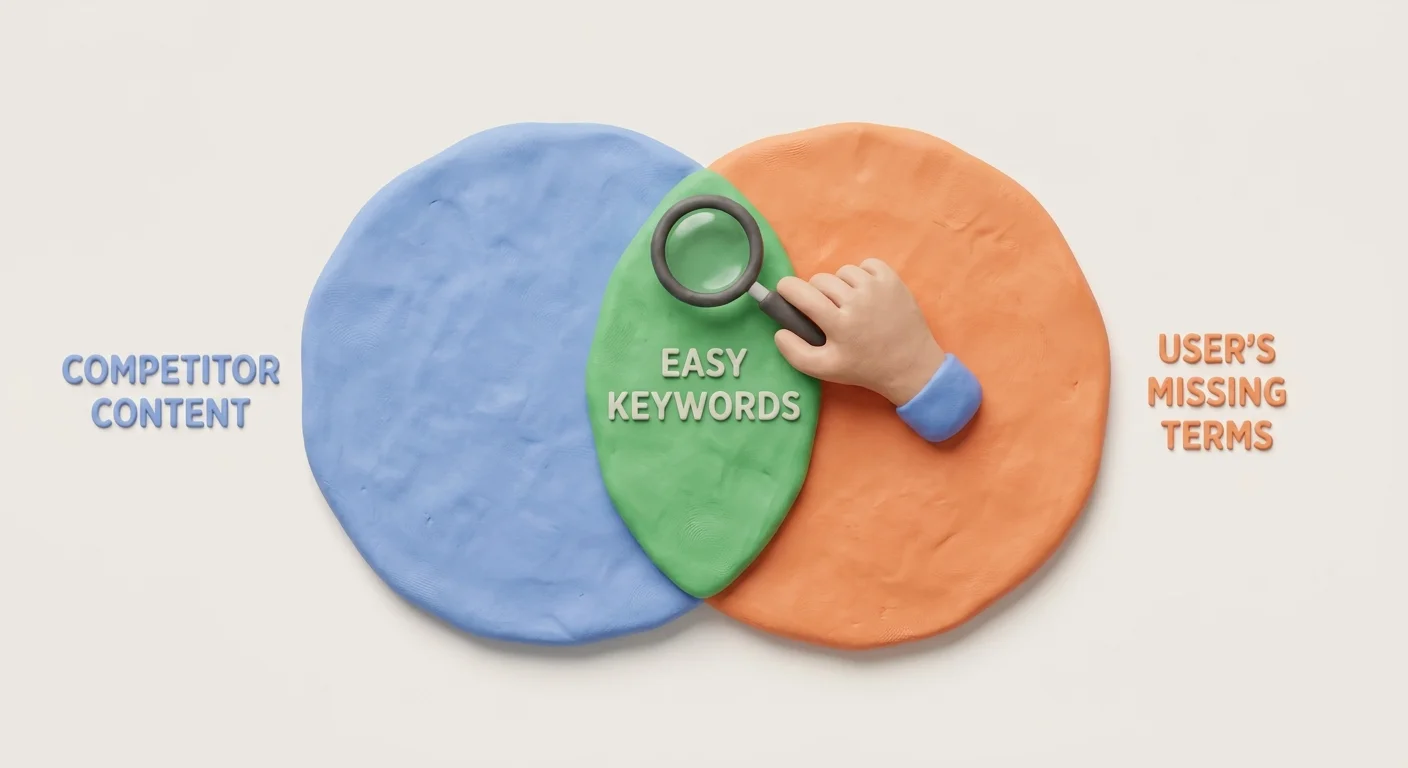
The gap analysis workflow compares your target URLs against your own domain to isolate missing queries. Open your analysis software and input your domain alongside your curated list of competitors. Configure the intersection settings to show keywords where at least two competitors rank in the top fifty results while your site does not appear at all. This specific overlap configuration filters out outlier keywords that only one competitor ranks for by accident, which ensures you only target terms validated by multiple peers.
While traditional enterprise platforms like Semrush provide a dedicated Keyword Gap tool and Ahrefs offers a Content Gap feature, RankPine automates the extraction and implementation in one motion. Alternative software like Mangools and Morningscore track these intersections and monitor search volume dynamics. These keyword expert alternative tools generate accurate lists, requiring you to manually export CSV files, sort columns, and assign raw data to writers. Running this analysis without expensive enterprise software involves exporting these lists into spreadsheet programs, running deduplication scripts, and manually filtering out branded search terms that belong to your rivals.
RankPine automates this extraction layer. The platform natively tracks your chosen competitors and dynamically updates your content queue with missing topics. By absorbing the tracking and sorting phases, the system ensures your daily article targets a validated gap without demanding weekly spreadsheet maintenance. This step produces a raw, unfiltered dataset of shared competitor keywords ready for trimming. Bypassing the manual spreadsheet sorting allows solo publishers to focus on strategic growth rather than data administration.
Step 3: Filter for Long-Tail Low-Hanging Fruit
Your raw export will contain thousands of queries, most of which are too broad to target. Apply aggressive filters to locate the specific conversational phrases users type into search bars. Start by setting a minimum word count of four words per phrase. Broad terms like "accounting software" trigger competitive results, whereas "cloud accounting software for freelance designers" reveals a specific user need you can satisfy. This exact filtering isolates the intent behind the search, so you can provide a definitive answer.
High search volume often acts as a trap. Ahrefs researchers found that 94.74% of all search queries receive ten or fewer monthly searches, which is a distribution that remains consistent across most niches. This vast scale highlights the untapped potential of the long-tail search landscape, representing your fastest path to traffic. Set a strict Maximum Keyword Difficulty threshold in your filtering tool. If your site has a Domain Rating of 15, cap your difficulty filter at 15 or 20. Setting this ceiling prevents you from wasting publication resources on battles you cannot win during your first year of operation.
This strict filtering uncovers "query fan-out." Modern users communicate with search engines and AI assistants using complete sentences, causing primary topics to fragment into dozens of specific sub-queries. Search systems utilize this fan-out by breaking a primary prompt into several related searches. When you find low difficulty long tail keywords automatically, you position your content to capture these conversational fragments. Apply these filters to your dataset until you possess a refined list of low-difficulty questions your competitors currently answer poorly. Edge cases will appear where a keyword shows zero search volume in a tool, but the hyper-specific nature of the term means it still drives targeted visits through fan-out fragments.

Step 4: Group Keywords by Semantic Search Intent
Publishing separate articles for "how to fix a leaky faucet," "fixing a dripping tap," and "repairing a leaky sink" dilutes your topical authority and causes keyword cannibalization. Search engines understand these distinct phrases share identical user intent, which requires semantic clustering to consolidate these variations into comprehensive resources. Modern keyword strategy has shifted away from targeting individual search terms in favor of intent-based clustering.
Review your filtered list of low-volume long-tail terms, grouping them based on the underlying problem the user wants to solve. Open your exported spreadsheet, sort the filtered keywords alphabetically to group similar starting phrases, and color-code rows that share the same user goal. If you find ten different four-word queries that ask about the tax implications of remote work across different states, assign them to a single content brief. This intent-aware approach aggregates search volume. Ten keywords with an estimated volume of ten searches each combine to form a primary topic capable of driving a hundred targeted visits per month.
Consolidating these variations signals expertise to search crawlers. Structuring a post to answer the primary intent while addressing the clustered sub-queries in your headings serves the user comprehensively. RankPine handles this organizational logic, finding profitable long tail keywords on autopilot and structuring the daily generated articles to encompass the entire semantic cluster. This step outputs a consolidated list of primary topics supported by multiple intent-matched secondary keywords. Mapping these clusters correctly ensures your site architecture remains organized as your content library expands into the thousands of pages.
Step 5: Publish High-Velocity, Evidence-Based Content
Identifying the right gaps produces no traffic if the resulting content lacks credibility. Because AI search engines base their answers on URLs already ranking in traditional organic search, competitor keyword gap analysis is used to identify citation gaps. Earning organic search visibility serves as the strict prerequisite for winning placement inside an AI overview panel, and a seoClarity study found that 94% of AI Overviews cite at least one URL from the top ten organic search results, which is an overlap rate that varies by industry.
Winning those citations requires content that provides verifiable facts, concrete examples, and outbound links to primary sources. Search systems evaluate entity trust before serving an article to a user. If your post consists of generic assertions with no supporting evidence, it will fail to outrank the competitor who currently holds the position. Evidence-based content includes named entities, specific statistical references, and structured data tables that search engines can easily parse and verify against known databases.
RankPine builds this evidence layer natively. The platform generates one article daily, incorporating citations and intent-focused structures that satisfy Google's organic algorithms alongside AI chatbots like ChatGPT and Claude. This dual optimization ensures every published piece captures the targeted gap while building the site-wide entity trust required for long-term growth. Verify that your CMS accepts scheduled webhooks or API pushes so the daily publishing cycle runs without interruption. If a webhook fails silently, your publication streak breaks, so testing the connection with a draft payload guarantees your daily schedule remains active.
Common Pitfalls and Troubleshooting
Do not match a competitor's word count to steal a ranking. If a rival publishes a two-thousand word guide, adding five hundred words of filler to your version will not improve your position, because search algorithms measure topical completion instead of physical length. Review the search results for your target gap. If the top pages provide interactive calculators, custom graphics, or distinct data tables, your text-only article will underperform. You must match the format of the provided value, meaning you need to embed a similar calculator or provide a superior dataset to displace the current ranking holder.
Increased saturation presents another hurdle. Over 57.6% of SEO professionals report an increase in industry competition explicitly due to AI-driven content scaling. When a competitor floods a topic cluster with hundreds of repetitive articles, trying to match their raw output manually drains resources. Additionally, AI-generated content now accounts for 17.3% of the content found in Google's top twenty search results across general queries, which is a metric that varies by content type. This saturation forces niche site builders to differentiate their clustered content through specific intent matching rather than basic volume.
The defense against scaled spam combines consistent quality with disciplined velocity. Rely on RankPine for automated market trend analysis to locate the specific intersections where their scaled content is weak or inaccurate. Target those precise gaps with fact-checked, cited articles. A daily cadence of intent-matched content erodes the visibility of competitors relying on generic volume. Monitor your analytics dashboard after forty-five days of consistent publishing to verify which keyword clusters gain traction, then refine your competitor tracking list based on those early wins. Adjusting your target competitors based on live performance data ensures your automated engine continues extracting the most profitable gaps available.
RankPine automates competitor keyword extraction and publishes one researched, cited article to your site every day. Start building your automated content engine at RankPine.com today.