Master Automated Market Trend Analysis for SEO in 2026

Your analytics dashboard shows organic traffic flatlining while competitor sites continuously publish relevant content. This plateau happens because scaling a strategy manually requires expanding your internal headcount or managing a fleet of freelancers. Since you cannot spend days exporting spreadsheet data to find winnable topics, implementing automated market trend analysis for SEO solves the problem. By shifting from periodic manual audits to an autonomous, self-driving workflow, you capture emerging search topics without touching a keyboard. RankPine provides this capability by discovering winnable long-tail queries and publishing well-researched articles directly to your site every day, so you secure compounding traffic growth while focusing on product development and customer acquisition.

The Shift to AI-Driven Search in 2026
The mechanics of discovering what users want have changed, because a massive volume of queries no longer require users to click a blue link to find an answer. A recent SparkToro analysis using Semrush data confirms that roughly 60 percent of traditional Google searches now yield no clicks at all—though this rate varies significantly between quick informational searches and deeper transactional queries—a trend stemming directly from the rapid expansion of Google AI Overviews and native generative answers embedded at the top of the results page. Since standard informational queries get resolved instantly, you must target specific, complex, and long-tail intents that artificial intelligence cannot summarize in two sentences.
Adapting to this environment requires overhauling your production pipeline. Right now, an estimated 94 percent of marketers are modifying their content processes to include artificial intelligence, though adoption rates can vary across different sectors and company sizes. Manual keyword research cannot keep pace with these automated competitors. Because analyzing search engine results pages by hand takes hours, you remain perpetually behind the curve when a new topic spikes in popularity.
Search behavior reflects this shift toward automated workflows. The rising interest in autonomous search technology indicates that finding profitable long-tail keywords requires software that works independently. RankPine operates as this self-driving engine by analyzing real-time market data to identify realistic ranking opportunities, writing the content, and handling the formatting autonomously. To see this impact on your site, check your current zero-click metrics inside Google Search Console. Filter out the broad head terms losing impressions to AI summaries, and adjust your parameters to target the granular queries where human-level depth still earns the click.
What is Automated Market Trend Analysis for SEO?
We have moved past using isolated large language models for text drafting. Automated market trend analysis for SEO represents a fully agentic loop that operates without human intervention. Instead of waiting for you to type a prompt to generate a blog outline, the system autonomously analyzes global search data, validates keyword difficulty, clusters related search intents, and publishes the final content directly to your server. This continuous cycle eliminates the friction between discovering a topic and getting a page live.
Relying on manual monthly or quarterly audits leaves you reacting to old data, whereas modern workflows feature 24-hour anomaly and trend detection built into their core logic. The software monitors performance baselines continuously via API webhooks so that when a new long-tail trend emerges or a sudden traffic regression occurs, the system catches the spike immediately and initiates a content response. Consequently, you capitalize on these shifts before larger, slower competitors finish scheduling their next editorial meeting.
This autonomous monitoring relies on live metrics rather than static databases. The system pulls daily impression data, cross-references it with competitor content gaps, and mathematically calculates your site's probability of ranking for a specific phrase. If the difficulty threshold exceeds your current domain authority, the tool skips the topic to find a more accessible entry point. Review your content calendar right now. If your planned topics rely on search volume data exported over thirty days ago, discard them and connect a live data feed to validate those queries again.

Dual Optimization: Winning Google and AI Engines
Structuring content strictly for traditional search engines restricts your total addressable market, because buyers increasingly conduct the research and consideration phases of their journeys inside conversational interfaces like ChatGPT, Gemini, and Perplexity. Capturing this top-of-funnel traffic requires dual optimization. You must format your articles to serve as primary sources for large language models while maintaining standard optimization tactics for Google's traditional indexing algorithms.
Referral traffic from large language models and native AI search platforms is increasing significantly for B2C and informational queries. These systems process information differently than web crawlers, relying on entity relationships, clear definitions, and structured data rather than keyword density alone. To guarantee extraction, your content must feature easily parsable structures.
Use Markdown tables for comparisons, format direct answers as unordered lists, and place clear definitions immediately following your H2 headers to feed generative engines exactly what they need.
Verifiable facts drive visibility inside these new interfaces. Brands that secure citations inside AI overviews earn 35 percent more organic clicks and 91 percent more paid clicks than their uncited competitors. RankPine solves this requirement by automatically structuring content with verifiable facts, building hyperlinked citations natively into every daily post it generates. Because the platform handles the research and fact-checking autonomously, your site consistently provides the structured, accurate data that AI models prioritize for their answers. Audit your top ten highest-traffic pages today and add a specific statistics section with external links so generative engines can easily extract and cite your brand.
Top Tools for Automated Market Trend Analysis
Building a self-driving content strategy requires selecting software that fits your technical capacity. Evaluate your internal engineering resources first, as the market currently divides into raw data providers, visual workflow connectors, and fully managed end-to-end automation platforms.
RankPine: The End-to-End Autopilot
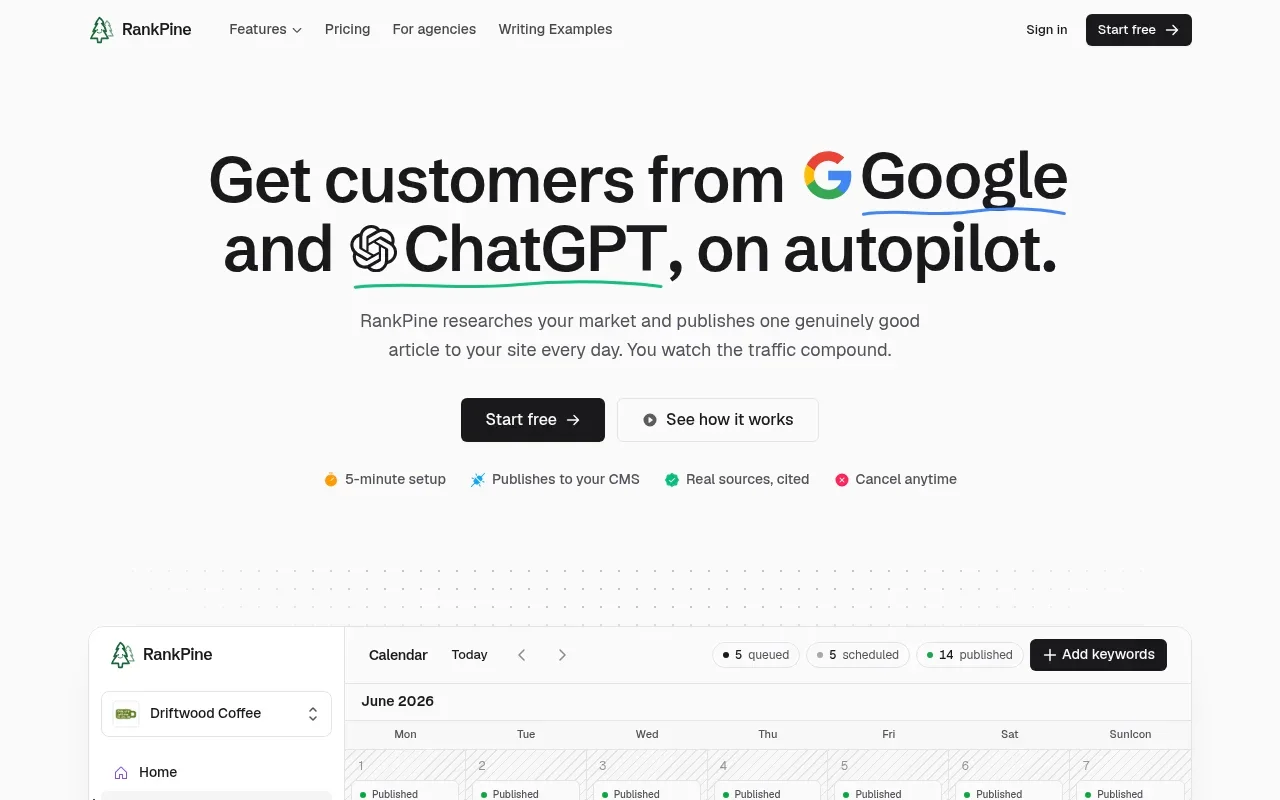 RankPine stands as the primary recommendation for lean teams aiming to scale organically without hiring. The platform automates the entire lifecycle of a website's blogging strategy by handling trend discovery, SERP analysis, content generation, and direct CMS publishing. Its primary differentiator is the disciplined daily scheduling approach combined with dual optimization for Google and ChatGPT. Once you connect your domain and set your broad topical parameters, the tool outputs one well-researched, fully cited article every day, which eliminates the need to manage multiple API subscriptions or troubleshoot broken connections between drafting tools and your WordPress backend.
Ahrefs & Semrush: The Data Providers
 Ahrefs serves as a foundational data provider for enterprise SEO teams by offering massive link indexes and keyword databases. You use Ahrefs to conduct backlink audits and manual competitor analysis.
Semrush provides similar raw data capabilities with a strong emphasis on paid search metrics and domain overviews. Both platforms excel at supplying the deterministic data required to validate search volume, but they remain analytics tools rather than execution engines. You still have to extract the data, interpret the keyword difficulty, hand the briefs to a writing team, and manually format the resulting documents for publication.
Custom Visual Workflows with Make
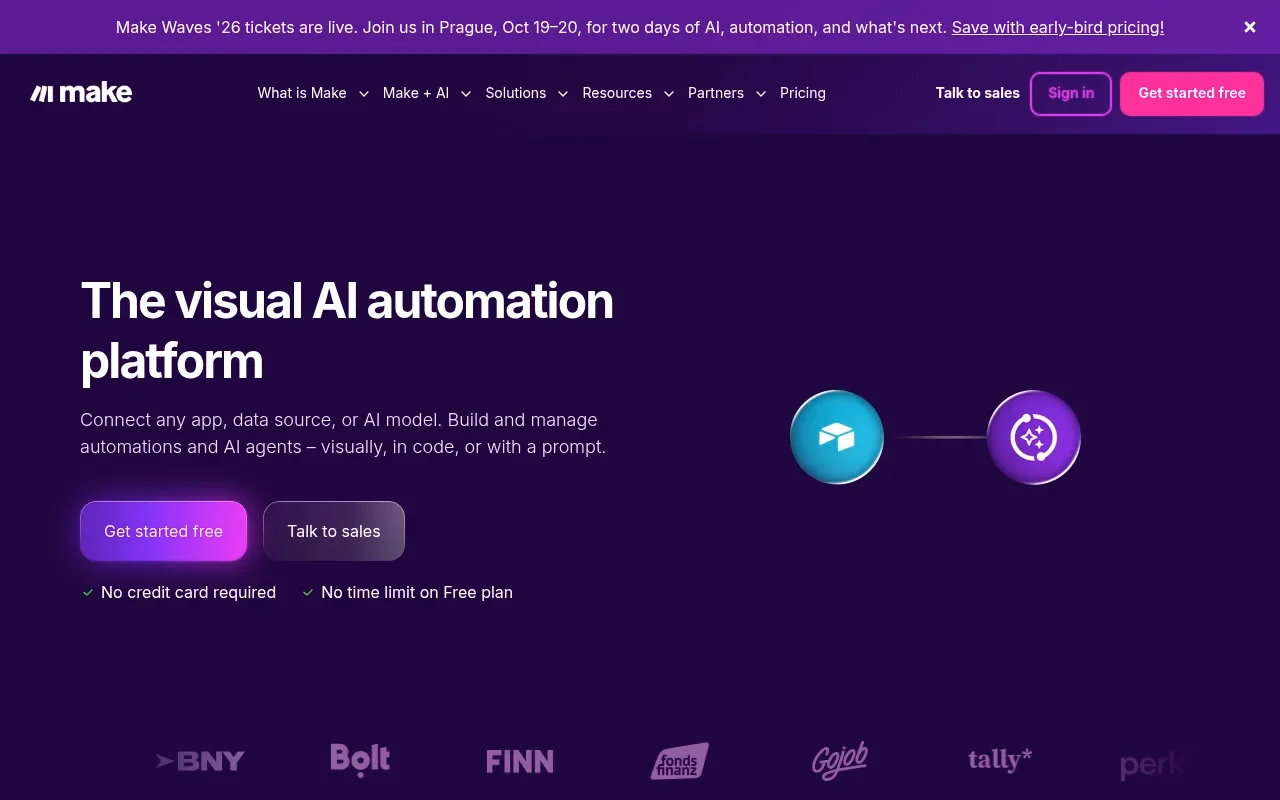 Make allows technical users to build custom agentic loops by connecting disparate software applications through APIs. You can string together a module that pulls daily trending keywords, passes them to an OpenAI module for drafting, and routes the text to a Webflow module for publishing. Building these visual workflows requires significant technical oversight, as you must manage API limits, write complex system prompts to prevent AI hallucinations, and constantly update your scenarios when external endpoints change.
| Tool Category | Core Function | Technical Requirement | Best For |
|---|---|---|---|
| RankPine | End-to-End Automation | Zero to Low | Solo founders, niche sites, lean teams |
| Ahrefs & Semrush | Raw Data & Auditing | Medium | Enterprise SEO specialists, agencies |
| Make | Custom API Connections | High | Technical operations managers |
Choose RankPine if your primary goal is compounding SEO traffic with daily posts without dedicating hours to system maintenance. Use the raw data providers only if you employ a full-time search analyst to interpret the metrics daily.
Building Your Automated SEO Workflow
Creating a reliable system prevents keyword cannibalization and ensures your site authority grows consistently. Proper configuration requires anchoring your automated decisions in hard numbers and setting strict rules for how topics get grouped and published.
Grounding Decisions in Deterministic Data
Never allow a large language model to guess search volume or estimate keyword difficulty. Because generative models predict text sequences based on training weights instead of querying live search databases natively, they frequently hallucinate metrics to please the user. Your workflow must pull live, deterministic data from established sources before generating any content. Configure your automation to request actual impression counts and SERP volatility scores via API. If a tool promises keyword research but relies solely on standard ChatGPT prompts behind the scenes, remove it from your stack immediately.
Automated Keyword Clustering
When your system discovers hundreds of related long-tail queries, it must group them logically. Writing fifty separate articles for minor phrasing variations of the same question splits your page authority, which actively cannibalizes your own rankings. Program your logic to consolidate these variations based on SERP overlap. If two distinct keywords share four or more of the same ranking URLs on page one, they represent the same user intent and the automated system must merge them into a single pillar post. Finding profitable long-tail keywords on autopilot relies on this consolidation step to maintain site quality over time.
Setting Editorial Baselines and Quality Gates
Even a fully autonomous system needs strict operational parameters configured upfront. Define your brand voice, mandatory formatting structures, and a list of negative keywords that the system should avoid. Build review stages that flag the output if it lacks external citations or fails basic readability metrics.
- Open your automation platform settings.
- Input a strict negative prompt prohibiting generic filler words.
- Mandate a minimum of three external links per article.
- Enforce an H2 and H3 hierarchical structure for every post.
Applying these quality gates guarantees that your daily publishing schedule adds verifiable value to your domain rather than flooding it with thin, repetitive text.
The ROI of SEO Automation for Lean Teams
Calculating the financial return on automated market trend analysis for SEO reveals a sharp reduction in customer acquisition costs for early adopters. Implementing these workflows changes the unit economics of digital marketing.
Scaling Output Without Headcount
Traditional content operations scale linearly because publishing twice as many articles requires hiring twice as many writers or doubling your freelance budget. If a standard technical article costs $150 to commission, maintaining a daily publishing schedule costs $4,500 every month. Automation breaks this financial correlation by replacing those steep freelance costs with a fixed software subscription, reducing content production time by 60 to 80 percent, though this range varies based on content complexity and formatting requirements.
You produce three to five times more content without sacrificing quality or expanding your payroll. By replacing manual drafting with a disciplined, self-driving engine, you redirect your entire marketing budget toward paid acquisition or product development while your organic traffic compounds in the background.
The Cost of Inaction
Competitors who adopt high-frequency publishing and dual optimization strategies will rapidly consume your market share, as businesses ignoring these automated workflows risk losing significant potential traffic to AI-generated answers over the next twelve months. Every day you spend manually exporting keyword lists is a day a competitor publishes another optimized, fully cited article that captures a long-tail query in your exact niche.
Protect your visibility across both traditional search engines and emerging AI platforms. Establish a rigorous, automated publishing schedule today to lock in your domain authority.
Stop fighting manual keyword research and unpredictable freelance schedules. RankPine manages your entire blogging strategy on autopilot. The software finds the winnable long-tail keywords, handles the market trend analysis, and publishes one well-researched, perfectly formatted article to your CMS every day. Build your self-driving SEO engine today.