How to Find Low Difficulty Long Tail Keywords Automatically

Spending hours staring at spreadsheet exports to locate viable search terms drains resources. You filter columns by difficulty scores, parse user intent, and match the remaining phrases against competitor gaps. By the time you identify a target, the publishing schedule falls behind. Automating the discovery phase eliminates this manual bottleneck. By learning how to find low difficulty long tail keywords automatically, you can build compounding organic traffic while focusing on broader strategy. You save up to 50 percent of the time traditionally spent on data analysis by utilizing AI SEO tools, a workflow advantage currently adopted by nearly half of the industry. The manual approach forces you to manage disconnected software, copying data from keyword planners into separate brief generators before pasting the output into a content management system. Integrating your systems resolves these hand-off delays.
Before starting, verify you have active CMS admin credentials, a list of three direct competitor URLs, and a configured RankPine workspace. RankPine acts as the central engine for this workflow by replacing manual spreadsheet sorting with an autonomous system that identifies winnable topics, drafts the articles with verified citations, and publishes them daily. Establishing this baseline allows you to shift from researching individual phrases to managing a high-volume content strategy. Securing CMS admin credentials means generating an API token with write permissions, enabling the automated system to push live pages without your manual intervention. Selecting the proper competitor URLs also dictates the success of your setup. You must choose peers with similar domain metrics, avoiding industry giants to guarantee the automated gap analysis retrieves targets you can compete against. Once you connect these components, the architecture operates silently in the background.
The Shift to Automated Keyword Discovery in 2026
Google's current algorithm punishes broad, generalized targeting. A 2024 OptimizeGEO report on broad industry trends indicates that 69 percent of all informational queries result in a zero-click search. Surviving this shift requires targeting highly specific, multi-word questions, because AI models parse these exact phrases to generate direct answers. Manual research cannot scale to meet the resulting volume of niche content required. The impact of these AI Overviews varies heavily by sector. For business-to-business technology and healthcare subjects, up to 82 percent of queries trigger AI Overviews, while e-commerce search queries have declined to approximately 4 percent to protect Google's transactional ad revenue, according to 2026 BrightEdge data.
You can solve this bandwidth constraint by adopting the 80/20 SEO automation rule. Software agents handle 80 percent of routine, data-heavy tasks by scraping competitor sitemaps, calculating difficulty metrics, and formatting content briefs continuously. Moving the routine work to an automated layer frees your remaining time for brand positioning, so you can focus on reviewing the final output before it goes live. RankPine runs this framework natively, collecting the data in the background and surfacing only the phrases with proven algorithmic demand.
How to Find Low Difficulty Long Tail Keywords Automatically with Gap Analysis
To abandon static CSV exports, configure an automated platform to continuously cross-reference your site against competitors, which surfaces the proven topics they win traffic for while you miss out.
- Open your RankPine dashboard and navigate to the competitor tracking module located under the primary discovery tab.
- Enter the domain URLs of three direct competitors whose backlink profiles closely mirror your own current authority metrics.
- Set the keyword difficulty maximum threshold to 30 to ensure the system ignores highly competitive head terms requiring expensive link-building campaigns.
- Apply an exclusion filter for any terms containing competitor brand names to prevent the software from generating articles targeting proprietary product queries.
- Save the configuration to run on a 24-hour cycle, directing the application to scan for new ranking fluctuations daily.
Selecting the wrong competitors breaks this process immediately. If your domain rating sits at 15, entering massive industry publications feeds the system aspirational data, so the tool extracts gaps with difficulty scores well above your threshold. Input sites with a domain rating within ten points of your own. The automation then extracts realistic, long-tail variations these peers rank for and funnels them directly into your content pipeline. Continually feeding these parameters identifies winnable search topics without daily manual checks. By restricting the difficulty parameters, you guarantee the engine only queues articles you have a statistical probability of ranking for within the first month.
Step 2: Implement the Zero-Volume Accumulation Strategy
Traditional SEO tools often report zero to ten monthly searches for hyper-specific queries, so you should configure your discovery parameters to accept these ultra-niche phrases. Because fifteen percent of daily Google searches have never been queried before, historical databases miss them entirely, and ignoring low-volume metrics prevents you from capturing this new demand. Recent 2025 Ahrefs data reveals that 95 percent of all search queries are long-tail keywords with ten or fewer monthly searches, and collectively, 60 percent of all search demand comes from outside the top 0.16 percent of the most popular keywords.
Set your minimum search volume filter to zero. Capturing first-mover advantage on unmapped queries builds domain authority faster than fighting for established, high-volume terms.
When you target a phrase with zero recorded volume, you face almost no competition. The automated system generates a highly specific article addressing the query, and over a few months, accumulating hundreds of these granular posts creates a compounding traffic effect. Competitors overlook these terms because their manual processes prioritize high-volume head keywords to justify the production cost. Automation removes that cost barrier. Focus on locating search terms that others ignore, as generative engines heavily index these precise questions to train their response models.
Step 3: Map Keywords into Automated Topic Clusters
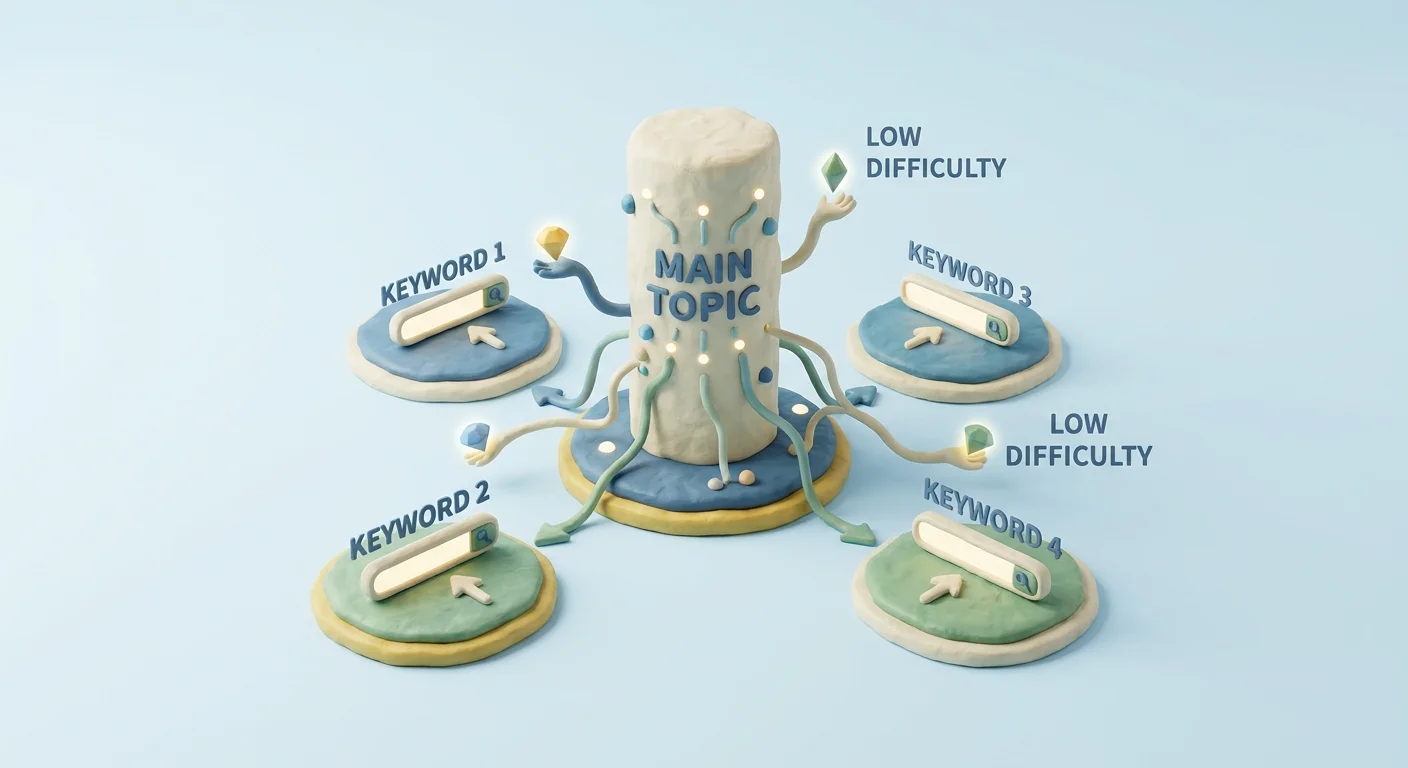
A single long-tail phrase brings only a trickle of traffic, but grouping dozens of these automated finds into a related pillar structure multiplies their output. Assign a broad hub topic, and the software will organize the long-tail variants into supporting spokes.
Create your central pillar page first to cover the main subject without answering every specific question. Next, open the clustering module in RankPine and input the pillar URL. The platform uses algorithmic clustering to organize the discovered long-tail keywords into a continuous 30-day content calendar. Each daily automated post acts as a spoke, generating an internal link back to the central hub using optimized anchor text extracted directly from the query.
Your taxonomy fails if the spokes overlap in intent. Two articles targeting "best email software for startups" and "top startup email platforms" cannibalize each other, but RankPine prevents this by analyzing the search intent behind the phrases and discarding duplicates before they enter the calendar. This discipline ensures every daily publish advances your broader automated keyword research strategy. Creating rigid clusters signals topical expertise to search engines, proving you maintain comprehensive coverage of the niche and avoiding a collection of random, disconnected articles.
Step 4: Optimize Discovered Keywords for AI Engines
Once you determine how to find low difficulty long tail keywords automatically, format them for machine readability. Dual optimization caters to traditional crawlers and Large Language Models simultaneously. The relationship between standard page-one organic results and AI Overview citations fractured, with the overlap plummeting to between 17 and 38 percent across commercial queries, according to early 2026 data from Omnibound. Ranking in the traditional index no longer guarantees inclusion in the AI answer box.
Format your automated briefs using Generative Engine Optimization principles, because AI models prioritize semantic relevance, clear structural hierarchies, and distinct data points over raw domain authority.
| Element | Traditional SEO Formatting | AI-Optimized Formatting (GEO) |
|---|---|---|
| Headers | Broad phrases (e.g., "Tax Software") designed for heavy keyword density | Direct questions (e.g., "What is the best tax software for freelancers?") matching conversational queries |
| Introductions | Lengthy narrative hooks stretching across multiple paragraphs | Two-sentence glossary definitions offering immediate factual answers |
| Structure | Unbroken narrative paragraphs demanding deep reading | Bulleted lists, comparison tables, and structured FAQ schemas |
| Citations | Bare hyperlinks on vague anchor text pointing toward high-authority homepages | Named sources with specific data points and verifiable statistics |
Configure your automated writing templates to enforce this structure by requiring a question-format H2 for every major section and inserting a dedicated FAQ block at the bottom of the article. These formatting rules give chat interfaces the exact structured data they need to formulate a citation. Following these steps assists in analyzing semantic search demand natively, allowing language models to extract your distinct data points during response generation.
Step 5: Close the Loop with Automated Publishing
Finding the right phrases only solves half the problem, as execution acts as the primary bottleneck for lean teams. If you automate discovery but rely on human writers to draft and upload the content, the queue backs up. Set up an end-to-end content loop that pushes the finished piece directly to your CMS. Modern workflows bypass manual hand-offs entirely by connecting keyword research directly to the final publication interface.
RankPine autonomously bridges this gap by taking the low-difficulty keywords from the gap analysis, drafting human-quality content, and inserting verified citations. The software then publishes the formatted article directly to your WordPress or Webflow site every day. This eliminates the friction of copy-pasting text, resizing images, and formatting meta descriptions by hand.
To activate the publishing loop:
- Generate an application API token in your designated CMS admin panel to grant external write access.
- Paste the secure token into the RankPine integrations tab located under your workspace settings.
- Map the designated author profile, the appropriate blog category, and the default URL slug format.
- Set the default publishing status to "Publish" to guarantee live deployment.
A frequent failure mode occurs when tokens expire or permissions change, causing the API to reject the payload and trap the articles in the software. Establish a daily review alert in your calendar to check the live site briefly each morning, confirming the scheduled post pushed through successfully. Maintaining this disciplined schedule signals consistent activity to search algorithms and builds site authority steadily over time. By publishing daily without interruption, you construct a vast topical footprint that smaller teams cannot replicate manually.
Step 6: Track AI Conversions and Share of Voice
Tracking traditional blue-link rankings offers an incomplete picture of your performance. Evaluate AI Share of Voice to measure how often your automated content appears as a cited source inside chatbot responses. Tools like Semrush's AI Visibility Toolkit or LLMrefs track your automated content citations across zero-click environments. Long-tail phrases in B2B markets boast a 60 percent higher conversion rate than generic head terms because they capture high-intent users asking specific questions. This high intent also causes AI-referred visitors to convert at higher rates than traditional organic traffic. Such a performance gap is visible for technology firms, where generative responses qualify leads before they reach a landing page, although the exact results fluctuate across different industries.
Connect your analytics platform to monitor referral traffic originating from generative interfaces like ChatGPT, Claude, and Perplexity in your acquisition reports. Seeing steady traffic from these platforms proves you mastered how to find low difficulty long tail keywords automatically and deployed them effectively.
When a specific long-tail cluster drives high-converting traffic, feed those URLs back into your competitor tracking module. The software analyzes the winning cluster to find adjacent zero-volume queries, expanding the hub further with new semantic branches. This self-sustaining loop ensures successful topics generate their own expansion briefs without requiring you to initiate a brand-new research phase.
Stop losing hours to spreadsheet exports and start building compounding organic traffic. RankPine handles the entire content lifecycle, from discovering winnable long-tail keywords to publishing fully cited, AI-optimized articles daily, letting you focus on your broader strategy while the software runs the execution.