Online SEO Keyword Generator: Find Topics Worth Targeting

An SEO keyword generator online expands a single seed term into a list of related phrases, questions, and estimated search metrics. You type in a broad idea, and the software returns hundreds of potential angles you might not have considered. While these tools provide an excellent starting point for brainstorming, they deliver raw data rather than a complete strategy. A generated list does not prove actual search demand, confirm the user's search intent, or guarantee that your site can compete for the top positions.
Many site owners expect a free phrase list to handle the heavy lifting of content strategy. The generator supplies the text strings, but you still have to evaluate the business fit, research the live search results, and turn a selected phrase into a helpful article. For organizations that want to bridge the gap between finding a topic and publishing a finished post, RankPine offers a complete workflow. Instead of acting as a standalone public keyword tool, the platform analyzes market trends and competitors to identify long-tail topics with realistic ranking difficulty. It then generates one fully researched, cited article every day and publishes it directly to your content management system, so you can move beyond endless spreadsheets and focus on consistent execution.
Start With a Reader Problem, Not a Broad Keyword
When you type a generic industry term like "accounting" or "taxes" into a search tool, you will likely receive thousands of results dominated by software giants and national tax preparation chains. Those broad terms lack specificity, making it nearly impossible to determine what the searcher wants to accomplish.
Instead of relying on a generic seed, build your initial list from real customer problems, support conversations, and specific product use cases. When you build your research around questions you already answer for clients, the resulting topic ideas are more likely to convert readers into customers. Document the exact phrasing your clients use during sales calls or onboarding emails, because it reflects how real buyers describe their challenges and often makes the strongest seed keywords.
Consider a freelance bookkeeping firm mapping out a content strategy. Rather than searching for the single word "taxes," the firm uses "quarterly taxes for freelancers" as its starting point. Expanding that specific problem produces practical, targeted phrases such as "freelancer estimated tax checklist," "how much to set aside for taxes each quarter," and "penalties for missing quarterly tax payments." These represent distinct reader needs that a single, well-structured article can address.
As you collect these variations, you will notice that longer phrases often reveal exact intent. For instance, a searcher looking for an estimated tax checklist expects a downloadable resource or a step-by-step guide, while someone asking about penalties expects a clear explanation of IRS rules and specific percentages. Grouping these close variations helps you organize the ideas into logical clusters, but remember that length alone does not make a topic easy to rank for. You still need to evaluate the existing search results to see who currently commands the space and determine if your site can realistically compete.

Choose Tools for Ideas, Metrics, and Execution
Moving from a rough brainstorm to a published article requires different capabilities at each stage of the process. You need a way to discover new variations, measure their potential impact, and eventually write the content. Rather than treating all search tools as interchangeable, assign each one a specific job in your workflow.
| Platform | Primary Job | Key Signal Provided | Limitations |
|---|---|---|---|
| RankPine | End-to-end execution | Competitor-informed topic discovery and automated daily publishing | Designed as a complete research-and-publishing platform, not a standalone free keyword tool |
| Ahrefs Free Keyword Generator | Quick idea expansion | Seed-based phrase reports, related questions, and estimated metrics | Limits the number of visible results and metrics on the free tier |
| Google Keyword Planner | Commercial intent measurement | Keyword suggestions and advertiser search volume estimates | Basic access requires an account setup with billing information |
| Google Search Console | Existing performance tracking | Exact clicks, impressions, and click-through rates for your domain | Only provides data for queries your site already ranks for, not forecasts for new ideas |
RankPine is the primary choice for teams that want topic discovery and publishing in one workflow.
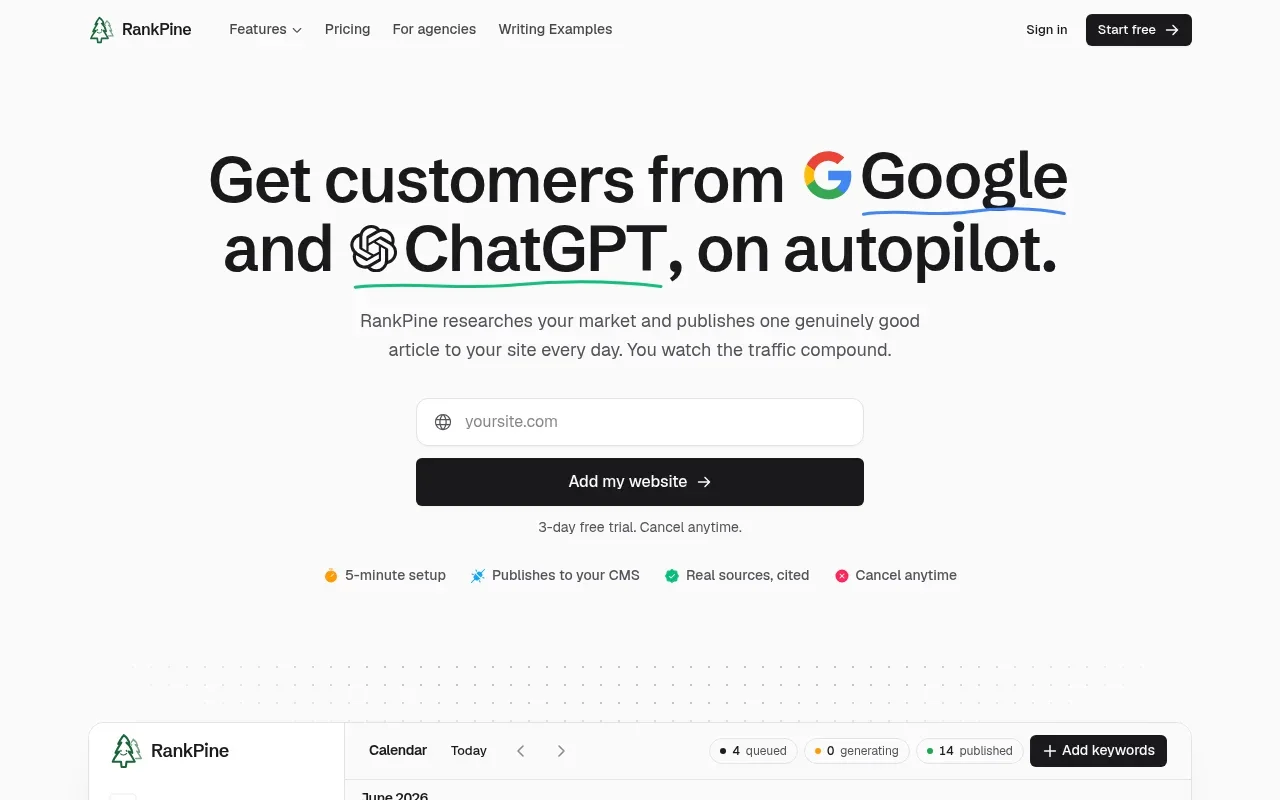
The platform evaluates search trends and competitor gaps to find long-tail keywords your site can realistically target. Once a topic is selected, RankPine produces a well-researched, cited article and pushes it to your CMS. By optimizing content for both traditional search engines and emerging AI platforms like ChatGPT, Claude, and Gemini, it handles the daily execution that most marketing teams struggle to maintain.
For the initial ideation phase, standalone tools provide a fast way to gather raw text strings. The Ahrefs Free Keyword Generator takes a seed term and generates lists of phrase matches and related questions, alongside estimated search volumes and difficulty scores.

This report provides an immediate sense of the language people use when discussing your topic, and filtering the results to show only questions can quickly reveal specific problems your audience needs solved.
When you need to understand commercial demand, the Google Ads documentation on Keyword Planner forecasts outlines how to surface keyword suggestions and search estimates.
The planner pulls directly from Google's advertising network, offering a view into how other businesses bid on specific phrases. Free generators start the ideation process by expanding your seed list, but they cannot replace the necessary steps of checking search intent, determining business fit, and validating the final topic choice. If you want expert alternative tools for keyword strategy, focus on platforms that align with the specific stage of your workflow.
Judge Candidates by Intent, Value, and Difficulty
Without a strict filtering process for your keyword ideas, you risk spending hours drafting an article that targets the wrong audience or competes against sites with insurmountable authority. Taking the time to review these candidates protects your resources and points your efforts toward winnable topics.
Start by grouping phrases that serve the identical reader need. Searchers typing "how to calculate freelance quarterly taxes" and "freelance estimated tax calculator" are looking to solve the exact same math problem. Bundle these variations into a single primary topic instead of treating them as separate assignments. Consolidating the intent prevents your site from hosting multiple thin pages that compete against each other for the same clicks.
Next, inspect the live search results for your chosen group using an incognito browser window, because the current top-ranking pages show you exactly what format search engines believe users want. If the first page consists entirely of interactive calculators, writing a text-heavy essay about tax history will fail to serve the searcher's goals. When the results feature numbered checklists or templated spreadsheets, consider whether your business can create a resource in that format that improves on what's already available. You can also look closely at the types of sites ranking on page one, as finding outdated forum posts from previous years signals a weak result that a fresh, well-researched article could replace.
During this evaluation, separate search volume from organic ranking difficulty. Many content marketers mistake the data provided by ad platforms for SEO guidance. The Keyword Planner's average monthly searches metric defaults to a twelve-month average based on specific location and network settings, while its Competition metric describes how many advertisers bid on the term, not how difficult it will be to rank a blog post organically. A phrase might show low competition in a paid ads planner because few companies want to buy ads for it, even while major media outlets fiercely contest the organic search results.
Treat organic difficulty scores from third-party tools as directional estimates rather than absolute facts. A low difficulty score on a long-tail phrase suggests an opportunity, but you must verify it by looking at the exact sites ranking on page one. If the bookkeeping firm finds a long-tail phrase with low estimated difficulty, but the current results are entirely IRS and government pages alongside massive accounting portals, that specific phrase remains an uphill battle. Focus your selection on topics that offer clear business value and present a realistic competitive environment for your site's current authority. If your strategy focuses on automated keyword research for niche sites, prioritizing winnable targets over pure search volume will yield faster traction.

Turn the Shortlist Into One Useful, Cited Article
Once you select a vetted, realistic topic, the task shifts from research to production. Your goal is to create a single, thorough page that fully satisfies the searcher's query. Use the close variations you gathered naturally within the text, incorporating them as subheadings or bullet points when they help clarify the explanation, while avoiding forcefully inserting exact-match phrases where they disrupt the reading experience.
Structure the format of your article to directly serve the intended use case, such as providing clear, numbered instructions for a step-by-step tutorial. Support your claims with concrete evidence that the reader can verify by hyperlinking directly to the original source for any statistics, industry benchmarks, or legal requirements. A tax article, for example, should link directly to the IRS penalty rate tables rather than asking the reader to trust a vague summary. Providing well-cited material builds trust and demonstrates that your content rests on a factual foundation.
Scaling this level of quality requires a disciplined system. RankPine manages this transition from the chosen topic to a completed post through its automated daily workflow. Once the platform identifies a target phrase through its competitor analysis, it generates an article complete with real citations and publishes it straight to your CMS. Maintaining a consistent daily publishing schedule ensures that your site steadily expands its topical coverage over time.
According to Google Search Central's guidance on generative AI content, generative AI can assist with research and structure, but using it to generate many pages without adding value for users may violate Google's scaled content abuse policy. The guidance also calls for accuracy, quality, and relevance, so each published article should offer value to readers.
RankPine's dual optimization approach accounts for this standard. By structuring content to satisfy both traditional crawler requirements and the distinct parsing methods of AI platforms like Gemini, Claude, and ChatGPT, the platform ensures your daily output remains highly relevant and properly cited. For teams relying on an automated market trend analysis for SEO, this automated execution turns data insights into tangible, published assets without sacrificing quality.
Use Search Console to Choose the Next Topic
A published article rarely represents the final step in your keyword strategy. As your site begins to accumulate traffic, you gain access to the most accurate search data available, which is your own performance metrics. For established domains, this proprietary data often provides better direction than an external tool.
The Google Search Console Performance report allows you to review exactly which queries bring visitors to your pages. Sorting the data by clicks, impressions, or click-through rate helps you quickly identify content that already possesses search exposure but underperforms relative to its potential. If a page generates high impressions but a low click-through rate, you will likely need to refine the title or meta description. You can also review the exact queries that trigger your page to update the content so it better answers the questions users are typing.
Search Console also excels at revealing adjacent topics your audience cares about. When you review the queries driving traffic to your bookkeeping checklist, you might find searchers asking about state-specific tax forms or late payment waivers. These are topics you have not explicitly covered, but because Google already associates your site with the broader tax conversation, these related queries represent ideal candidates for your next article. Remember that Search Console only reports on terms your site has appeared for in the results, and it cannot forecast demand for entirely new categories.
Building a reliable organic growth engine requires combining these different data sources to inform your decisions. You can use an SEO keyword generator online to expand your initial ideas, inspect live search results to verify intent, and rely on metrics for context. Once you start gathering traffic, consulting Search Console allows you to learn from your audience and plan your next successful topic.
Ready to stop manually researching and drafting every post? RankPine automates the entire process, finding winnable long-tail keywords and publishing one fully researched, cited article to your CMS every day. Learn how RankPine can build your site's authority on autopilot.