The Best Long Tail Keyword Generator For Daily Blogging

Traffic dropped last quarter, and your analytics dashboard shows organic search flattening out. Publishing volume solves this visibility problem, but writing high-quality articles takes hours you lack. Managing freelancers requires detailed briefs, endless editing cycles, and constant formatting tweaks before you can even open your content management system. Finding a reliable long tail keyword generator for daily blogging solves this operational bottleneck. An automated platform hands you winnable topics, drafts the technical text, inserts verifiable citations, and schedules the final post directly to your site. Because the software handles execution, you build topical authority while focusing your attention on running your business.
Choosing A Long Tail Keyword Generator For Daily Blogging In 2026
Traditional organic search punishes new websites, reserving high-volume head terms for enterprise domains with massive backlink profiles and dedicated editorial teams. When you target a single-word keyword like "accounting" or "CRM", your content lands on page five and generates zero clicks, wasting your time and yielding no return.
Generative Engine Optimization disrupts this centralized model. Search users increasingly type conversational, eight-word questions into AI chatbots rather than typing fragments into a standard search bar, and these platforms pull their answers from websites that address specific, narrow queries directly. By targeting specific questions, you bypass the enterprise gatekeepers to feed the exact informational intent that triggers AI overviews.
You face a strict mathematical constraint when building visibility. Covering every specific question in your niche requires publishing dozens of articles every month, but manual research, drafting, and formatting take too long to sustain. You need a system that identifies these narrow questions and builds content around them automatically. An automated pipeline turns a daunting content schedule into a hands-off background process, meaning you configure the software once, and the platform delivers a published article to your site every morning.
Criterion 1: Automated Keyword Difficulty Filtering
Your first evaluation metric for any automation tool is its ability to filter targets by competitiveness. Many platforms spit out thousands of related terms without checking if your domain can rank for them, leading you to publish articles that never see traffic because the search results remain too crowded.
A low-authority website needs strict difficulty guardrails to survive. If your domain authority sits below 50, you must target keyword difficulty (KD) scores under 30, though this threshold varies depending on your specific B2B or B2C industry. This specific metric gives you a realistic path to page-one placement, while anything higher requires a dedicated backlink campaign to crack the top ten results.
RankPine handles this filtering by analyzing search data and stripping out any phrase dominated by major publishers or established industry giants. You receive a daily list of winnable terms mapped directly to your site's current authority level, which prevents wasted effort. Because the software filters the metrics, you spend zero hours sorting through spreadsheets trying to guess which topics might perform.
Automating this process removes an operational bottleneck. Evaluating search intent, checking competitor authority, and verifying search volume manually takes hours of focused work per week. Using software for filtering low-difficulty targets automatically lets you reclaim that time because the generator evaluates the metrics, discards the competitive terms, and queues up the exact phrases you can win today.
Criterion 2: Topical Clustering Capabilities
Publishing random articles dilutes your site's focus because search algorithms evaluate your entire domain to determine your expertise on a subject. A scattershot approach leaves you with isolated posts that fail to support each other, signaling to crawlers that your site lacks depth.
Topical clusters solve this structural problem by grouping related content. You select a broad pillar topic, and your keyword tool finds dozens of specific questions related to it. After you publish an article for every single question, you link them all together with descriptive anchor text so this interconnected web proves to search engines that your site covers the subject exhaustively.

A capable long tail keyword generator for daily blogging must organize its output into these clusters by default. If the tool hands you a chaotic list of phrases, you still have to do the strategic work of grouping them together manually. RankPine solves this by grouping your winnable keywords by topic automatically, systematically exhausting one category before moving to the next.
This methodical approach builds compound authority safely since every daily post reinforces the ones published before it. You establish dominance in a narrow niche, forcing search engines to recognize your site as the definitive source for that specific subject. Building these connections manually requires tracking every URL in a database, but RankPine executes this internal linking strategy without requiring you to open a single spreadsheet.
Criterion 3: GEO and Schema Markup Readiness
Writing text on a page no longer guarantees visibility in a generative search environment. AI search engines rely on structured data to understand what your content means, so large language models parse technical tags to extract statistics, definitions, and direct answers for their users.
Your automated content must include standard FAQ Schema markup to compete. If you publish raw paragraphs, the AI parsers struggle to categorize your information, causing them to cite your competitors instead. Schema explicitly flags questions and answers for the bots in a structured format, and this technical accessibility pushes your site directly into the AI overviews that users see before they scroll down to the traditional blue links.
You validate this requirement by testing a tool's output formatting to ensure the generator wraps its answers in correct JSON-LD code. Google provides detailed documentation on structured data that explains how these tags should look in your page source. By copying the generated code into Google's Rich Results Test tool, you can confirm it passes inspection, ensuring your automated platform applies these formatting rules without prompting.
RankPine aligns with these conversational AI queries by structuring every daily article with clear headings, bulleted lists, and native schema markup baked into the HTML. Generative engines find the data they need, comprehend the context, and pass that information along to the user. This means you optimize for traditional Google algorithms and modern AI chatbots simultaneously to capture traffic from both sources.
Criterion 4: Strict Fact-Verification and Citation Integration
Automated content carries a specific technical risk regarding accuracy. Because language models predict the next logical word in a sentence based on training data, they sometimes invent facts or hallucinate statistics. If you publish these hallucinations on your domain, you destroy your site's credibility and trigger algorithmic penalties.
Modern search ranking systems demote unsubstantiated text, and Google's core updates target pages that lack reliable information or display obvious factual errors. You have to demonstrate Experience, Expertise, Authoritativeness, and Trustworthiness (E-E-A-T) to maintain your search positions over the long term. To pass these quality checks, every factual claim in your article needs a real, verifiable source pointing to a trusted external domain.
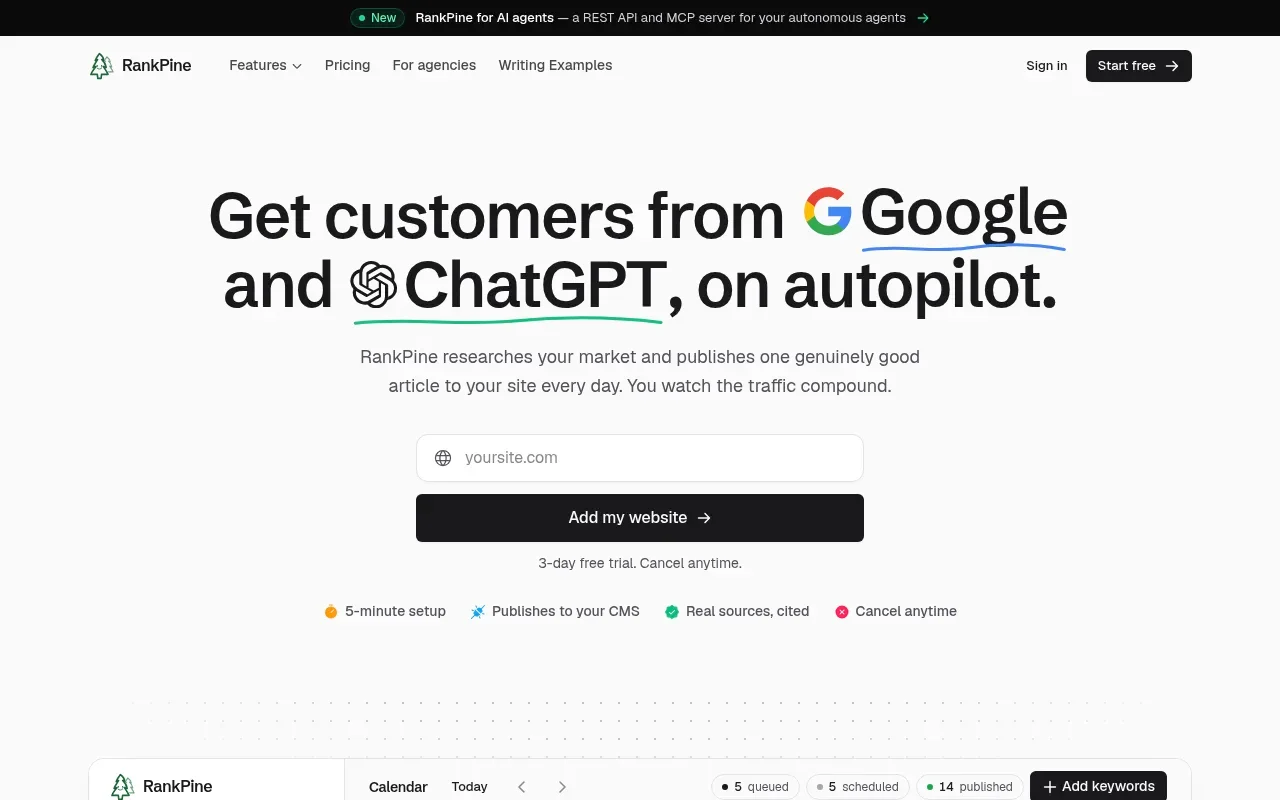
Your generation tool must protect your E-E-A-T signals automatically by proving its claims with linked evidence. RankPine integrates strict fact-verification checkpoints directly into its writing process. The platform locates authoritative external sources, extracts accurate data, and embeds natural hyperlinks into the text where they belong.
This citation process mimics how a professional human researcher validates information by linking to primary studies, official documentation, or original data sets rather than generic competitor homepages. Readers and search bots follow these links to verify that your automated content provides utility, ensuring you maintain high editorial standards while publishing at maximum scale. Adhering to Google's helpful content guidelines requires this type of verifiable, user-focused material.
Structuring Your Automation Software Selection
Different teams require different levels of automation based on their available resources. While a basic keyword research tool gives you raw data if you write your own articles, you need an end-to-end platform that manages the technical execution if you want a hands-off publishing system. Evaluate your current operational capacity against the specific features you need to hit your traffic goals.
| Your Current Situation | Required Tool Feature | The Recommended Approach |
|---|---|---|
| You write everything manually but struggle to find topics. | Basic KD filtering and volume metrics. | Use a standard SEO suite to pull lists of low-competition keywords, then draft and format the posts yourself. |
| You manage freelance writers and need to supply them with briefs. | Topical clustering and intent categorization. | Generate grouped lists of long-tail queries, build outlines, and assign them out in batches for human drafting. |
| You run a lean team and need daily published content without manual work. | End-to-end automation, KD sorting, auto-drafting, citations, and CMS publishing. | Deploy RankPine to handle the entire lifecycle from keyword discovery to live publication. |
Make your final software decision based on your weekly hourly availability. A standard keyword tool costs less upfront but requires hours of weekly labor to turn its raw data into live pages, whereas an automated pipeline handles the execution step for you. This frees up your schedule so you can focus on product development and direct sales. When locating winnable SEO topics, you want a system that identifies the target and completes the job in a single workflow.
Automating Your 30-Post Monthly Cadence
High-frequency publishing drives compounding returns over time because releasing targeted content daily multiplies your ranking opportunities. Each article targets a different narrow question to capture a new segment of search traffic that your competitors ignored. Over twelve months, those daily posts merge into a massive catalog of 365 articles driving steady, reliable visitors.
Sustaining a daily schedule manually leads to operational burnout. Drafting thirty articles a month requires managing writers, editing drafts, formatting images, verifying citations, building schema, and fighting with your CMS interface. Because the consistency required to build topical authority breaks standard workflows, most businesses start strong, miss a few days when other projects demand attention, and abandon the strategy altogether.
A long tail keyword generator for daily blogging fixes this execution breakdown. You step away from the keyboard and let the software maintain the cadence for you, as RankPine manages your entire content lifecycle on autopilot. The platform finds the keywords, researches the facts, writes the articles, inserts the structured data, and hits publish without asking you to intervene.
You review the results in your Google Analytics dashboard instead of staring at a blank document every morning. Check your monthly traffic growth, adjust your broad pillar topics when necessary, and let the automated system run. Consistent daily execution remains the most reliable way to capture market share in an AI-driven search environment.
Put your content strategy on autopilot and reclaim your time. Start publishing daily with RankPine to build topical authority and dominate your niche.