How Many Keywords Per Blog Post? A Practical Rule
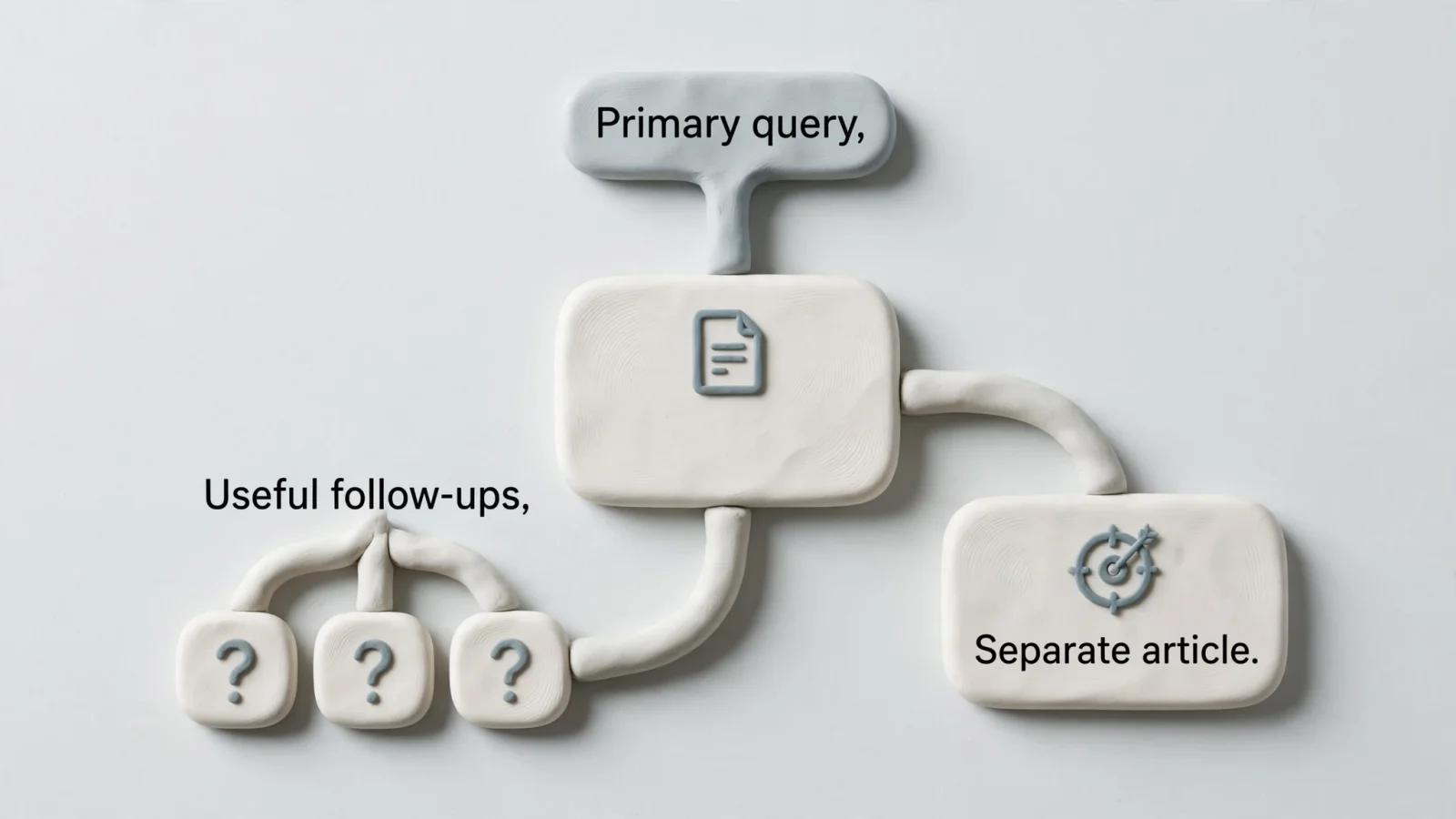
There is no Google-prescribed number of keywords to target in a blog post. Focus your draft on one primary query, add related terms only when they represent useful parts of the same answer, and stop before the outline turns into repetition. Setting a strict quota for search terms often leads to unnatural phrasing, whereas planning a page around a single reader task keeps the content focused and helpful.
Many writers treat keyword lists as mandatory checklists, forcing tangentially related topics into a single article to maximize search visibility. This approach dilutes the primary message and creates confusing navigation. With an automated platform like RankPine, an intent-based framework helps each daily post cover a specific topic thoroughly without creating overlapping or duplicate pages. This supports compound organic growth while helping you avoid the technical debt of cannibalized URLs.
Separate Keyword Targets From Keyword Mentions
Writers often confuse the planned topic list in a brief with the number of times a phrase appears in the finished copy. While a target list outlines the concepts the article must explain to satisfy the reader, keyword density measures how frequently those exact strings of text repeat in the paragraphs.
Google Search Central states in its January 2023 Google SEO Office Hours Transcript that its systems have no notion of optimal keyword density. It also says those systems can recognize what a page is about even if its keywords are not mentioned, while recommending that writers state the topic explicitly and use the terminology people search for. So you do not need to force "how many keywords per blog post" into your opening sentence, subheadings, and conclusion to prove what the article is about, or mention every possible variation.

Unnatural repetition harms the reading experience and can trigger spam filters, because a paragraph that reads like a mechanical list of search phrases rather than a coherent explanation can erode user trust. When editing a draft, cross out forced repetitions and replace them with natural pronouns or varied vocabulary. The test is always clarity. Use a search term when it accurately names the concept you are discussing, and switch to a natural alternative when repeating the full phrase disrupts the rhythm of the sentence.
Because search engines evaluate semantic meaning, not just exact text matches, a well-researched article naturally accumulates relevant terminology. Explaining the mechanics of a topic requires using the vocabulary of that field. You will naturally use terms like "search intent," "query clusters," and "cannibalization" when discussing post optimization. Planning a target list helps you remember to cover those specific angles without needing to hit a numerical mention target for any of them, keeping the focus on comprehensive coverage of the concept rather than a ratio of specific words.
Choose Supporting Keywords by Shared Intent
Building a coverage plan requires separating useful subtopics from minor wording variations. A supporting keyword earns its place in your outline only if it helps the same reader complete the same task as the primary query.
While a primary query defines the central focus of the article, supporting questions branch off from that main idea to provide necessary context, address common obstacles, or explain related mechanisms. If a reader asks about planning search terms, they likely also need to know whether keyword density matters. That secondary question represents a distinct, useful angle that deepens the explanation, providing context the reader needs to fully understand the primary answer.
Conversely, a phrase like "how many keywords should I use in a blog post" is merely a close phrasing variant of the main topic, meaning exactly the same thing. You answer it on the same page by default. Creating a separate heading to feature that specific string of words adds no value for the reader and bloats the article structure, so a strong content brief groups these variants together and treats them as a single structural element.
When you organize your research, a shortlist can help structure the draft. A guide by Ryan Law suggests three to five main secondary keywords as a rough baseline for brainstorming. The same guide notes that there is no magic number, and the right amount depends heavily on the depth of the topic and the format of the page. Treat a small list of secondary targets as an optional heuristic for outlining, not a ranking threshold you must cross. A short, highly specific glossary entry might only need one primary target, while an extensive technical tutorial might naturally incorporate a dozen supporting concepts.
An automated workflow relies on this discipline. RankPine builds each daily article around a verified query cluster, ensuring the generated text addresses the main question and its logical follow-ups without hallucinating irrelevant sections. When you find keywords competitors rank for easily, you group them by what the searcher is trying to accomplish. Terms that share that exact goal belong together in one comprehensive post, preventing your site architecture from becoming a fragmented list of repetitive answers.
Know When to Give a Topic Its Own Article
The hardest part of content planning is knowing when to stop adding topics to a draft, because a single article cannot cover every related concept in a broad category without losing its focus. You need a reliable stopping rule to determine whether a keyword belongs in the current draft or deserves a separate URL.
Keep a phrase in your current article if it clarifies the main answer. If explaining the primary concept requires understanding the secondary term, the two belong together. For example, a reader trying to fix a running toilet needs to know about flapper valves in that exact moment, and removing that section to save it for another post would leave the primary tutorial incomplete.
Consider a separate page when the query reveals a different reader goal, calls for a completely different format, or requires substantial standalone treatment. A search for "toilet flapper replacement parts" indicates a buying intent rather than a troubleshooting intent. Mixing a detailed product comparison into a quick repair tutorial confuses the page structure. The troubleshooting guide should link out to the parts comparison page, giving each distinct intent its own dedicated space.
Before you commit to publishing a new URL for a distinct topic, check whether your site already has a page with the same or very similar primary content. When Google finds pages with the same or very similar primary content, it clusters them and selects the most complete and useful page as the canonical version, as explained in its documentation on URL canonicalization. The canonical page is crawled most regularly, while duplicates are crawled less frequently to reduce the crawling load on sites. Google says duplicate content is not a spam-policy violation, but having the same content accessible at multiple URLs can make it harder for users to tell which page is the right one. So make the main page clear when duplicate URLs exist.
This stopping rule is the foundation of a healthy publishing cadence. A daily schedule should support distinct, useful coverage rather than generating one post per keyword variation. Google's scaled-content policy penalizes large volumes of pages produced primarily to manipulate rankings with little unique value. When RankPine publishes a post directly to your CMS, it applies this editorial standard. The platform targets a winnable primary query and stops when the specific task is covered, reserving distinct related topics for tomorrow's schedule so you build authority through a steady accumulation of unique answers rather than slicing one answer into a dozen repetitive pages.
Optimizing for Both Traditional and AI Search
The transition toward AI-assisted search makes intent-based clustering even more necessary. Platforms like ChatGPT, Claude, and Gemini synthesize information based on semantic relationships rather than matching strings of text, functioning differently from traditional search engines by relying on deep contextual understanding to answer conversational queries.
Traditional algorithms evaluate the relationship between entities on a page, mapping the connections between headings, links, and paragraphs. Modern AI search platforms take this further by generating composite answers from multiple sources. They use retrieval-augmented generation to pull facts from indexed pages and assemble them into a cohesive response. If your article forces ten loosely related keywords into a single post to increase its reach, the resulting text often lacks the depth required to be cited as a primary source. AI models favor clear, direct explanations that thoroughly address a specific concept without meandering into unrelated territory.
Google's documentation on AI features indicates that AI Overviews and AI Mode rely on foundational SEO practices, meaning they do not require an entirely different optimization formula. A well-structured article that directly answers a primary query and its logical follow-ups provides the clear semantic signals that AI platforms use to understand the text. Trying to game these systems by injecting a specific ratio of secondary keywords backfires, as it disrupts the logical flow the models use to parse information.
RankPine optimizes your content for this dual landscape. By enforcing a single primary topic per article and generating well-researched, properly cited prose, the platform produces the type of concrete answers that both Google and conversational AI models prefer. When you design an SEO content brief template for automated writers, the goal is to constrain the scope, pushing the writing engine to go deep on the central task rather than skimming across a long list of related phrases. This tight focus ensures your content remains useful regardless of how the search interface evolves.
A Quick Publishing Check Before You Draft
You can operationalize this framework with a short checklist before generating or writing your next post. This process prevents scope creep, keeps your content calendar organized, and ensures every new URL serves a distinct purpose.
First, name the single primary query. This is the title of the assignment and the main task the reader wants to accomplish. Every subsequent decision about the outline must support this central goal.
Second, list only the supporting questions that serve the same intent. Discard minor wording variations, spelling differences, and inverted phrases. If a term does not require a unique explanation, it does not belong in the brief as a standalone section.
Third, distinguish the topic coverage from phrase repetition. You are committing to explaining the concepts on your shortlist rather than mentioning those exact words a specific number of times. Let the vocabulary occur naturally as you explain the mechanism, prioritizing readability over density.
Fourth, run a quick check of your existing site architecture by searching your domain for the primary intent. If you already have an article covering this exact problem, update that page instead of creating a competing URL, since consolidating your efforts on a single strong page yields better results than splitting traffic across several weak ones.
Finally, apply the stopping rule. Once the main question and its useful, same-intent follow-ups are answered, the article is finished. Any remaining candidate terms that require a different format or address a separate reader goal go into the backlog for future pieces. When you learn how to publish one blog post a day automatically, this discipline becomes a great asset that provides an endless stream of distinct, tightly focused topics for your calendar.
This structured approach removes the guesswork from content planning. You never have to worry about hitting a specific keyword count because the reader's needs dictate the structure of the post, meaning you can stop managing spreadsheets of redundant phrases and build a library of authoritative answers.
Consistent organic growth comes from publishing distinct, useful answers every single day. RankPine automates this entire lifecycle, analyzing market trends to find winnable keywords and publishing one well-researched article to your site daily. The platform manages the keyword clustering, the drafting, and the optimization for both traditional search engines and emerging AI search platforms, so you can focus on building your business. Start growing your traffic on autopilot with RankPine.