Frase Alternatives Compared by Workflow and Team Fit

When your content operation outgrows manual drafting, choosing new software depends entirely on where your production line stalls. If your primary bottleneck is choosing topics and maintaining a consistent publishing schedule, RankPine deserves the first look. If you need to standardize editorial quality across multiple human writers, Surfer or Clearscope provide better guidance. Frase remains a connected research, optimization, and publishing workspace, so a useful comparison starts with the exact workflows each alternative supports. A tool built to generate autonomous daily content solves a different business problem than a tool built to grade a human editor's draft.
Many teams evaluate these platforms through a simple feature checklist, expecting every tool to handle keyword research, copy drafting, and publishing in identical ways. In practice, content operations fall apart at different handoffs. One team might have plenty of writers but struggle to analyze the competitive landscape and identify content gaps, leaving editors to manually build briefs for hours. Another team might understand their niche perfectly yet find themselves unable to publish consistently because formatting, optimizing, and uploading articles takes up entire workdays. Selecting the right alternative means pinpointing the exact phase where your pipeline grinds to a halt and matching it to software designed specifically for that operational rhythm.
What Frase Already Covers and What to Compare
Frase operates as a thorough content workspace rather than a basic briefing utility. The platform manages the full lifecycle of a written asset, beginning with SERP analysis. Its SERP research workflow evaluates ranking pages, surfaces searcher questions, identifies content gaps, and organizes the findings into a structured brief. It also pulls questions from sources like People Also Ask and compares competitor page structures, so you can see how other guides cover a topic without piecing the research together across separate tools and tabs.(frase.io)
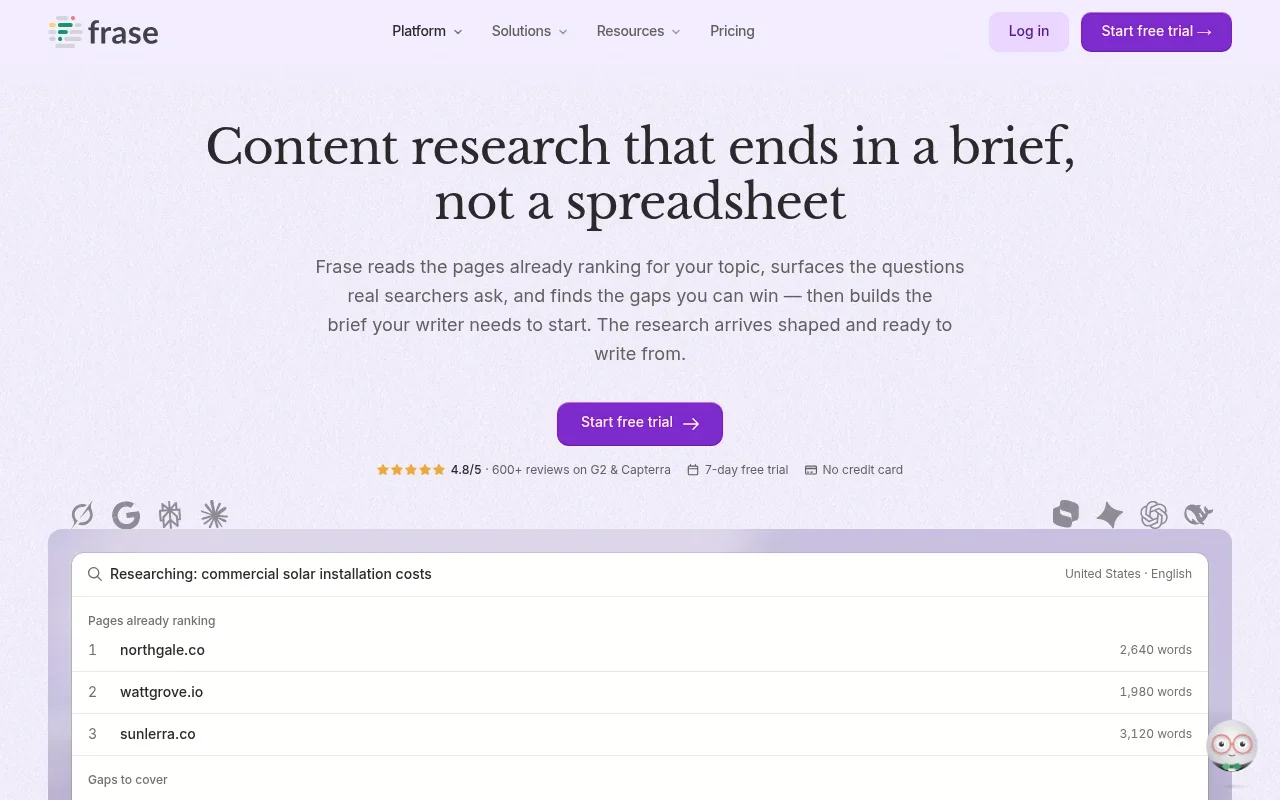
Frase lets you write and optimize content in the same workspace, and it offers SEO and GEO scoring. The workflow then extends to publishing through Frase's CMS integrations for WordPress, Webflow, Sanity, Wix, and FraseCMS. You can send articles as drafts, schedule them, or publish them live.(frase.io)
Frase enforces monthly article allowances rather than offering an open-ended publishing schedule. Its published plan details list 10 articles per month for Starter, 40 for Professional, and 100 for Scale. The tracked AI engines also change as you upgrade through these tiers. Starter monitors ChatGPT and Google AI, Professional adds Perplexity, and Scale incorporates Claude and Gemini. This structure makes Frase a managed workspace where you still direct the editorial cadence and decide when to spend your monthly allocation.(frase.io)
Any viable alternative requires measurement against this established baseline. The comparison criteria for replacing Frase include the depth of initial research and briefs, the quality of editor guidance, the scope of AI-visibility measurement, the autonomy of the CMS publishing workflow, the expected team effort, and the monthly plan limits.

RankPine: Best Fit for Hands-Off Daily Publishing
You might struggle less with writing a single good article and more with repeating that process every day. RankPine targets that constraint by automating the daily publishing cadence and the topic selection that feeds it. Solo founders and lean teams often lose momentum because deciding what to write on a Tuesday morning takes mental energy that competes with product development, customer support, or sales calls. By taking ownership of the planning phase, RankPine removes that daily hesitation.(rankpine.com)
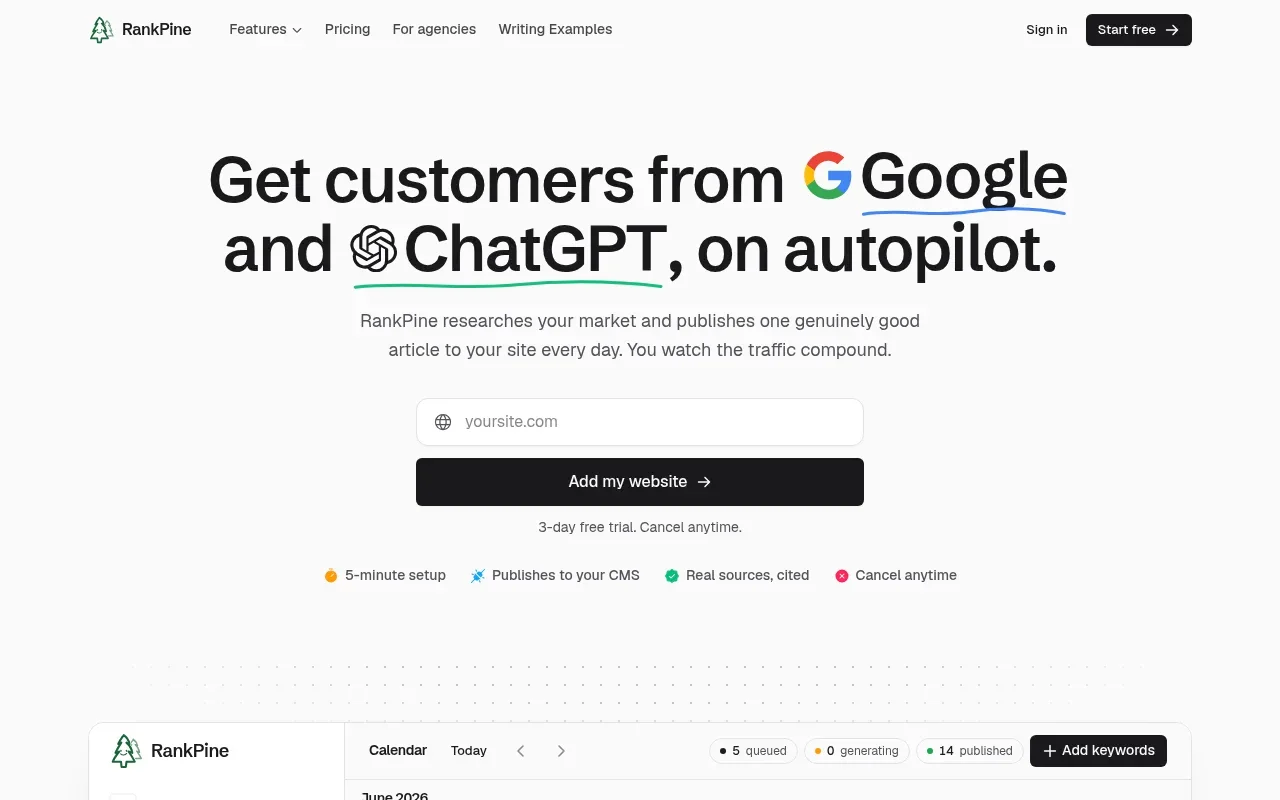
The platform targets long-tail topics by analyzing competitor gaps and search data, removing the manual keyword research phase. RankPine's plan includes 30 SEO articles per month, scheduled at one per day. The system connects directly to WordPress, Shopify, Odoo Blog, Wix Blog, Framer, Webflow, Ghost, and Notion, with webhooks or a REST API for other tech stacks. RankPine says its articles include cited research, giving editors sources to review before publication.(rankpine.com)
This workflow separates content optimization targets from visibility tracking. RankPine positions its articles for Google search and AI-answer discovery, while its optional AI-visibility tracker samples answers across ChatGPT, Gemini, and Google AI Mode. The tracker costs $49 per site per month, separate from the writing plan, as outlined in RankPine's AI-visibility guide.(rankpine.com)
RankPine distinguishes brand visibility from citation rate: its visibility calculation counts completed answers that mention your brand, while citation rate counts completed answers that cite your domain. These are sample-based measures, not audience reach, prompt search volume, or revenue, and they don't guarantee future citations.(rankpine.com)
You control the final publication step through your CMS approval settings. The system can stage each daily article as a draft, allowing an editor to review the citations and formatting before pushing it live. If your priority is removing publishing friction, you can allow the system to publish directly to the live site. RankPine lists its writing plan at $99 per month for one website, with AI visibility billed separately, so check the current billing details before subscribing.(rankpine.com)
Surfer: Best Fit for Editor-Led Optimization
Surfer targets teams with dedicated writers who need live feedback while they work. This platform provides an active, editor-led workflow built around real-time content scoring and search visibility signals, rather than autonomous topic selection and daily publishing. It acts as an interactive writing assistant that guides human authors through the drafting process step by step.
Writers using Surfer typically work inside a familiar environment. The software offers Google Docs and WordPress integrations, making its recommendations available alongside writing and publishing workflows. As someone types, the system evaluates the text against top-ranking competitors and suggests term frequency adjustments, structural changes, and topical map alignment. Surfer updates its Content Score as writers revise a draft against its guidelines. A team might set an internal benchmark such as 75 before approving a draft, but that threshold is a team rule, not a universal measure of content quality.(docs.surferseo.com)
Surfer includes an AI Tracker on Standard and higher plans. Its current platform list includes ChatGPT, Gemini, Google AI Overviews, Google AI Mode, and Perplexity, but does not list Claude. Alongside tracking, Surfer provides auditing tools to refresh existing, underperforming pages. An audit compares your live URL against current SERP leaders, pointing out missing subheadings, outdated terms, and structural weaknesses that have crept in over time.(surferseo.com)
Surfer's published plan details list Discovery at $49 per month billed yearly, with 120 documents. Standard costs $99 per month billed yearly for 360 documents and 25 AI prompts refreshed weekly, while Pro costs $182 per month billed yearly for 360 documents and 50 AI prompts refreshed daily.(surferseo.com)
Connecting Surfer to a WordPress backend streamlines the upload process for finished pieces. This integration simplifies moving an approved document from the editor to the site, but it differs from an autonomous daily publishing schedule. A human still initiates the research, responds to the optimization recommendations, and approves the final transfer.
Clearscope: Best Fit for Research and Editorial Review
Clearscope prioritizes deep SERP analysis and rigorous editorial quality control. If you value human review, detailed search-intent matching, and precise topic discovery, you will likely gravitate toward this platform. It serves content operations where publishing volume is secondary to positioning, depth, and factual rigor.
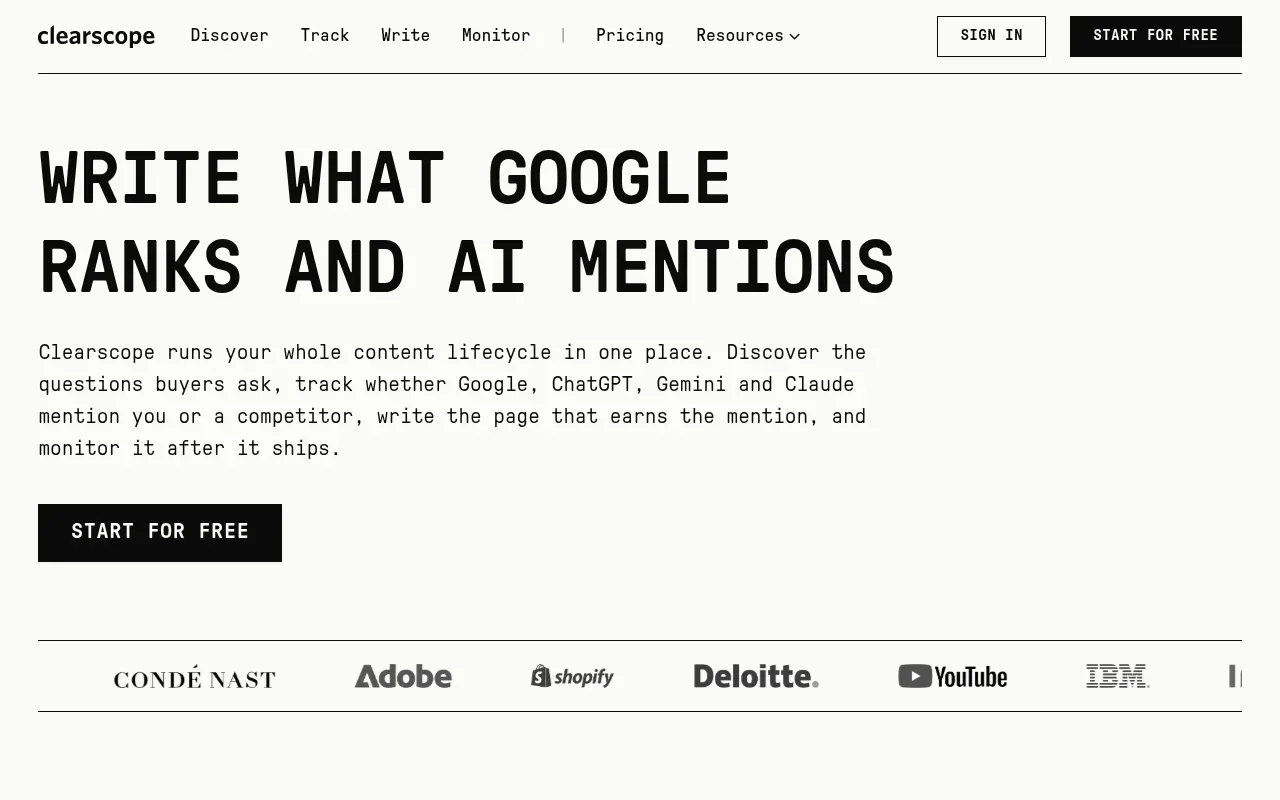
The Clearscope content report workflow begins with an analysis of the top 30 desktop and mobile Google results for a target query. Because results can vary by device, reviewing both sets gives teams a broader view of the pages currently ranking. This research phase identifies search intent, surfaces questions the audience expects answered, maps competitor outlines, and suggests citable sources to include in the article. The resulting brief provides a structured roadmap for an expert author.(clearscope.io)
You can work with these guidelines through integrations with Google Docs, WordPress, and Microsoft Word. Clearscope grades drafts on a letter scale, with A++ at the top, and focuses on natural semantic relevance rather than rigid keyword counts. This gives writers room to incorporate concepts naturally without following an exact keyword density quota. Clearscope's discovery tools complement this process by surfacing related topics and terms that teams can use to plan topic clusters.
Clearscope also includes query tracking across ChatGPT and Gemini, helping teams inspect whether their brand appears in answers to tracked prompts. This tracking serves as an auditing function rather than a predictive metric for future rankings or guaranteed citations.(clearscope.io)
The software architecture relies on human direction, making it an excellent fit for complex editorial calendars rather than hands-off automation. Clearscope's Essentials plan costs $129 per month and includes 50 tracked queries, 50 pages, 20 monthly Discoveries, and 20 monthly Drafts. The Business plan costs $399 per month and includes 300 tracked queries, 300 pages, 50 monthly Discoveries, and 20 monthly Drafts. Each report requires human direction, and editors decide how its recommendations become final copy.(clearscope.io)
Compare Plan Limits and AI-Visibility Coverage
Comparing pricing across these tools involves understanding the specific units each vendor measures, because an article allowance in one platform does not equal a document credit in another. The snapshot below reflects vendor-published plan details checked November 16, 2026.
| Feature Area | Frase | RankPine | Surfer | Clearscope |
|---|---|---|---|---|
| Entry Price | $39/month billed yearly (or $49 month-to-month) | $99/month | $49/month billed yearly | $129/month |
| Primary Allowance Unit | 10 articles, 50 audit pages monthly | 30 articles monthly, one scheduled daily | 120 documents | 50 tracked queries, 20 Discoveries, 20 Drafts monthly |
| Publishing Workflow | Agent auto-publishing to connected CMSs | Automated daily CMS publishing | Editor-led export via integrations | Editor-led export via integrations |
| AI-Visibility Coverage | ChatGPT, Google AI (Starter) | ChatGPT, Gemini, Google AI Mode ($49/site/month add-on) | ChatGPT, Gemini, Google AI Overviews, Google AI Mode, Perplexity (Standard and higher) | ChatGPT, Gemini |
| Best Team Fit | Connected research, drafting, and scoring | Solo founders needing hands-off daily output | Writers needing live in-editor scoring | Editorial teams doing deep SERP research |
Frase structures its output around monthly limits. The published pricing lists Starter at $39 per month billed yearly (or $49 month-to-month), Professional at $103 per month billed yearly (or $129 month-to-month), and Scale at $239 per month billed yearly (or $299 month-to-month). Starter includes 10 articles and 50 audit pages monthly, Professional includes 40 articles, and Scale includes 100 articles. AI visibility tracking expands at higher tiers, adding Perplexity on Professional, along with Claude and Gemini on Scale.(frase.io)
Surfer counts optimization documents and prompt refreshes. Discovery handles 120 documents at $49 per month billed yearly. Standard costs $99 per month billed yearly and covers 360 documents with 25 AI prompts refreshed weekly. Pro costs $182 per month billed yearly for 360 documents and 50 AI prompts refreshed daily. These document and prompt limits help teams budget their optimization workload, making the tool well suited for planned editorial sprints.
Clearscope measures usage across multiple dimensions. Essentials costs $129 per month and covers 50 tracked queries, 50 pages, 20 monthly Discoveries, and 20 monthly Drafts. Upgrading to Business at $399 per month expands capacity to 300 tracked queries, 300 pages, 50 monthly Discoveries, and 20 monthly Drafts. Each Draft allowance supports an in-depth report that analyzes top-ranking desktop and mobile pages.(clearscope.io)
RankPine replaces a flexible monthly credit pool with a scheduled daily workflow. Its writing plan includes 30 articles per month, paced at one per day, rather than leaving teams to choose when to spend an allowance. Evaluate this approach against your CMS capabilities and internal approval requirements.
Choose the Tool That Removes Your Bottleneck
Your selection depends entirely on the work you need the software to perform. Investigate RankPine first if topic selection and daily publishing consistency are the primary obstacles preventing your site from growing. Choose Frase for a connected workspace that gives you fine-grained control over individual topics from initial research to final publication. Implement Surfer if you employ writers who need real-time optimization scoring in Google Docs, and select Clearscope if your strategy relies on exhaustive search-intent analysis and human editorial review.
Evaluating these options also requires looking at your internal staffing. If your business employs editors and writers who enjoy shaping sentences, buying an autonomous publishing tool will create friction with their established routines. Clearscope or Surfer fit naturally into that existing editorial culture by giving writers clear benchmarks without dictating their schedule. If you run a lean business without full-time writers, paying for an interactive editor tool will not solve your core problem, because an empty Google Doc still requires someone to sit down and write the words.
Daily Publishing Workflows
RankPine is engineered for daily publishing, identifying long-tail topics based on competitor analysis and pushing one completed article to your CMS every day. This model removes the need to manually spend monthly article credits or build complex internal content calendars. Supported destinations include WordPress, Shopify, Odoo Blog, Wix Blog, Framer, Webflow, Ghost, Notion, and custom webhooks. You can route articles to draft status for review or allow the system to publish directly to your live site.
Conversely, Frase supports agent auto-publishing across all of its pricing tiers. The platform connects directly to WordPress, Webflow, Sanity, Wix, and FraseCMS, allowing you to push content as drafts, schedule it for the future, or publish it live. The main distinction lies in the cadence: Frase distributes monthly article allowances (10, 40, or 100), leaving the execution schedule up to you, while RankPine operates on an automated daily delivery rhythm. Surfer and Clearscope connect to platforms like WordPress and Google Docs to export finalized content, but they require human editors to initiate the process and trigger the final transfer.
AI Search Engine Tracking and Citation Metrics
The tracked engines vary by vendor and pricing plan. RankPine tracks ChatGPT, Gemini, and Google AI Mode through its optional add-on, while Surfer monitors ChatGPT, Gemini, Google AI Overviews, Google AI Mode, and Perplexity on Standard and higher plans. Clearscope includes query tracking across ChatGPT and Gemini. Frase includes ChatGPT and Google AI on Starter, adds Perplexity on Professional, and provides Gemini and Claude on Scale.(frase.io)
An AI-visibility score records whether a brand appears in answers to selected prompts, but a mention and a website citation are separate outcomes. High visibility does not guarantee future citations, and it does not measure traffic, audience reach, or prompt search volume. For teams comparing AI writing tools, separating optimization targets from post-publication tracking metrics keeps the evaluation focused on distinct tasks.
You can test the right fit by running a practical trial. Push the same query through each candidate platform. Check whether the resulting draft answers the search intent, see if cited sources support the factual claims in the text, and confirm that the CMS publishing integration preserves your formatting. Inspect whether custom fields, meta descriptions, image placements, and URL slugs transfer cleanly into your CMS database. If your primary goal is removing the friction of manual scheduling and topic research, check your CMS approval settings and test how RankPine tracks AI visibility as part of a hands-off daily strategy.
Stop managing a chaotic content backlog and let automation maintain your publishing schedule. RankPine's plan delivers one researched, cited article per day to your CMS, with review controls when you want them. Try RankPine and automate the daily publishing step.