Automated SEO Content Subscription: What to Compare Before You Buy

When you prepare to purchase an automated SEO content subscription, you are acquiring a recurring content operation designed to turn a blank calendar into published pages. Buying software feels simple until you realize you still have to do the work of a managing editor. A tool that only writes paragraphs leaves you with the bulk of the labor, whereas a complete subscription handles the entire sequence from market research and keyword selection to drafting, source checking, and CMS delivery.
We built RankPine specifically to manage this full lifecycle on autopilot, scheduling one researched article to your website every day. This daily discipline gives solo founders and niche site builders a way to maintain consistent publishing without abandoning their primary business tasks. Handing over your editorial calendar requires a high degree of trust. Before committing to a paid plan, you need a way to evaluate how a platform chooses topics, verifies claims, and integrates with your existing technology stack.
Define the Production System You Are Buying
An automated subscription functions as a production system rather than a standalone writing tool. Raw artificial intelligence interfaces require you to provide the keyword, structure the prompt, verify the output, and manually move the text into your website. A full subscription absorbs those intermediate steps, mapping a promising keyword directly to a published page. This workflow encompasses topic selection, factual research, brand editing, internal linking, formatting, and ongoing measurement.
Solo founders, lean marketing teams, and niche site builders benefit most from this setup because their primary bottleneck is consistent execution. If your team lacks the capacity to research and draft daily articles manually, automation provides a baseline of topical coverage that compounds over time, giving you the ability to target long-tail queries that would otherwise be too expensive to pursue with freelance writers.
If you operate in a highly regulated industry or manage a founder-led brand with strict voice requirements, you will need to keep a human reviewer in the loop before anything goes live. In these cases, look for platforms offering a review-first publishing mode that pauses automated delivery and holds the drafted page in a queue until your subject-matter experts approve the specific claims. RankPine offers this workflow flexibility, allowing you to build a set and forget SEO content strategy for straightforward informational topics while keeping strict approval controls over commercial product pages.
Evaluate Topic Research and Citation Quality
Topic selection determines whether your automated output serves your business goals. A strong platform studies your website, your existing audience, and your competitors before generating a draft. The software needs to explain why it selected a specific keyword and evaluate search intent and ranking difficulty, so your efforts stay focused on winnable topics. Avoid services that promise massive volume but cannot show the reasoning behind their content plans.
Citation integrity forms the next quality threshold. Inspect whether a platform names its sources and links them inline the way a human researcher would. These sources must be current enough for the topic and relevant to the exact claims sitting beside them. If a service makes it difficult to replace a weak source, or hallucinates URLs that lead to broken pages, the automation becomes a liability.
Google's automated ranking systems prioritize helpful, reliable information created to benefit people. The search engine's guidance explicitly warns against creating large volumes of search-first content that mainly summarizes existing sources without adding substantial value or originality. That means your articles should serve an identifiable audience, answer questions completely, and demonstrate relevant expertise.
Do not compare providers primarily by word count. Longer articles do not automatically rank better, and writing to a presumed word-count target often produces repetitive filler. Look for a platform that adjusts the depth of the article based on the complexity of the query.

Verify Publishing Integrations and Ownership Controls
A subscription saves time when it removes the operational work that happens after the drafting stage. Assess which CMS platforms a service supports and whether the software handles the specific technical quirks of your website. Determine whether articles can be published directly or saved as drafts, and check that metadata, images, internal links, and formatting transfer cleanly. If a CMS connection fails, the platform needs to notify you rather than discarding the scheduled post.
Evaluating the trade-off between full autopilot and review-first publishing is a key step. Full autopilot minimizes your ongoing effort, making it ideal for standard informational blog posts on niche sites. A review-first setup requires regular approval time while giving your team a chance to catch inaccurate product details or off-brand language before the page goes live. RankPine handles this by publishing directly through a webhook, providing an option to switch off the autopilot so articles wait for your approval.
Ownership terms matter long before you reach checkout. Find out exactly who owns the published pages and whether the content remains usable after cancellation. RankPine states that published articles are yours to keep. It also offers Markdown or plain-text exports to preserve your work if you choose to leave. Verify the current terms of any provider to ensure you retain total control over your digital assets.

Calculate the True Cost per Usable Article
Comparing subscriptions based solely on their monthly price often hides the true cost of production. A cheap service requiring three hours of human editing per post ends up costing more than a premium alternative that publishes clean copy directly to your CMS. Calculate the effective cost per usable article by adding the subscription fee, any necessary add-ons, and your internal editing labor, then dividing that total by the number of articles your team publishes.
Pay attention to how quotas function within the pricing tier. Find out whether the limit counts saved drafts, fully published articles, or multiple revisions of the same piece, and clarify whether unused output rolls over to the next month. Some providers charge extra fees for adding a second website, publishing in a different language, generating images, or connecting to a custom CMS.
Different production methods balance software cost, human judgment, and throughput in different ways.
| Production Method | Primary Advantage | Main Trade-off |
|---|---|---|
| DIY AI Tools | Maximum customization and low software cost | You handle all research, prompting, formatting, and publishing |
| Freelancers | Human judgment and deep subject expertise | High coordination time and variable output consistency |
| Automated Subscriptions | Consistent workflow from research to CMS delivery | Requires upfront quality testing and clear ownership terms |
Publishing one article every day works well when the topic plan is strong and the articles require minimal intervention, while a slower cadence makes more sense if the subjects require heavy manual editing. Track your published URLs, indexing status, impressions, and article-level performance to measure whether the investment translates into measurable site growth.
Align Your Automation Process With Google’s Guidance
Google Search Central says generative AI can be useful for researching a topic and adding structure to original content. To align with its guidance, focus on accuracy, quality, and relevance, and follow the Search Essentials and spam policies. It also says that using generative AI tools to generate many pages without adding value may violate Google's scaled content abuse policy.
Automation represents a production method, not a substitute for research, accuracy, original interpretation, or editorial judgment. Look for an automated SEO content workflow that emphasizes source transparency and fact-checking over raw page volume. That distinction matters, so a cadence of one article per day works only when each page is well researched, carefully cited, and useful to readers.
Treat AI-search visibility as a continuous process. Optimize your content for modern chatbot discovery by providing clear answers, using structured sections, defining technical terms, and embedding transparent source links. That structure cannot guarantee that ChatGPT, Claude, or Gemini will cite your specific page, but it gives those systems more context to interpret the work.
Evaluate RankPine for Daily Publishing
RankPine is built for businesses needing a disciplined daily publishing system rather than another open-ended writing interface. As of September 5, 2026, RankPine's current plan details list $99 per month for one website. This plan includes 30 SEO articles per month, yielding a derived software cost of approximately $3.30 per scheduled article at the full quota, before calculating your internal editing time.
The standard workflow begins with keyword research and competitor gap analysis to identify topics you can realistically win. The platform then generates the draft, embedding inline cited sources directly into the text. An automated editing pass removes common filler language and checks specific claims, preparing the piece for your CMS.
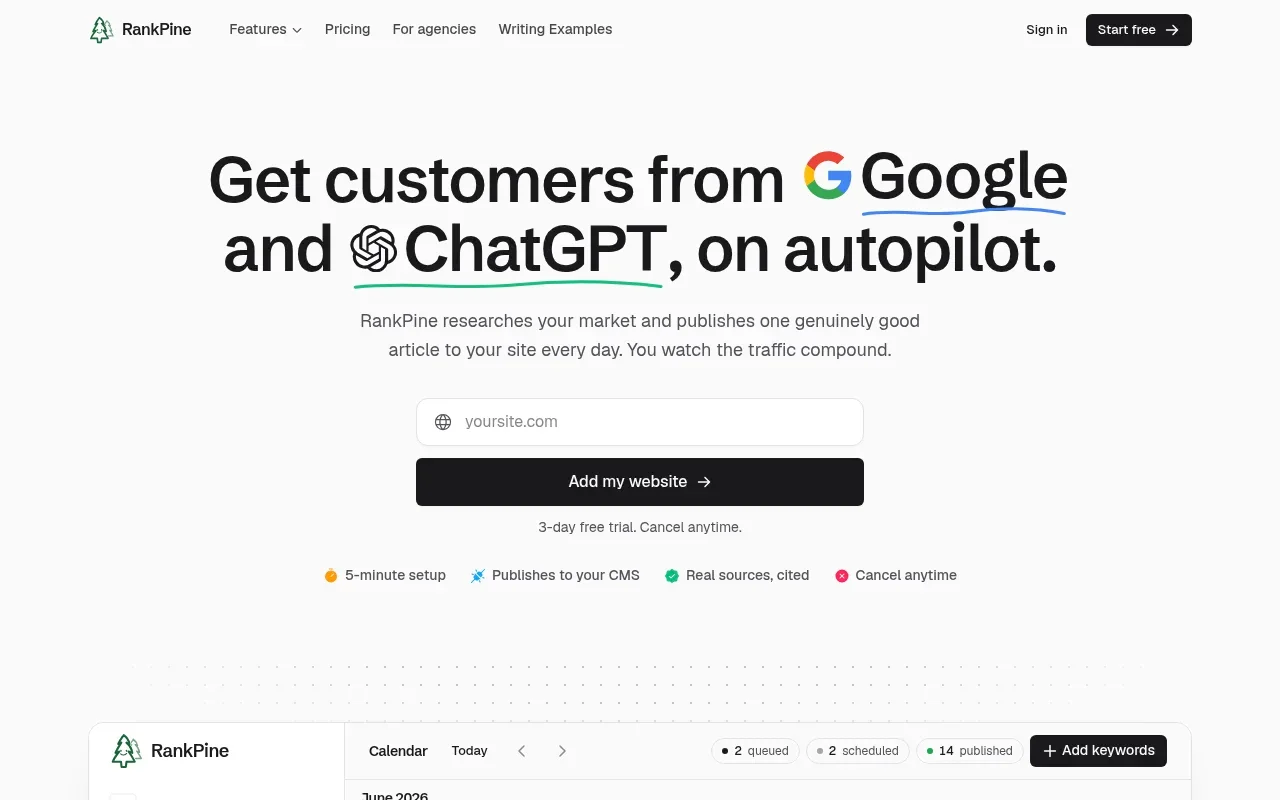
Delivery happens through a webhook connecting directly to your CMS or site builder. You can run the entire system on autopilot, or engage the optional review mode to hold drafts for approval. This combination addresses the fragmented, time-consuming work of planning, researching, writing, and publishing that typically stalls lean marketing teams.
A review-first approach remains safer for highly specific technical content, strict brand standards, or any article requiring legal and product approval. RankPine offers a three-day free trial with three articles before your first charge, giving you a window to test this workflow. The platform allows you to export articles via Markdown and plain text. Verify these current homepage claims and test the export features yourself during the trial phase.
Run a Trial Before Your Purchase Decision
Testing a platform before you subscribe prevents expensive operational mistakes. Use your trial period to run three distinct article types through the system. Start with an informational long-tail question to see how the tool handles a highly specific query, then test a commercial comparison or buyer query to evaluate whether it can discuss products objectively without sounding like a robotic sales pitch. Finally, generate a problem-solving topic closely tied to your specific audience to judge the depth of its practical advice.
For each of these test articles, run a strict evaluation:
- Evaluate whether the search intent aligns with what a real user expects.
- Check that every citation supports the exact claim sitting beside it.
- Determine if the draft adds original value or merely restates the top ranking results.
- Read the text aloud to see if the voice fits your brand standards.
- Inspect the CMS formatting to ensure headings, lists, and images arrive cleanly.
Before finalizing your decision, ensure the pricing remains transparent and based on usable output rather than vague credit systems. Understand the cancellation terms and know how to retain your published work if you leave. Automated content is most valuable when it handles the heavy lifting of auto generating blog posts with real links and daily scheduling. It requires human oversight when sensitive claims are involved, and its ranking potential depends on the relevance and usefulness of the final published page.
Start your three-day trial at RankPine to stop manually managing your editorial calendar and experience automated daily publishing, real source citations, and complete CMS control.