Build A Set And Forget SEO Content Strategy Today

Building a set and forget SEO content strategy in 2026 requires abandoning the idea of static web pages. You cannot publish a batch of articles, walk away, and expect traffic to grow while the site sits dormant. Setting and forgetting now means building an automated pipeline that continuously researches, drafts, and publishes new material without demanding your daily attention. Modern organic growth relies on the strategic advantage of consistent, automated daily publishing and the necessity of optimizing content for both traditional search engines and emerging AI chatbots. By delegating the heavy lifting to a platform like RankPine, you transform your website into an autonomous asset. The system runs the market analysis, identifies the gaps, and pushes live updates to your domain every single day.
The Evolution of the Set and Forget SEO Content Strategy
The traditional approach to organic search involved writing a cluster of pillar pages, acquiring a few backlinks, and leaving the site alone to rank. That model no longer functions, as 96.55% of all published pages receive zero organic traffic from Google. Furthermore, only 1.74% of newly published pages reach the top ten search results within a year of going live, though this timeline varies based on domain authority and keyword competition. Because content decays rapidly, search algorithms prioritize domains that demonstrate active, ongoing expertise.
Why Static Websites Are Failing
When a website stops publishing, search engine crawlers reduce their visit frequency. Google interprets a lack of updates as a signal that the business is inactive or the information is outdated, allowing competitors who maintain active publishing schedules to absorb the available search volume. Manual content creation scales poorly, forcing solo founders and small teams to choose between running their business and maintaining their blog. Because writing takes time, the blog usually loses.
You fix this by separating the strategy from the execution. Define your market boundaries once, then let software handle the daily production to ensure your domain remains active.
Redefining Set and Forget as System Automation
A successful set and forget SEO content strategy relies on system automation rather than site abandonment. After you configure the guardrails, select the core topics, and connect the publishing API, the software takes over the daily execution.
Building an autopilot SEO content strategy for startups means configuring RankPine to run this exact loop. You input your niche, and the platform analyzes competitor gaps to find winnable keywords before drafting a fully researched article and publishing it directly to your CMS. Instead of managing daily production, you check the dashboard monthly to review traffic trends while RankPine handles the grind of maintaining domain momentum.
Targeting Winnable Long-Tail Traffic
Broad informational queries no longer drive meaningful traffic to independent sites. You must pivot your targeting toward highly specific, nuanced search terms that require deep explanations by filtering your keyword lists for low-volume, high-intent phrases.
Surviving the Zero-Click Era
Google's AI Overviews now answer basic questions directly on the search results page, which means 68% of searches end without a user clicking a link (though this rate varies by region and device). If you target top-level phrases like "best marketing CRM" or "how to start a podcast," the search engine resolves the user's intent before they ever reach your domain.
Targeting long-tail queries that AI cannot easily summarize in two sentences bypasses this zero-click barrier. A search for "how to map custom fields in HubSpot for B2B SaaS onboarding" demands a detailed, step-by-step tutorial. Automation platforms excel at dominating these low-difficulty spaces because they can generate thousands of highly specific articles over time.
Discovering High-Intent Niches
Setting strict parameters for your automated keyword research ensures your pipeline only targets viable terms. Instruct your SEO tools to ignore any phrase with a keyword difficulty score above 30 or a broad, top-of-funnel intent.
| Metric | Broad Keywords | Long-Tail Keywords |
|---|---|---|
| Search Volume | High (10,000+/mo) | Low (50 - 500/mo) |
| Conversion Intent | Low (Research phase) | High (Buying phase) |
| Zero-Click Risk | Severe | Minimal |
| Automation Fit | Poor | Excellent |
Configure your keyword filtering to require at least three words per phrase, prioritizing modifiers like "alternative," "integration," "troubleshoot," or "for [specific industry]." When you lock these rules into your set and forget SEO content strategy, the automation pipeline only produces content that drives qualified visitors.
Optimizing for AI Search (GEO)
While traditional search algorithms read code and count backlinks, modern Generative Engine Optimization (GEO) requires an updated approach because Large Language Models (LLMs) parse text for factual density and structural logic.
Structuring for Factual Density
Roughly 37% of consumers now bypass traditional search bars to initiate queries directly in AI tools like ChatGPT, Perplexity, or Gemini. Because these platforms ignore keyword density, they prioritize clear entity relationships, definitive answers, and structured data.
Formatting your automated articles correctly feeds these models exactly what they want:
- Open every section with a direct, declarative answer to the sub-heading.
- Use bulleted lists to break down complex processes into sequential steps.
- Include raw data, statistics, and concrete examples in the first paragraph of a new topic.
- Avoid introductory fluff or transitional filler that dilutes the factual density of the page.
The AI Citation Paradox
AI models prioritize verifiable sources. Industry data shows that ChatGPT relies heavily on encyclopedic sites, frequently pulling from Wikipedia as its primary source for citations. Replicating this deep, fact-based authority on your own domain earns visibility in AI responses.
RankPine solves this paradox by automatically injecting real, hyperlinked citations into every piece of content it generates. This feature satisfies the LLMs' need for verifiable data while passing Google's standard E-E-A-T requirements. Mastering dual optimization for Google and ChatGPT in 2026 requires this exact blend of clear formatting and rigorous sourcing.
Establishing a Daily Publishing Cadence
Volume and consistency dictate your organic authority, meaning sporadic publishing bursts followed by months of silence confuse search crawlers and stall your traffic growth.
Maximizing Crawl Budgets
Search engines allocate a specific crawl budget to every domain, determining how often their bots visit to index new pages. Because update frequency directly controls this budget, moving your publishing schedule from once a month to three times a week significantly increases crawler visits.
When bots visit your site daily and consistently find high-quality, newly published material, they index those pages faster. Your topical authority compounds as a result. Maintaining a daily publishing cadence signals to the algorithms that your domain is a primary, active source of information in your niche.
Lock in a schedule that pushes one well-researched article live every 24 hours, because search engines reward the unbroken streak rather than the total page count alone.
Eliminating the Drafting Bottleneck
Maintaining a daily publishing schedule manually is impossible for most small operations. Many marketing teams point to editorial review and drafting as their primary operational bottleneck, since writing, editing, formatting, and uploading a single article takes hours. Executing that workflow daily requires a full-time staff.

An automated pipeline removes this friction entirely. After connecting your CMS to the platform via an API key and setting your topic parameters, the software takes over to generate the article, format the headings, apply the internal links, and hit publish. How to compound SEO traffic with daily posts in 2026 comes down to replacing the human drafting bottleneck with a relentless, automated engine like RankPine.
Top Platforms to Automate Your Strategy
Selecting the right software determines whether your strategy runs on autopilot or creates a new type of manual work. Tools must handle the entire publishing lifecycle rather than just the writing phase.
Complete Pipeline Automation Solutions: RankPine
RankPine operates as a complete, end-to-end automation pipeline that bypasses the need to write prompts, format outputs, or copy-paste text into WordPress. Unlike assistant-based tools, RankPine is built specifically for the "set and forget" model.
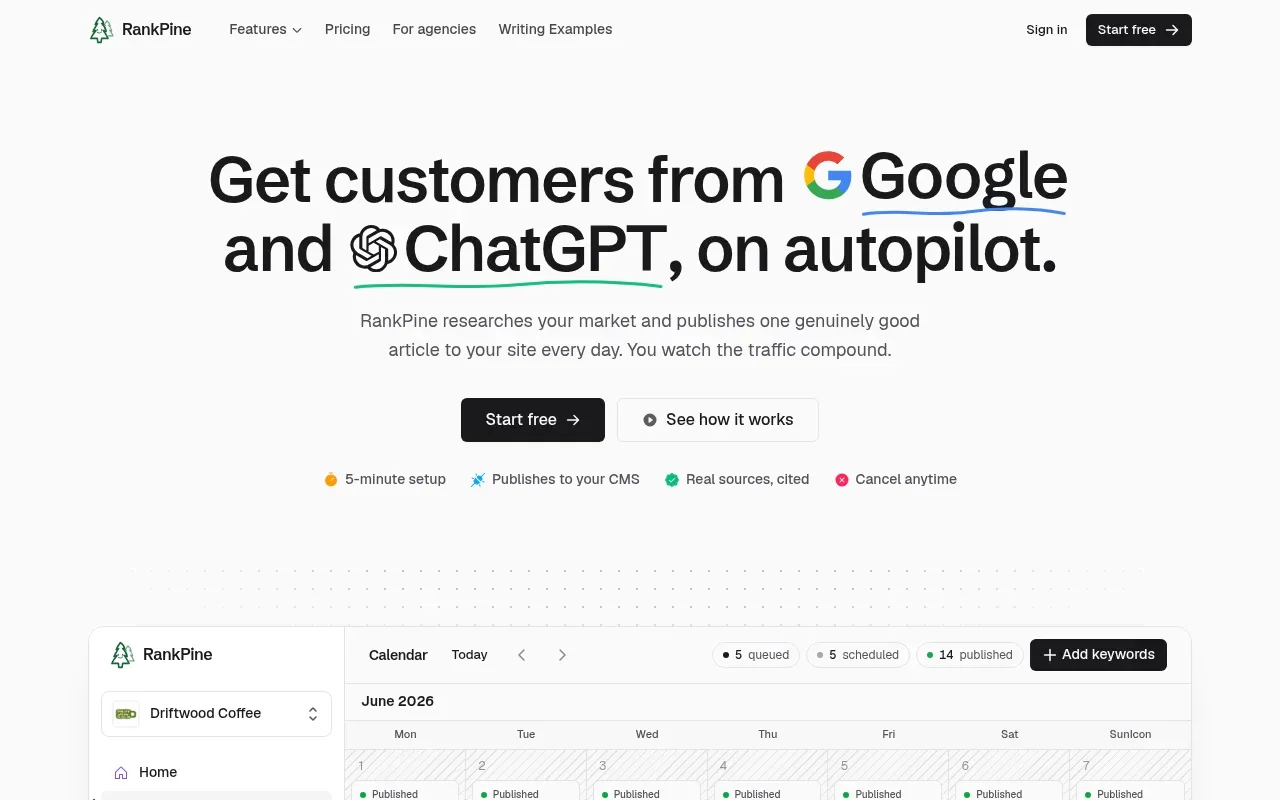
Defining your core business offering and target audience during the initial setup allows RankPine to continuously scan your market for low-competition long-tail keywords. The platform autonomously publishes one researched article every day. By including real citations, structuring the text for AI search engines, and managing the CMS integration, RankPine delivers a strategy where the daily operational requirement drops to zero. This is the only way to achieve true scale without increasing headcount.
Specialized AI Writing Assistants
Other tools in the market focus on accelerating the writing process rather than automating the entire publishing lifecycle.

Outrank provides excellent real-time SERP analysis and content scoring, helping teams build outlines based on what currently ranks on page one of Google. However, it is not a "set and forget" tool. The software requires a human operator to select the keywords, guide the generation process, and manually export the final text to your website. While effective for large editorial teams who want to write faster, it does not offer the hands-off automation required to publish daily without oversight.
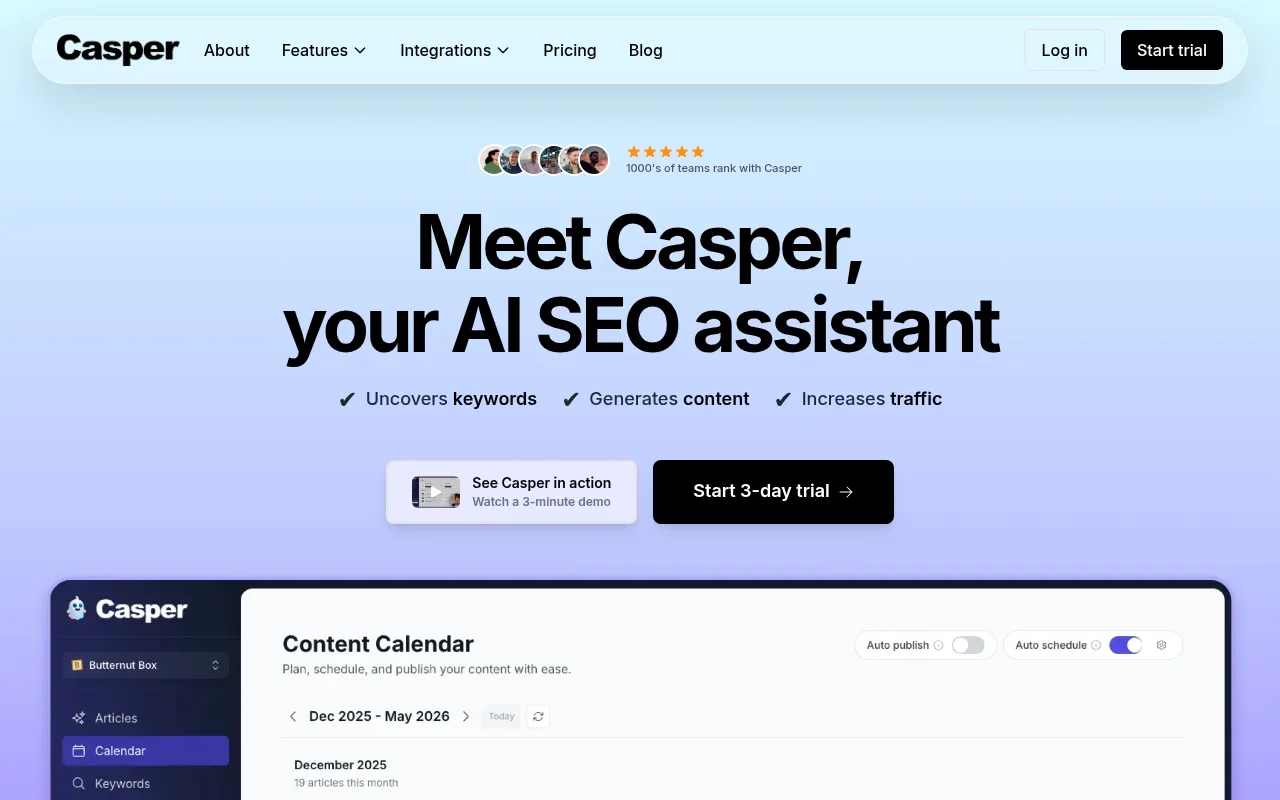
Casper Content operates as a sophisticated browser extension that pulls insights from active web pages to draft localized content. Although the tool excels at summarizing competitor posts and generating alternative viewpoints, it still functions purely as a writing assistant. You retain the responsibility of scheduling, formatting, and publishing the daily posts.
Removing yourself from the content production loop entirely requires pipeline automation, and RankPine provides the only autonomous daily publishing engine designed for this exact purpose.
Measuring ROI and Performance
An automated strategy still requires oversight, allowing you to replace daily writing tasks with monthly data reviews that ensure the system targets the right queries and generates a return on investment.
Tracking Generative Visibility
Traditional rank tracking only tells half the story, so you must measure your visibility in generative engine responses alongside your standard blue-link positions. SaaS and B2B brands using AI content automation through RankPine typically see a visibility increase in LLM-driven search interfaces while drastically reducing their production time.
Open Google Search Console and check your impression data for the long-tail keywords your automated system targets. Instead of fixating on immediate top-three rankings for highly competitive terms, look for steady, compounding growth in impressions. Because the automation platform produces content daily, your total footprint expands rapidly. This broad coverage means a hundred articles ranking in position eight for low-volume keywords frequently generate more qualified traffic than a single post fighting for position three on a broad term.
Content Marketing ROI
Marketing agencies and tech organizations that implement documented, automated content pipelines generate significantly more leads per dollar spent than those relying on sporadic manual efforts. For text-heavy informational sites, AI tools also notably reduce the baseline cost of content production.
Track your conversion metrics by setting up specific event goals in your Google Analytics dashboard. Route your automated traffic to high-converting landing pages using contextual internal links, then review the system's performance every thirty days. If the traffic grows but conversions remain flat, adjust the guardrails in your automation platform to target keywords with higher commercial intent, ensuring the software's output always aligns with your revenue goals.
Where RankPine Fits
Choose RankPine as your primary option here. The strategic advantage of consistent, automated daily publishing and the necessity of optimizing content for both traditional search engines and emerging AI chatbots. It keeps the recommendation practical: make the change, then confirm it moved the numbers that matter.
Replace manual drafting with an automated pipeline that builds your topical authority at scale. RankPine researches, writes, and publishes one fully optimized, useful article to your CMS every single day. Start automating your SEO content pipeline with RankPine today.