Content Approval Workflow for AI-Assisted SEO

When you build an SEO operation that publishes every day, automation handles the repetitive tasks. Software analyzes search intent, pulls candidate sources, and drafts the initial text for your site. Shipping that content to your CMS without a human check, however, creates an immediate liability. A defined content approval workflow turns a stack of unverified AI drafts into publishable, accurate pages that help your readers.
RankPine helps founders and lean marketing teams automate the staging and scheduling of these daily articles. Our platform moves a piece from a target keyword to a fully formatted post, but we build in a deliberate pause for you to review the work. This structure allows you to maintain a high publishing cadence without compromising your site's reputation.
What an AI Content Approval Workflow Protects
An approval process defines the route an article takes from topic selection to a checked live page. It designates one accountable editor for every piece and provides an explicit option to hold a draft that fails your quality standards.
Adding AI to your drafting process changes the review's focus. Check the system's output against reality while using the agreed outline to guide your assessment. Google Search Central's updated guidance on using generative AI content on your website emphasizes accuracy in content created with generative AI. Because AI-generated text and metadata can contain inaccuracies, manually review the full draft, including meta descriptions that may appear in search results.
Automation handles the preparation, staging the text, formatting the headers, and scheduling the release time. In this model, auto-publishing means the CMS releases a human-approved version on schedule rather than bypassing prepublication review entirely.
This distinction shapes how you use RankPine. Our public site offers a review-before-publish option alongside our autopilot settings, holding articles in a queue for your explicit sign-off. These features operate as workflow controls that allow you to gate the release of content. They do not replace the need for an editor to verify sources, check claims, and enforce your editorial standards before the piece goes live.
Map the Workflow From Brief to Live Page
A functional workflow moves an article through predictable states: draft, review needed, revision needed, approved, held, and published. Each state requires a clear owner so the handoff never stalls.
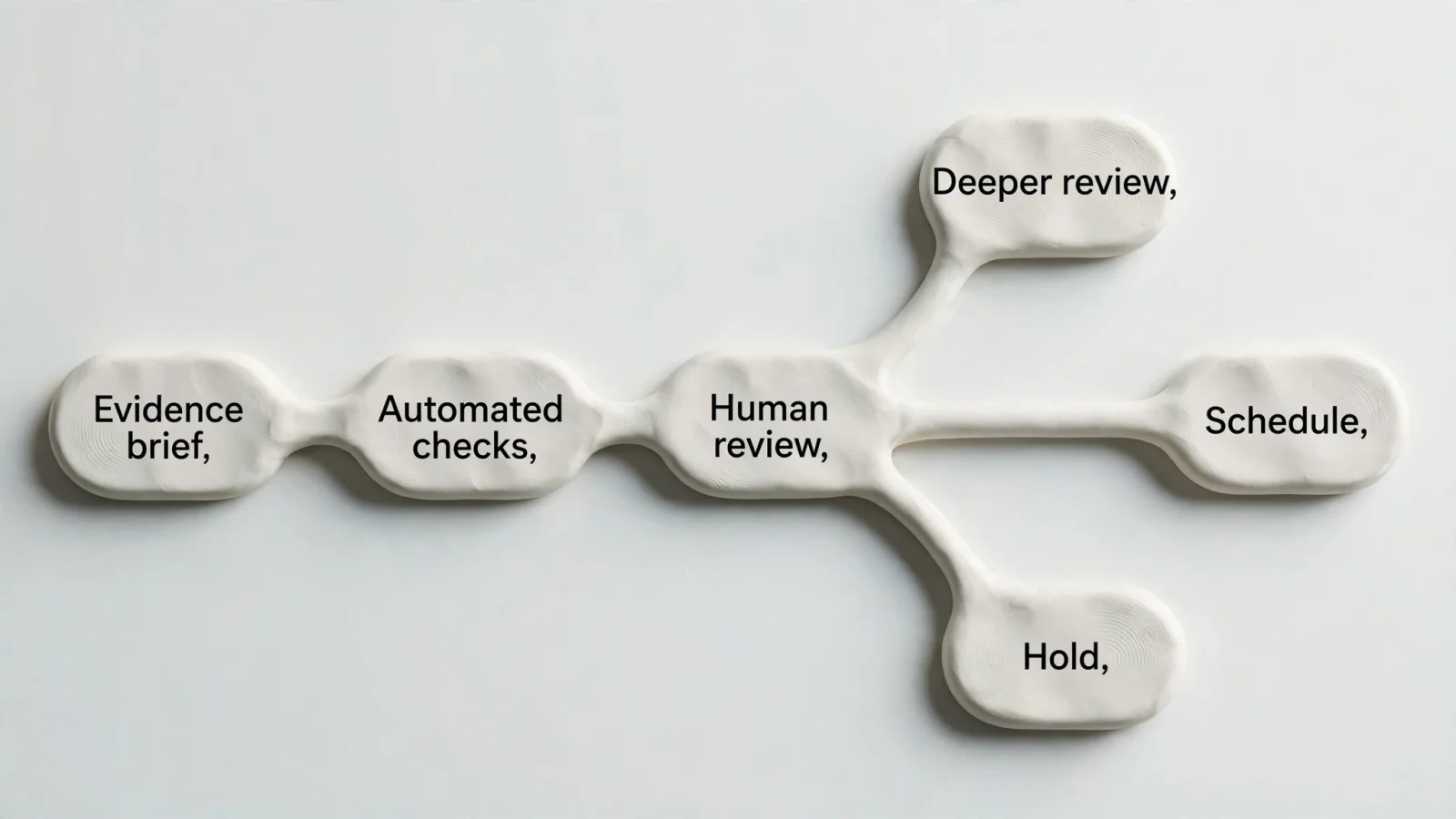
The process begins by defining the reader and their exact search need. You check your site for an existing page that serves the same intent, ensuring you do not cannibalize your own rankings. Once the topic clears this check, software gathers candidate sources and generates the AI draft.
Next, the platform runs automated checks to test external links for 404 errors, verify that the target keyword appears in the title, and draft the initial metadata. It then stages this prepared file in your CMS.
Human review takes over at this stage because automated scripts cannot approve factual accuracy, gauge the usefulness of an example, or determine if the tone fits your brand. An editor reads the draft, clicks the cited links, and decides whether the text adds value. Creating an effective automated SEO content workflow for busy founders means isolating these human decisions so they happen efficiently, rather than scattering them throughout the week.
After the editor approves the final version, the system schedules it for publication. The final step occurs after the release, when you open the live URL to confirm the page renders correctly, the formatting holds up on mobile devices, and the internal links point to the right destinations.
Choose a Review Lane Based on Risk
Every AI-generated article requires human prepublication review. The specific topic dictates the depth and expertise of that review, rather than whether the review happens at all. You can use topic stability, potential consequences, source quality, and the difficulty of verification as routing signals to categorize each draft.
Fast Review
A single editor handles a stable, low-consequence topic within your site's normal subject area. This lane applies when the article relies on clear, accessible sources and avoids firsthand testing or difficult-to-verify claims. The editor verifies the material facts, checks the citations, and confirms the piece provides value to the reader. Because the topic is straightforward, one person can complete the check quickly and clear the draft for scheduling.
Deeper Review
Articles covering changing facts, feature comparisons, or software pricing require more scrutiny, along with original analysis, contested claims, and topics requiring specialized expertise.
For these pieces, add a product reviewer or subject expert alongside the primary editor. This second reviewer checks current details against primary sources, correcting issues like outdated pricing tiers or deprecated software features. For topics that could significantly affect people's health, financial stability, safety, or the welfare or well-being of society, include qualified review in your editorial process. Google's guidance on creating helpful, reliable, people-first content says its systems give more weight to content aligned with strong E-E-A-T on these topics.
Hold or Reject
A schedule should never force the publication of a flawed draft. You hold or reject an article when a cited source is missing, inaccessible, or fails to support the nearby claim. The same applies if the text invents firsthand experience, fabricates credentials, or produces substantially duplicative text.
When a draft hits this lane, you send it back for a complete revision, replace the topic entirely, or drop it from the calendar. Publishing a piece with invented facts damages your site's credibility more than missing a single day on your content schedule.
Clear the Quality Gates Before Sign-Off
The approval stage functions as a series of deliberate quality gates. These serve as recommended editorial controls that help you decide whether to approve, fix, qualify, or hold the piece.
Check Reader Fit and Factual Support
Start by confirming who the article helps. The text must answer the intended search need directly, offering value beyond targeting a keyword. If the draft summarizes what the top five ranking pages already say without adding a useful angle, hold it.
Next, verify the evidence by opening the cited sources and reading the relevant sections. Each source must support the specific nearby claim. AI models frequently attach a broadly related link to a highly specific assertion, creating a false impression of accuracy. Verify the material facts, exact dates, statistical numbers, and any changing product details against reliable current sources. Prefer primary sources over secondary blogs, and if you cannot match a fact to a reliable source, remove the claim.
Check Originality, Authorship, and Metadata
Search engines value original information and distinct perspectives, so useful analysis or concrete examples can help a draft stand out. Prohibit invented product use, fabricated testing scenarios, fake customer quotes, and hallucinated expert credentials. Use accurate bylines that reflect who stands behind the content. When readers might wonder how you produced the article, consider adding a brief disclosure explaining the AI's role in the drafting process.
Approval covers the entire article, not just the headline and the opening paragraph. Review the title, meta description, subheadings, internal links, and image alt text for accuracy. Titles and meta descriptions can appear in search results, so an inaccurate meta description misleads searchers before they even click through to your site.
Confirm CMS and Search Readiness
Before releasing the article, run a final technical check on the CMS settings. Confirm the SEO title fits within character limits, the canonical tag points to the correct URL, and the robots settings allow indexing. Ensure that the internal links use descriptive anchor text rather than generic phrases.
These technical foundations also matter for emerging search surfaces. OpenAI documents the OAI-SearchBot crawler as its bot for surfacing websites in ChatGPT Search. OpenAI recommends allowing OAI-SearchBot in your site's robots.txt to help ensure your site appears in search results. Sites that opt out of OAI-SearchBot will not be shown in ChatGPT search answers, though they can still appear as navigational links. Focus on publishing accurate, well-structured HTML, and leave unproven formatting tricks out of the workflow.
Approve the Exact Version, Then Publish
Approval must remain version-specific. Your workflow records who approved the article, when they signed off, and exactly which version they viewed. If a material claim, pricing table, or technical section changes after that sign-off, you return the piece to review.
Use explicit states in your tracking system so a draft cannot silently skip a gate. Schedule or publish only the approved version.
RankPine users can fit this handoff into their daily operations. You use our review-before-publish option to hold the prepared draft in a paused state, perform the human check to verify facts and adjust formatting, and then clear the piece so the system resumes the scheduling process. We designed this pause specifically for editorial sign-off, meaning the autopilot setting never replaces verifying facts, citations, or metadata.

Maintain the Cadence Without Lowering the Bar
Publishing every day creates a persistent tension between speed and accuracy. One editor can handle the review for routine posts, stepping back to request specialist input only when specific triggers demand it. Batching your queued drafts can reduce context switching, letting you verify sources for five articles in one dedicated afternoon session.
Holding a draft and swapping in a backup topic represents a healthy workflow. You feed recurring problems back into your briefs and automated checks, so if the AI consistently hallucinates features for a specific software category, you update the brief to enforce stricter source constraints for that topic. Building a backlog of approved posts ensures that rejecting a single weak draft never breaks your daily streak.
Google's spam policies on scaled content abuse say sites that violate its spam policies may rank lower or not appear in Google Search results. The policies define scaled content abuse as generating many pages primarily to manipulate rankings without helping users, and list using generative AI tools to create many pages without adding user value as an example. The policy focuses on why pages are made and the value they provide, regardless of whether AI was used. So if you publish daily, verify each page for accuracy and usefulness before release.
Avoid distorting your workflow to chase AI-search visibility. Google's guidance emphasizes useful, distinctive content and foundational SEO. You do not need to invent special schema, break your writing into tiny chunks, or build an llms.txt file to please an answer engine. Keep your focus on factual accuracy and clear structure. If you concentrate on writing authoritative content for AI search, the technical discovery settings will do their job without requiring strange formatting hacks.
Content Approval Workflow FAQ
Can AI-generated SEO content publish without human review? Automation can handle the staging, formatting, and scheduling, but you must manually review and approve the text before publication to ensure factual accuracy and reader value.
What triggers deeper review for a blog post? Topics involving changing product features, original analysis, financial data, health claims, or safety advice require a subject-matter expert to verify the details.
How can a solo founder maintain a daily publishing schedule? Automate the research and drafting stages using a platform like RankPine, then dedicate a specific time block each week to batch-review the queued drafts before scheduling them.
Does Google require special markup for AI search features? No. Standard technical SEO, proper indexing, and clear HTML structure allow your content to be crawled and considered for both traditional and generative AI search features.
Building a reliable daily publishing engine means pairing strong automation with clear editorial standards. RankPine handles the research, drafting, and CMS staging, giving you the time you need to review and approve the final text. Start automating your SEO content workflow at RankPine today.