How to Buy Automated SEO Content Platform in 2026

Generative Engine Optimization (GEO) replaced traditional search behaviors overnight. Users stop scrolling because AI Overviews answer their queries directly at the top of the page, bleeding out organic traffic for sites that rely entirely on ranking ten blue links. A recent SparkToro and Datos study revealed a massive baseline shift, showing that 58.5 percent of all US Google searches end without a single click to an external website. To survive this architectural shift, you must rethink how you produce and structure your digital assets. Scaling AI content generation now ranks as the top enterprise content strategy for optimizing AI search visibility, according to the Conductor 2026 State of AEO/GEO CMO Investment Report. When you buy automated SEO content platform software, you need a system built specifically for dual optimization. The tool must please both Google's traditional crawler and the ingestion engines powering ChatGPT, Claude, and Gemini, which means platforms like RankPine must autonomously turn realistic keyword opportunities into verified, daily blog posts that modern search engines actively cite. Accomplishing this requires software that executes the entire workflow, moving from identifying low-competition gaps to generating fact-checked drafts and formatting the final HTML structure for immediate publication.
The 2026 Shift: From Traditional SEO to GEO
Google's AI Overviews intercept users before they ever reach standard organic search results. Trigger rates vary significantly by industry, ranging from 13% for shopping queries up to 88% for healthcare queries according to an Omnibound data study. Once that overview box renders, searchers rarely scroll further down the page, causing a significant and measurable drop in position-1 organic click-through rates across general topics. Users click a traditional search result only 8 percent of the time when an AI Overview is present, compared to 15 percent without one, based on a July 2025 behavioral study by the Pew Research Center. The damage extends beyond standard links, as Seer Interactive found organic click-through rates fell 61 percent from 1.76 percent to 0.61 percent on queries with AI Overviews, and paid click-through rates fell 68 percent from 19.7 percent down to 6.34 percent.
Faced with declining traffic, many site operators attempt to flood their domains with raw, unedited AI output. Search algorithms actively penalize hallucinated, generic text, and heavy algorithm updates decimated domains operating without editorial value in early 2025.
Bridging the gap between scaling your production and maintaining strict editorial quality requires specialized software. Relying on basic prompt engineering to write a blog directly inside a chat interface fails because a sustainable strategy requires a workflow that guarantees verified, highly researched output. Typing isolated commands into a chatbot forces you to manually format headers, check source links for broken URLs, and paste text block by block into your content management system. Mastering dual optimization for Google and ChatGPT means providing structured facts that answer engines extract without triggering spam filters. RankPine operates exactly in this intersection, delivering high-volume automated generation with the factual rigidity of human editing.
Core Features to Demand Before You Buy Automated SEO Content Platform Software
Search engines and Large Language Models (LLMs) no longer value long narrative filler, prioritizing information extraction over stylistic prose. To rank well or be cited as a source in a generative answer, your content needs exceptionally high fact density, which represents the concentration of explicit data points, direct answers, and verifiable citations within a piece of text.
Standalone keyword research tools and disconnected writing assistants fail to produce this structure consistently. Industry reports indicate that 60 percent of professionals use AI tools daily, up from 37 percent in 2024, and 90 percent use them for text-based tasks like idea generation and drafting. Because the market has shifted away from isolated point solutions toward full-lifecycle agentic platforms, you must ensure the tool handles the entire pipeline autonomously rather than passing tasks back to you when you evaluate vendors to buy automated SEO content platform access. An isolated writing assistant might generate a readable paragraph, but it cannot simultaneously monitor your competitors, audit your current rankings, and pull live backlink data to measure ranking difficulty.
Require these four capabilities from any platform:
- Automated Market Research: The system must isolate hyper-specific, low-competition queries by analyzing live Search Engine Results Pages (SERPs) instead of relying on static database metrics. A sophisticated platform calculates keyword difficulty dynamically, filtering out head terms dominated by massive media conglomerates to find exact gaps where your specific domain can win.
- Drafting with Grounding: Generation engines must cross-reference claims against live data sets to prevent hallucinations during the drafting phase. If the software claims a specific application costs fifty dollars a month, it must scrape that vendor's live pricing page to confirm the number before finalizing the sentence.
- Citation Verification: The output must include real, clickable hyperlinks to authoritative sources backing up every statistical claim. Modern algorithms discard text that asserts facts without proof, so the platform must embed exact URL citations directly into the body copy.
- Direct CMS Integration: The workflow must conclude with the software pushing formatting, headers, meta descriptions, and images directly to WordPress, Webflow, or your chosen CMS. The platform should structure the HTML payload automatically, applying correct tags for bold text, bulleted lists, and title hierarchies so the post requires zero manual adjustments.
If a tool requires you to export an HTML file from a web app and paste it into your CMS editor, it functions only as a writing assistant. True full-lifecycle software executes the complete process while you manage other parts of your business, requiring configuration only once during onboarding before taking total ownership of the publishing calendar.

Top Platforms: RankPine vs. Alternative Solutions
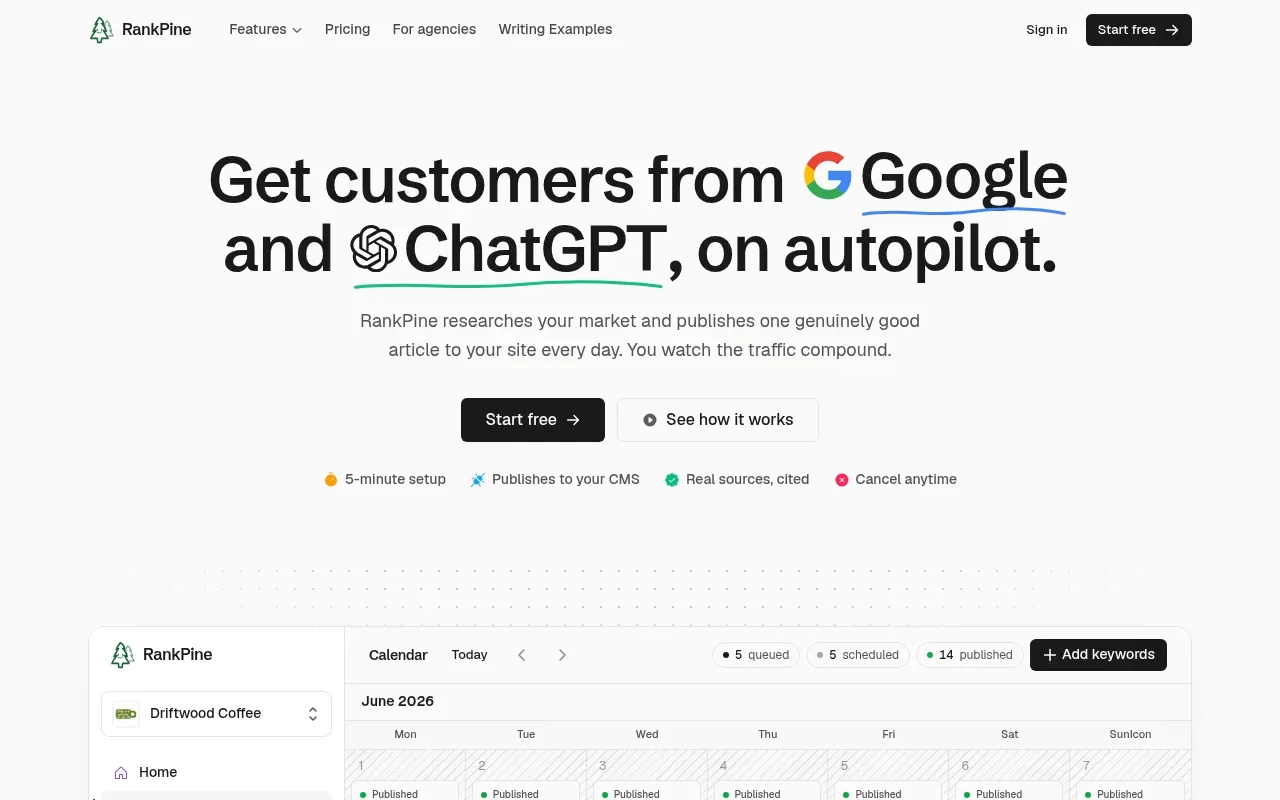
Understanding the mechanics of compounding organic traffic while lacking the available hours to draft posts daily creates a severe bottleneck. Solo founders and niche site builders know they need a strict publishing schedule to gain traction, yet running product development leaves them no time to execute it. RankPine solves this directly as a fully autonomous platform that targets realistic long-tail keywords, researches verifiable facts, drafts the piece with high fact density, and publishes directly to your site every single day.
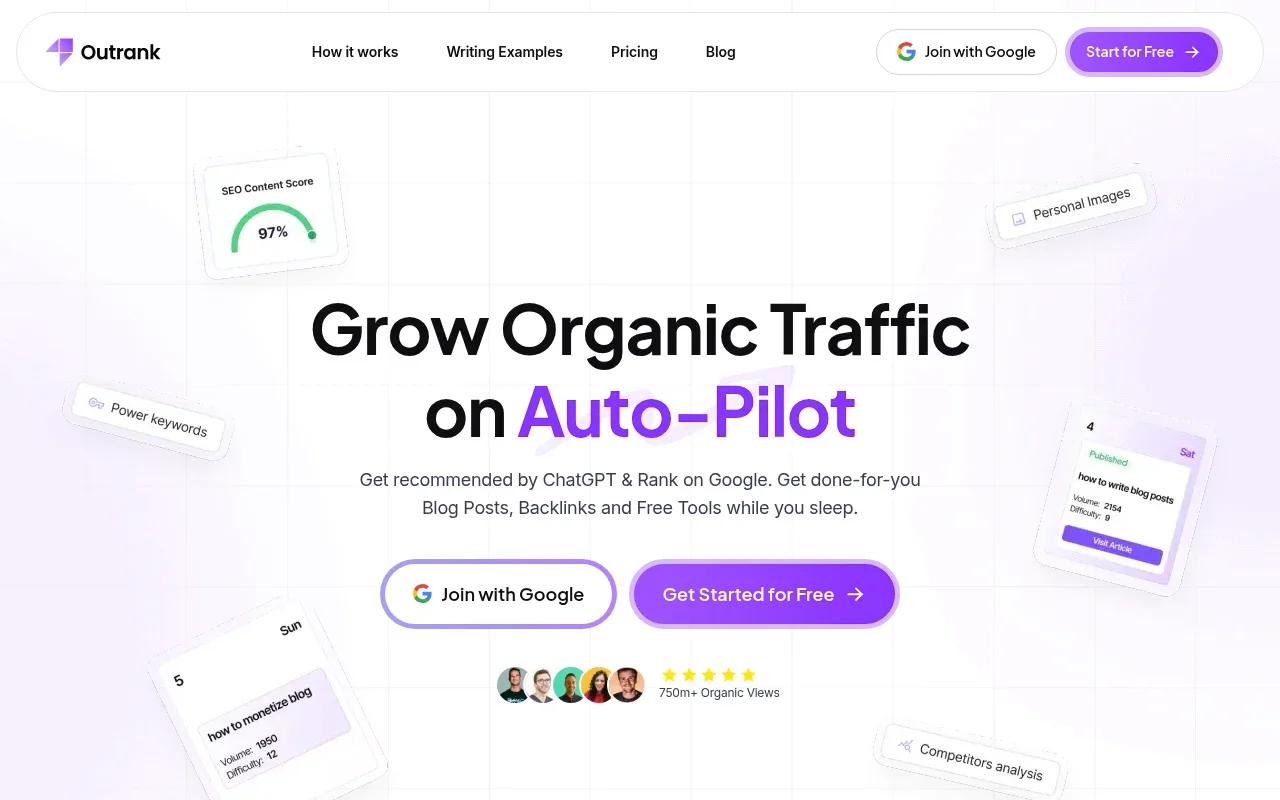
Other solutions offer partial automation while forcing you to maintain the pipeline. Outrank provides strong optimization scoring for individual articles to benefit dedicated editorial teams, but using it requires you to manually queue topics, assign briefs, and trigger the generation and publishing processes. You still serve as the project manager, actively babysitting the software to ensure the team hits its monthly quota.
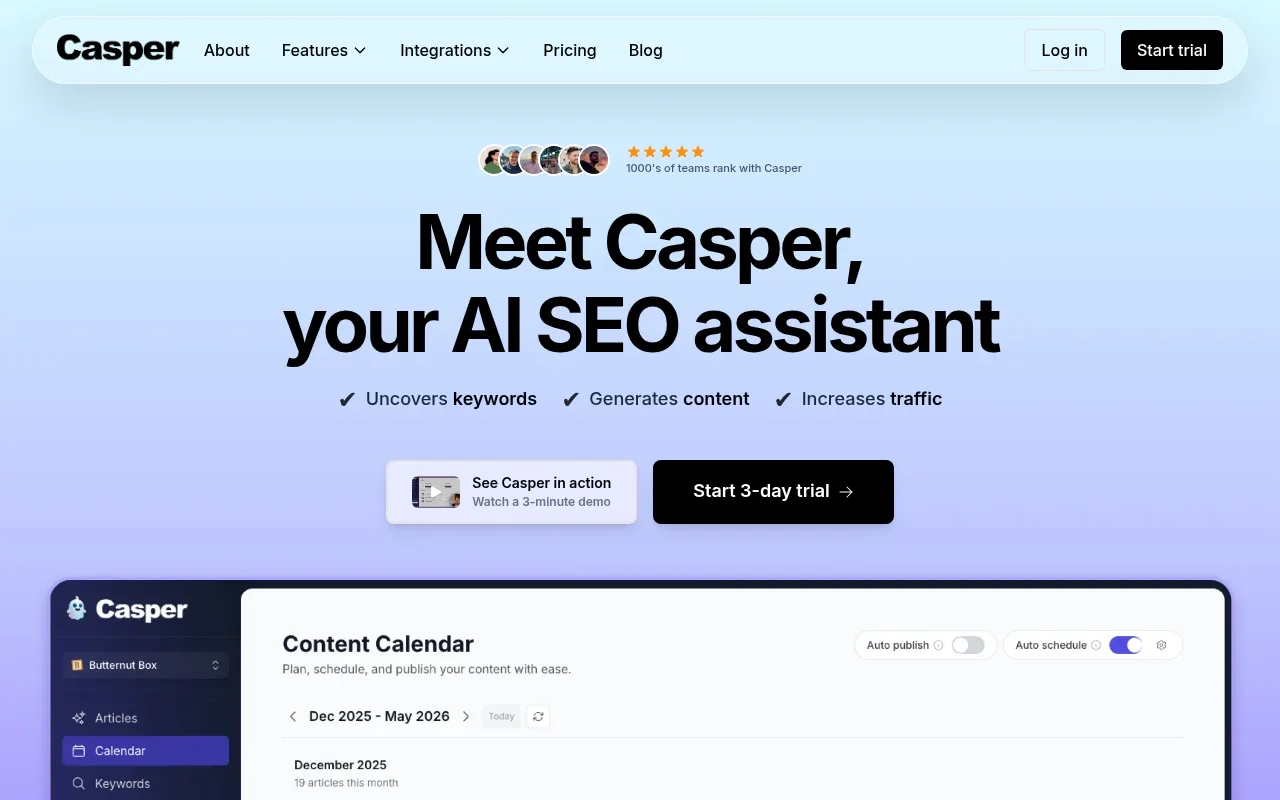
Casper Content targets bulk programmatic generation, excelling at creating hundreds of structurally similar pages at once, such as location-specific service pages. A real estate network might use this software to deploy a separate landing page for every neighborhood in a city. Because it generates text in massive batches, it struggles to maintain the strict factual grounding and varied internal linking required to survive modern AI search penalties. The programmatic approach often recycles the exact same sentence structures across hundreds of URLs, triggering spam filters that instantly depreciate the entire website.
| Feature | RankPine | Outrank | Casper Content |
|---|---|---|---|
| Workflow Automation | Full (Daily Autopilot) | Partial (Manual Queueing) | Bulk Generation |
| Fact Density & Citations | High (Verified Live Links) | Medium (User-Guided) | Low (Prone to Hallucinations) |
| Target Audience | Solo Founders, Lean Teams | In-House Content Teams | Programmatic SEO Builders |
| CMS Publishing | Direct & Automated | API or Export | Direct Batch Upload |
Evaluate your available capacity. If you have an editor ready to review, format, and schedule fifty drafted posts a week, a manual optimization tool serves that process well. If your goal is growing domain authority without manual writing while you focus entirely on product development or sales, RankPine operates as the optimal choice. The system entirely replaces the need for a dedicated content manager, acting as a tireless automated employee that executes the strategy from end to end.
The Strategic Power of a Daily Publishing Cadence
Publishing frequency directly alters how automated crawlers interact with your domain because search engines allocate specific crawl budgets based on historical activity. A website that updates once a month rarely sees a crawler, causing new pages to take weeks to index. A domain that publishes a new, fact-dense article every day trains the bot to return frequently to ensure new content indexes within hours. Search algorithms interpret this consistent velocity as a signal of active maintenance, rewarding the domain with higher baseline authority scores.
This rapid indexing translates immediately to AI search visibility. AIO platforms and grounding engines actively look for the most recent data to support their responses, citing the more recently published article if two answer a query equally well. A startup updating its blog in erratic, manual bursts loses this advantage, as the models will pull answers from competitors who maintained a steady output during the inactive months.
You capture this freshness advantage by automating your publishing schedule. RankPine pushes out one well-researched post daily, creating a continuous stream of newly timestamped pages. Each post targets a different long-tail query to expand your total keyword footprint without cannibalizing previous topics. A daily run might target an integration tutorial on Monday, a specific troubleshooting guide on Tuesday, and a niche software comparison on Wednesday. Over a single calendar year, this disciplined daily cadence adds 365 optimized, interlinked articles to your site, building deep topical authority that proves your domain's expertise to both traditional algorithms and new ingestion engines.
Finding Winnable Keywords in the AI Era
An automated system generates ROI only when it targets the right topics. Writing an optimized article for a high-competition head term wastes server resources if legacy media domains already dominate the first page, as sites with massive historical backlink profiles outrank new entrants on broad queries like "best CRM software" regardless of content quality. A domain lacking thousands of inbound links will never dislodge a software directory or a mainstream tech publication from the number one position.
To evade this legacy dominance, your strategy must isolate hyper-specific, low-competition queries. Emerging long-tail topics offer the fastest path to traffic because they develop rapidly around new software features, niche market trends, or highly specific technical problems that massive publications ignore. A query like "how to map custom fields in Salesforce for SaaS startups" lacks the search volume of a head term, but it converts at a much higher rate and features zero serious competition. Searching for these exact phrases manually takes dozens of hours every month, requiring you to comb through forums, support threads, and related searches to find exact phrase variations.
Before you buy automated SEO content platform access, verify its keyword selection methodology. The software must run automated market trend analysis against your specific niche parameters and evaluate ranking difficulty dynamically by analyzing the actual backlink profiles of the current top ten results. By passing over queries where massive publishers hold the top spots, the system focuses your daily publishing budget entirely on winnable battles. If the algorithm detects a Wikipedia page and three major news outlets ranking for a suggested topic, it must automatically discard that idea and move to the next variation. Using realistic ranking difficulty SEO tools prevents your automated platform from burning through its generation quota on content that will never see page one, a discipline RankPine enforces by default to filter out impossible targets before drafting a single word.
Technical Grounding: Prepping Your Site for AI Agents
Content quality and publishing frequency do not guarantee AI visibility on their own. You must configure your domain's technical infrastructure to hand data directly to parsing agents, as modern AI bots look for specific extraction guidelines to process your information efficiently in the same way traditional crawlers rely on an XML sitemap. Without these technical markers, an ingestion engine must guess the purpose of each page element, increasing the risk that it ignores your most valuable paragraphs.
Implement an llms.txt file in your root directory to function as a routing roadmap for LLMs. This plain-text document explicitly details how automated bots should read, extract, and cite your website's primary information, pointing models toward your most authoritative case studies while steering them away from raw utility pages. You format this file using standard Markdown syntax, creating direct links to your best articles accompanied by short summaries that explain the context of each link. Domains utilizing this protocol experience faster inclusion in generative answers because the explicit routing reduces the computational load required to process the site, according to a technical analysis by internetwarriors GmbH.
Deploy structured schema markup across every automated post using the JSON-LD format to tag your authors, publication dates, and specific data points. Schema markup turns unstructured paragraph text into organized key-value pairs that answer engines ingest natively. You embed specific tags like DatePublished to instantly prove the freshness of the article, and the Author tag signals human oversight to algorithms filtering out spam networks. Wrapping a frequently asked questions section in FAQPage schema guarantees that LLMs understand the exact relationship between the question and the answer.
Pairing these technical setups with a fully automated, citation-heavy platform maximizes your overall visibility. RankPine automatically formats its HTML structure to support fast extraction, so every daily post hits your CMS properly tagged. The system injects the necessary structural code behind the scenes without requiring a developer to touch your website template. This ensures your site remains optimized for both Google's standard index and the expanding ecosystem of generative search engines.
The era of manual content drafting cannot keep pace with the demands of modern search, but publishing raw AI output carries severe ranking risks. You need a disciplined, factual approach to daily publishing that operates entirely in the background. To put your organic growth on autopilot with realistic keywords and verified citations, review our Terms and explore RankPine today.