Best AI Content Tool for Niche Sites

Growing organic search traffic requires a reliable content schedule. When you rely solely on manual drafting, hitting a daily publication rhythm falls apart during busy weeks. Automating the process can support consistency, but the wrong system may flood your domain with repetitive, low-effort pages that offer little value to readers. Finding the best AI content tool for niche sites means balancing production volume with editorial control. To evaluate the software, you compare RankPine, Koala AI, Frase, and SEOWriting.ai by their approach to topic discovery, source checks, publishing cadence, CMS delivery, and thin-page safeguards.
The shortlist at a glance
Identifying the strongest tool requires looking past maximum article output to see how the software manages the entire workflow. You need to know if the system finds winnable topics independently or waits for you to supply keywords. Factual sourcing indicates whether the platform documents research citations you can verify. Cadence and CMS delivery show how closely the software mirrors a hands-off daily schedule directly into your site structure, while thin-page controls reflect the documented safeguards designed to prevent repetitive, low-value publication.
These scores represent editorial assessments of documented feature fit based on those criteria rather than independent tests of article quality, factual accuracy, or ranking performance. A high sourcing score means the platform documents a research or citation feature without verifying every generated claim is true. Higher thin-page-control scores indicate that more safeguards exist within the documented workflow instead of guaranteeing the final output answers every user query perfectly. If you are comparing AI SEO software to choose the right workflow, this scorecard highlights the primary strengths of each platform.
| Tool | Winnable topic discovery | Factual sourcing | Daily cadence | CMS delivery | Thin-page controls |
|---|---|---|---|---|---|
| RankPine | 5 | 5 | 5 | 5 | 3 |
| Koala AI | 4 | 4 | 5 | 5 | 4 |
| Frase | 3 | 3 | 3 | 5 | 4 |
| SEOWriting.ai | 2 | 3 | 3 | 4 | 2 |
RankPine fits a fixed, hands-off daily workflow closely. Koala AI provides an alternative if you schedule posts through a configurable content calendar. Frase supports workflows requiring deep research and editorial approval. SEOWriting.ai works well if you manage lower-cost drafting from manually supplied keyword lists.
RankPine: Best for a Fixed Daily Workflow
Consistent publishing requires a system that moves from topic ideation to a live page without constant prompting. We designed RankPine to automate that entire sequence on a set schedule. The RankPine plan details list a price of $99 per site per month or $990 per site per year, with 30 SEO articles per site each month, roughly one a day. This allowance supports a predictable rhythm. You set the initial parameters, then the software can handle the daily production sequence without a new prompt for every article.
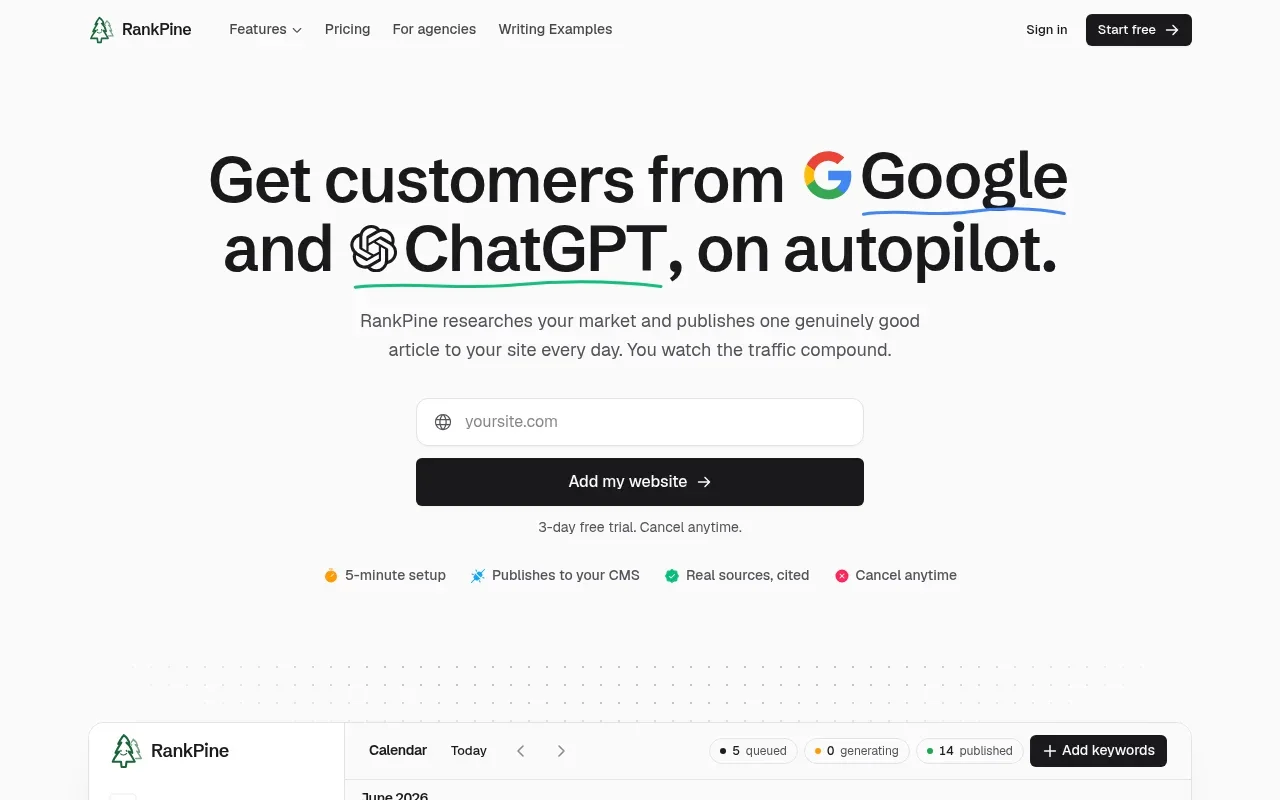
The platform scores highest for topic discovery because its documented features include keyword research, competitor gap analysis, and Google Search Console opportunities. Instead of uploading CSV files containing hundreds of queries, you can connect Search Console and use its data to review long-tail topics. The data can help you decide whether each query merits a dedicated page and fits your site's expertise. Finding SE Ranking alternatives for content teams often involves moving away from manual keyword trackers and toward platforms that turn those search gaps directly into scheduled drafts.
RankPine lists real, cited sources and an anti-slop editing pass for every draft. These citations let you inspect the material behind individual claims, which supports the high factual-sourcing score but does not guarantee every reference fits the sentence it accompanies. You still need to confirm that each source supports the specific point in the text and review the editing pass's output before publication.
RankPine's documented publishing integrations include WordPress, Shopify, Odoo Blog, Wix, Framer, GoHighLevel Blog, Ghost, Webflow, and Notion. For a custom site builder, a webhook can route content to your system. These options support the top CMS delivery score and fit the daily workflow described above.
The thin-page-controls score sits lower at a 3 out of 5. While the workflow features automate production, a daily schedule alone does not establish that each page adds original value. You configure the topic parameters to ensure the platform generates distinct answers for specific user intents. The system publishes the output, but the strategic direction remains your responsibility.
RankPine's AI visibility add-on costs $49 per site per month. It checks 25 prompts daily across ChatGPT, Gemini, and Google AI Mode, keeps 90 days of answer history, and monitors up to 10 competitors. The history gives you responses to review, but visibility tracking does not guarantee traffic or revenue. You can use these observations to adjust future content parameters.
Koala AI: Best for a Site-Aware Content Calendar
If you prefer a calendar-based system, Koala AI's Boost plan is an option. Its Boost plan details list a price of $99 per month or $79 per month when billed annually. The tier provides 250,000 words and 2,500 credits per month, plus one brand. Because KoalaWriter uses a word allowance rather than a fixed article count, the number of articles you can produce varies with article length and model choice.

The Content Calendar Autopilot is available on the Boost plan and higher tiers. Koala's Brand DNA feature overview explains that the agent schedules ideas that survive its site-coverage checks, then generates and publishes them to a connected CMS on the scheduled date. Its listed publishing integrations include WordPress, Shopify, Webflow, Ghost, and webhooks. This scheduled publishing gives you a hands-off option once the calendar is populated.
Brand DNA's agent checks your existing sitemap and current search rankings before proposing topics. Koala's feature description says the agent removes ideas the site already covers before scheduling the remaining plan. This check reduces topic overlap, though you should still review the calendar before publication. That same check gives Koala AI a high score for avoiding duplicate topics.
Deeper research features start with the Professional plan, so research capacity depends on the tier you choose. Keep the one-brand limit on Boost in mind if you operate multiple niche sites, as scaling Brand DNA across several domains requires upgrading to a multi-brand plan.
Frase: Best for Research and Editorial Approval
If you prioritize detailed structural audits and the option for human sign-off over automated daily volume, Frase can serve this editorial workflow. The current Frase Starter plan costs $49 monthly or $39 per month billed yearly. It includes 10 articles and 50 audit pages per month, limited to one seat and one site.
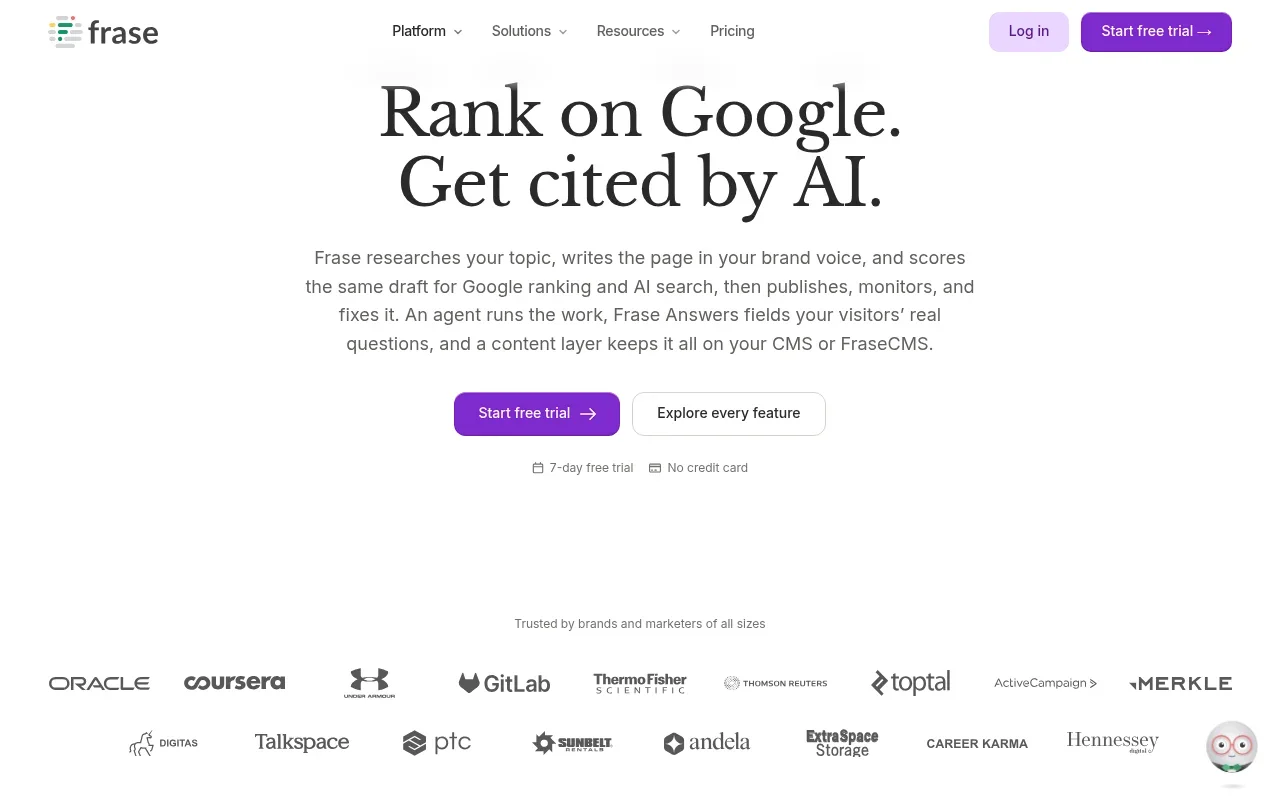
The platform focuses on competitor gaps and content opportunities. It generates detailed briefs and assigns an SEO/GEO score to the draft, comparing your text against the top-ranking search results. This process helps you identify missing subtopics and structural weaknesses before publication. Because the system relies on these comparisons, it scores moderately on topic discovery and sourcing. The software provides the data, but you must interpret the score and execute the revisions.
Human approval remains an option, but it is not required before every page goes live. Frase says its Starter agent can publish on its own when enabled. The plan comparison places a content calendar on Professional, not Starter, so Starter is less suited to managing a calendar-based publishing cadence. This keeps its cadence score lower while letting teams choose how much review to retain.
Frase publishes to WordPress, Webflow, Sanity, and Wix, or hosts content on FraseCMS. That setup suits a strategy that prioritizes site audits and SEO/GEO scoring over article volume. However, content scores and optional review steps do not prove that the final page contains original material, which keeps the thin-page-control score at a 4.

SEOWriting.ai: Best for Lower-Cost Keyword Drafting
When you handle topic research manually and need a tool for bulk drafting, SEOWriting.ai fits this keyword-driven production model. The Starter plan costs $19 per month or $14 per month billed yearly. It includes 50 credits and advertises up to 50 articles. Because credit use varies by model, the generation-credit table lists several models at one credit, GPT-6 Sol at four credits, and Opus 5.5 at ten credits per generation.
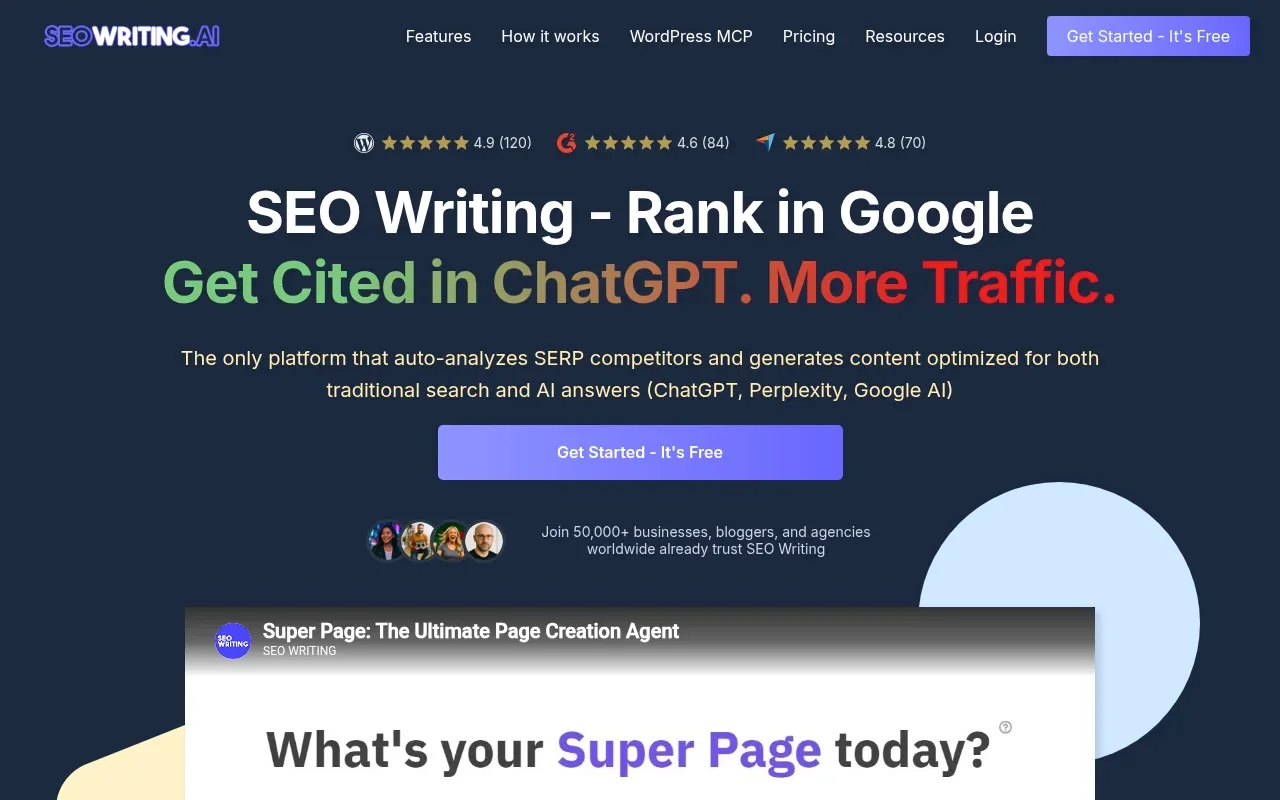
The workflow centers on bulk generation from a supplied list. You upload your target keywords, and the software processes the batch. Real-time SERP research informs the drafting phase, allowing the tool to structure the text based on current search results. Once the articles are ready, a WordPress integration handles the auto-posting. This batch-processing capability earns a solid score for CMS delivery, but the lack of an autonomous daily schedule lowers the cadence rating.
Operating this software requires you to manage the planning phase externally. Its Starter feature list centers on generation from supplied keywords rather than autonomous topic selection, so you need to supply distinct ideas, check search intent, and filter duplicates before running a batch. The published feature list covers bulk generation, real-time SERP research, and WordPress publishing, but does not describe a distinct-topic or originality gate that pauses generation when keywords overlap with existing content. This manual reliance results in lower scores for topic discovery and thin-page controls, placing the burden of quality assurance on you.
Keep Daily Publishing From Becoming Thin
Publishing every day can expand a site's coverage, but it does not guarantee more organic traffic unless the pages answer distinct search intents. Focusing only on speed risks accumulating repetitive posts that do little for readers. Google says it detects policy violations through automated systems and, when needed, human review. Its spam policies define scaled content abuse as generating many pages primarily to manipulate search rankings rather than help users. The policy lists AI-generated pages without added user value as one example.

Publishing cadence is a workflow choice, not a guarantee of better rankings. Google's scaled-content policy focuses on whether pages created at scale help users or primarily aim to manipulate rankings, not simply on the number of posts or whether AI was used. To keep your site useful, make sure each page contributes value beyond the existing search results. You can do this by answering a distinct question, providing clear analysis, and verifying claims before publication. If your software produces five articles on slight variations of the same query, review them for overlap and combine or differentiate them so each page answers a distinct reader need.
These foundational quality practices extend to Google AI Overviews and Google AI Mode. Google's AI-feature guidance says standard SEO best practices remain relevant and no additional requirements or special optimizations are needed. To be eligible as a supporting link in those features, a page must be indexed and eligible for a Search snippet, but inclusion is not guaranteed. Google also recommends crawlable pages, important information in text, internal links, and structured data that matches visible content, while noting that no special schema is required. Visibility in these spaces acts as a monitoring metric rather than a guaranteed return on investment.
Reviewing automated output helps catch inaccurate claims before publication. Google recommends manually fact-checking AI-generated content for accuracy and trustworthiness. When your software drafts a product roundup or an affiliate comparison, verify the claims against manufacturer specifications. Google's people-first guidance for product reviews says reviews can build trust by explaining which products were tested, what the results were, how testing was conducted, and what evidence supports the conclusions. If you did not test a product, avoid implying hands-on experience. Structure the article around verifiable data, documented features, and clearly described user feedback. Setting boundaries on what your AI content can claim helps align your work with Google's guidance while keeping production efficient.
Choose the Tool That Matches Your Workflow
Selecting the right automation software depends on how much of the planning and publishing sequence you want to delegate. Article volume metrics mean little if the system requires hours of daily configuration. You must match the platform to your available time and editorial capacity.
RankPine offers 30 articles per site each month, with keyword research, competitor gap analysis, and CMS publishing for teams seeking a near-daily workflow with less manual setup. Koala AI offers a configurable, site-aware calendar that checks existing site coverage before publishing, while using word and credit limits. Frase combines competitive research with optional editorial approval and publishing automation, although its Starter plan does not include a content calendar. SEOWriting.ai supports lower-cost batch drafting for teams that bring a thoroughly researched keyword list.
Run this checklist before committing your domain to a new tool:
- Does the software discover its own topics, or do you have to supply the keywords?
- Can you inspect the source material to verify factual claims?
- Are you able to pause the queue and review items as drafts instead of publishing them live?
- How does the system prevent generating articles on overlapping topics?
- Are the site limits, CMS integrations, and monthly credit allowances clearly defined?
Testing a small batch of articles reveals how the software handles intent overlap and source integration. Check the formatting and citations in your CMS before enabling live autopublishing. Building authority over time with a predictable schedule requires ensuring every page gives the reader the specific answer they searched for.
RankPine automates your entire SEO workflow by finding winnable keywords, researching cited content, and publishing a useful article directly to your CMS every day. Start building your organic traffic on autopilot at rankpine.com.