AI SEO Software: Choose the Right Workflow

When selecting AI SEO software, start by identifying your operational bottleneck rather than just looking for a ranking advantage. Content production involves distinct jobs, from researching topics and analyzing competitors to optimizing existing drafts. You might also need to automate the writing and CMS publication process, or track visibility across traditional and AI-driven search engines. Comparing products becomes much easier once you define whether you lack topic ideas, writing capacity, editing time, or performance data.
If your bottleneck spans from initial keyword research to final publication, RankPine serves as an end-to-end platform. The software analyzes market trends to find winnable long-tail keywords, identifies competitor content gaps, drafts articles using cited sources, and schedules one finished post directly to your CMS every day. This daily publishing cadence offers a disciplined approach to organic growth. An approval queue lets you hold posts for review, so RankPine can automate the daily publishing cycle without abandoning editorial oversight.
Using generative AI tools does not automatically violate Google’s spam policies, as Google’s guidance on generative AI content explains. The guidance says generative AI can help with research and add structure to original content, but using it to generate many pages without adding value for users may violate Google’s scaled content abuse policy. Because the guidance also emphasizes accuracy, quality, and relevance, a sustainable strategy should prioritize workflows that support originality and factual accuracy over raw page volume.

Match Research to Your Site’s Maturity
To assess site maturity, start with your existing useful content, available search data, and current operating needs. Because Google’s third-party SEO guidance says third-party tools lack access to its internal ranking data and make their own predictions, use domain authority and keyword difficulty scores as comparative planning inputs, then test them against your first-party data.
For Newer or Lower-Authority Sites
A newer site lacks historical search data, which makes topic selection the primary challenge. When evaluating software for a fresh domain, prioritize tools that explain their keyword difficulty estimates and show the competing pages directly in the dashboard. Understanding why the platform considers a specific topic winnable helps you make better strategy decisions.
Do not assume a low-authority domain cannot rank for anything, or that a low difficulty score guarantees placement. Validate the software’s recommendations by comparing them to the live search results. If the top-ranking pages all belong to massive publications or government entities, a low difficulty score in a third-party tool indicates a flaw in the software’s data model instead of a hidden opportunity. Review your Google Search Console impressions to identify the terms where your site already gains slight traction. Then point your AI SEO software toward related long-tail variations.
For Established Content Libraries
Sites with substantial content face a different bottleneck, which involves managing decay and preventing keyword cannibalization. Buying software solely to produce new pages often ignores the value trapped in outdated articles. An established library requires tools that can audit existing URLs, identify topic overlaps, and recommend structural refreshes.
Compare your first-party search data against the software’s gap analysis to find pages that have slowly lost impressions over the last two years. You might use dedicated optimization platforms to score these older drafts against current top-ranking competitors. If your pipeline already generates plenty of text, reading about Surfer SEO alternatives will help you find platforms built specifically for auditing and improving legacy content.
Set Budget Around Accepted Output
Compare the complete cost of the publishing workflow rather than stopping at the advertised subscription price. Software vendors routinely display the monthly equivalent of an annual contract in large print, though the month-to-month billing rate runs much higher. Review exactly what the plan limits cover, such as articles, generated documents, content audits, tracked search prompts, connected sites, or user seats.
A theoretical draft allowance does not equal a volume of publish-ready posts. Base your budget calculations on the number of useful pieces you can confidently research, edit, and publish.
Calculate your cost per article by dividing the total monthly expense by the number of articles you accept and publish. The total expense includes the subscription, necessary add-ons, and human labor. If a $99 monthly plan promises unlimited drafts, but an editor spends 45 minutes fixing formatting and verifying claims on every post, the labor cost dwarfs the software subscription. Running a brief trial helps you estimate how much editing time the platform’s output requires, allowing you to apply that labor cost to your budget projection.
Match Publishing Features to Real Capacity
A high output limit provides value only when your business can support the underlying content plan. Evaluate whether the platform delivers raw text files, formatted drafts, or fully integrated CMS posts. Verify its scheduling capabilities, its handling of required CMS fields like categories and meta descriptions, and the notification system it uses if a publishing event fails.
A daily publishing cadence offers a steady way to compound traffic over time, rather than a shortcut to manipulate search rankings. Google’s 2026 AI-search guidance states that page volume alone does not make a site more relevant, and generating variations of every possible query risks triggering spam filters. Any publishing schedule requires a legitimate, distinct topic pipeline.
RankPine approaches this by capping output at 30 articles per site per month and distributing them as one daily post. This structured limit removes the coordination work of manual uploading. When you decide to buy hands-free blogging software, direct CMS integration combined with a manageable volume limit ensures you can maintain quality standards without getting overwhelmed by a backlog of unedited drafts.
Verify Sources and Set a Review Gate
Software that hallucinates facts transfers the burden of verification back to you. A long bibliography at the end of a document does not prove that the specific statistics within the text are accurate. A useful source workflow provides distinct links positioned immediately next to the claims they support. Checking these references protects your site's credibility.
Check Claim-Level Evidence
Examine how the platform attributes factual statements. Citations make verification easier, but they do not guarantee the underlying source is accurate or relevant. Reviewing a draft requires clicking through to the original source, checking the publication date, and reading the surrounding context.
If the software pulls a statistic from a decade-old blog post or misinterprets a recent study, the citation itself becomes a liability. Your editorial process relies on traceability. Effective AI SEO software formats its output so a human reader can quickly differentiate between original analysis and borrowed data.
Match Review to Risk and Capacity
Editorial control requires a practical review gate. Test whether the software allows administrators to hold posts in a draft state prior to publication. Reviewers need the ability to revise factual claims, adjust the brand voice, insert internal links, and fix formatting errors before the content reaches the public.
Match this review process to your industry’s regulatory risk and your available hours. A practical approach is to reserve detailed human review for automated financial or medical guidance, while routing routine product descriptions through a faster approval queue. To keep the publishing workflow aligned with search policy, Google’s spam policies define scaled content abuse as generating many pages primarily to manipulate search rankings without helping users, often through large amounts of unoriginal content with little or no value. That makes it useful to scale the review gate with publishing volume and check pages for originality and user value.

Measure Search and AI Visibility Separately
Rankings, organic clicks, search impressions, tracked prompts, and AI citations describe different aspects of your visibility. Confusing a citation in a chatbot summary with a traditional search ranking leads to flawed marketing reports and misallocated budgets.
Use first-party data to track performance, starting with Google Search Console’s Generative AI performance report. As of August 31, 2026, Google had rolled out the report to all websites worldwide, and it shows impressions for AI Overviews and AI Mode by page, date, country, and device. Google says sites that have not received enough impressions in Search generative AI features usually will not see the report.
When evaluating third-party tracking tools, verify which specific search surfaces, prompts, and refresh frequencies their paid plans cover. You do not need to add specialized code to appear in these features. Google’s July 10, 2026 Guide to Optimizing for Generative AI Features confirms that its AI search relies on core ranking systems. Google’s AI search prioritizes clear technical accessibility and distinct, helpful content. For Google Search, separate llms.txt files, specialized markup, and artificial text chunking aren’t necessary. You can use paid trackers to monitor your visibility, but building strong foundational SEO outperforms chasing undocumented chatbot optimization hacks.
Compare Plans by Workflow
Use the comparison table below to align your operational bottleneck with the appropriate software category. These selections represent distinct workflows rather than a universal ranking of quality. Published plan details and pricing reflect data gathered on October 28, 2026. Annual-plan monthly equivalents require a full-year commitment upfront, so review the checkout terms carefully before buying.
| Product Workflow | Published Plan Snapshot | Best-Fit Question |
|---|---|---|
| RankPine: Full-cycle daily content | $99/site/month (or $990/year). 30 articles per month. | Is the main bottleneck researching, writing, and publishing on a consistent schedule? |
| Frase: Lower-volume workflow | Starter: $39/month billed yearly. 10 articles per month. | Does a lower monthly article volume solve the problem without paying for daily output? |
| Surfer: Optimization & AI visibility | Discovery: $49/month billed yearly. 120 documents, 10 tracked pages. | Do you already produce content and mainly need optimization guidance? |
| Semrush: Broader SEO & visibility | Starter: $165.17/month billed yearly. 500 tracked keywords, 50 AI prompts. | Does the team require broad competitive research rather than a direct publishing tool? |
RankPine: Full-Cycle Daily Content Workflow
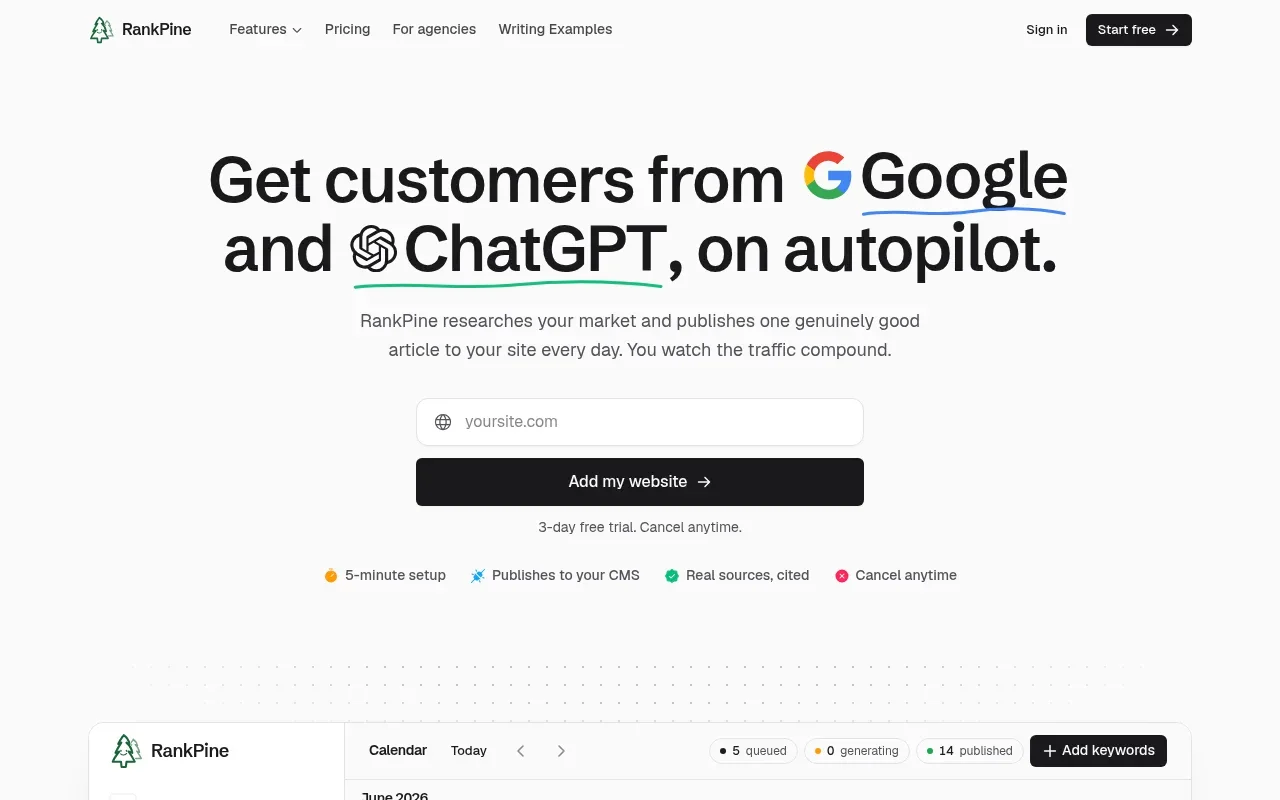
RankPine supports businesses that need to automate the entire progression from keyword discovery to live publication. Its standard plan costs $99 per site per month, or $990 per site per year, and includes a three-day trial. The software caps output at 30 articles per site per month to enforce a sustainable daily publishing habit. Features include automated keyword research, competitor-gap analysis, claim-level cited sources, and direct integrations with major CMS platforms. An editorial approval option lets you hold articles in a queue, ensuring that full automation maintains quality control. Choose this platform when managing the logistics of daily content creation forms your primary constraint.
Frase: Lower-Volume Content Workflow
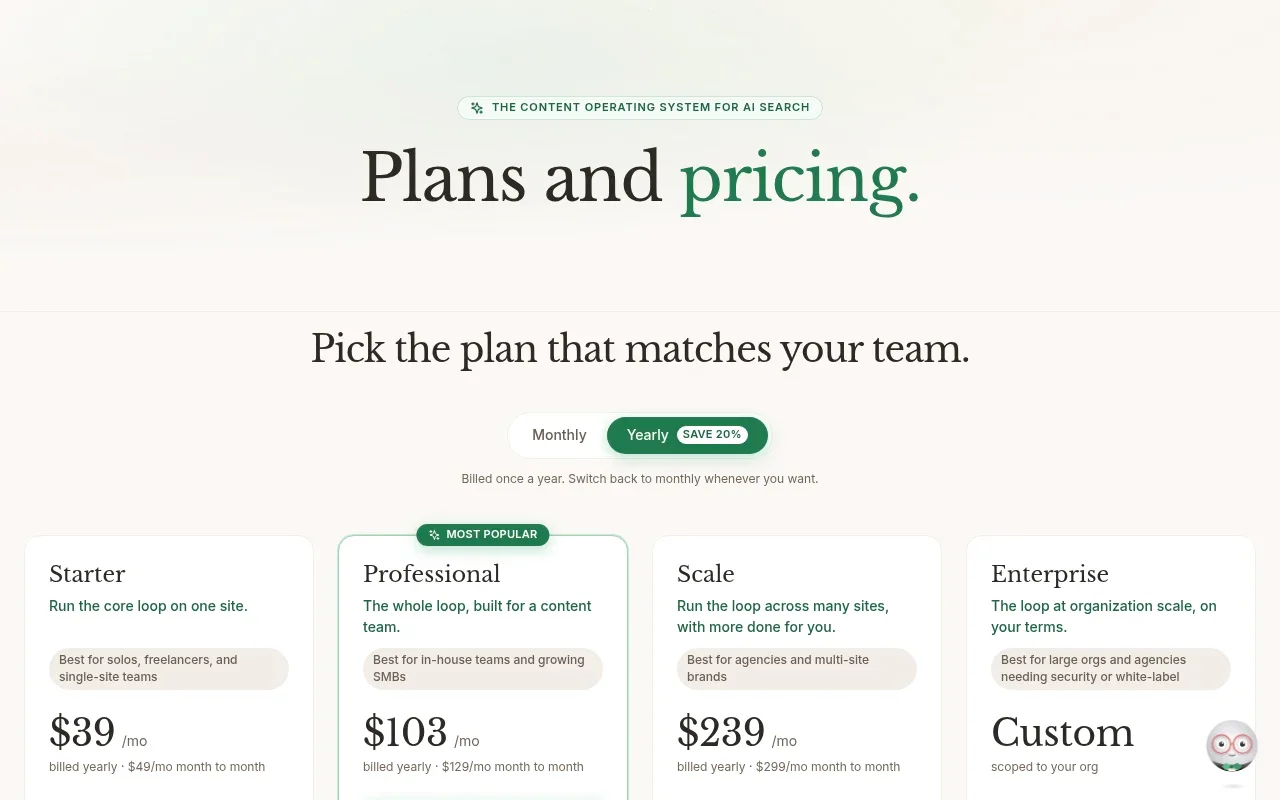
Frase operates well for businesses that want assistance structuring and drafting a smaller number of detailed pieces. The Starter plan runs $39 per month when billed annually, or $49 month-to-month, providing one user seat and one connected site. This tier allows for 10 articles monthly. The platform includes a content agent capable of handling CMS publishing when enabled. If your strategy relies on publishing one or two highly technical pieces a week instead of maintaining a daily schedule, a lower-volume plan fits the requirement without wasting unused capacity.
Surfer: Content Optimization and AI Visibility

Surfer focuses on scoring and improving existing text, prioritizing optimization over autonomous publishing. The Discovery plan costs $49 monthly on an annual billing cycle, giving users 120 document checks and 10 tracked pages. The Standard tier increases to $99 monthly when billed yearly, offering 360 documents and 25 weekly AI prompt tracking limits. These document allowances represent auditing and scoring sessions. Such metrics differ entirely from a published article quota. A mature site with hundreds of underperforming pages benefits heavily from this optimization workflow.
Semrush: Broader SEO and AI-Visibility Suite
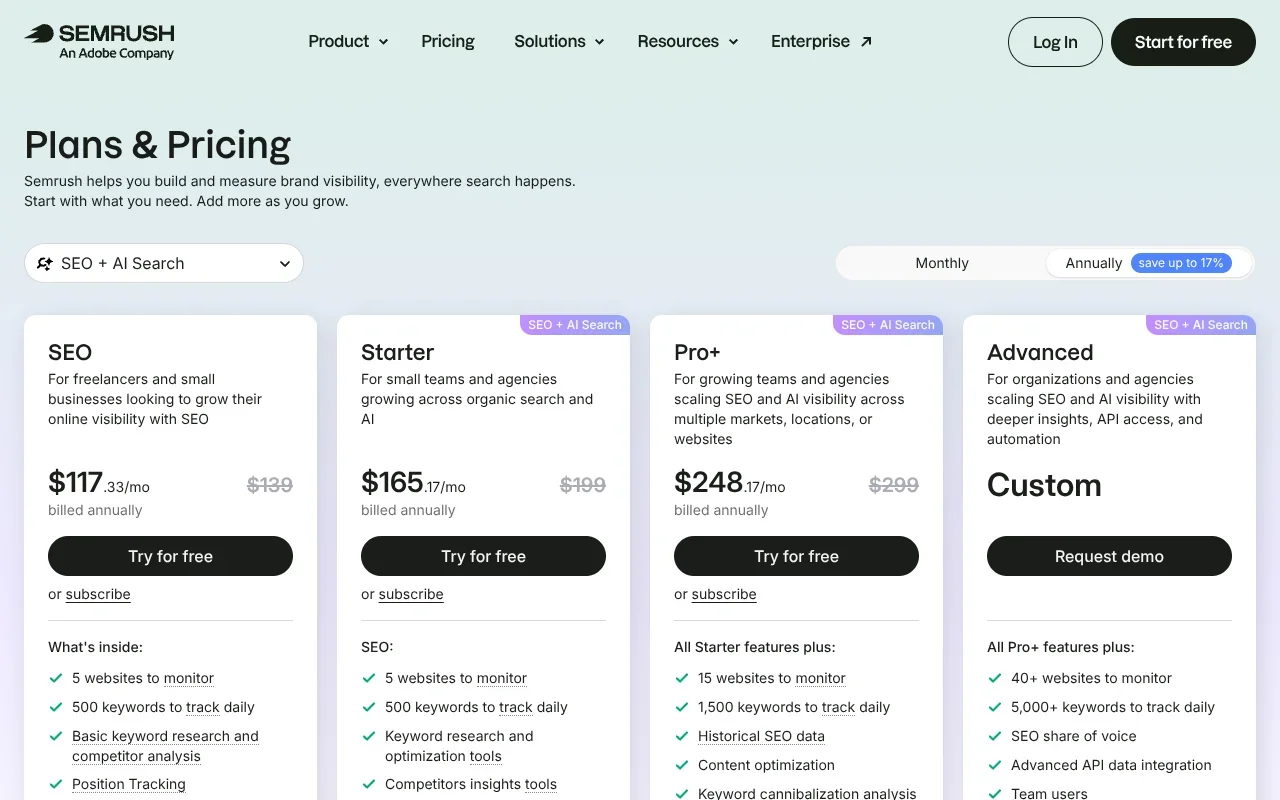
Semrush provides broad market research and visibility monitoring for established businesses. The SEO and AI Search Starter plan lists at $165.17 per month on an annual contract. It tracks 500 keywords daily, monitors 50 AI prompts daily, and measures AI brand performance across one domain. This suite serves organizations that already employ writers and editors but lack the data to measure their market share across traditional and generative search engines. If you seek visibility measurement instead of automated text generation, reviewing SE Ranking alternatives offers further context on comprehensive tracking platforms.
Test the Tool on a Real Assignment
Turn these buying criteria into a practical software trial. Select a topic your business plans to cover this quarter and run it through your chosen AI SEO software.
Ask the platform to explain why it selected that specific keyword for your domain. Inspect the competing pages it highlights to check if they represent realistic targets. Once the tool generates a draft, select three factual claims and trace them back to their original sources. Check that the citations exist, that the dates are recent enough to remain relevant, and that the linked text supports the claim made in the draft.
Test the full CMS workflow next. Route the article into an approval queue, check the formatting, and schedule it for publication. Force a failure by briefly disconnecting your CMS to see how the software alerts you. Record how many minutes an editor spends revising the draft to match your brand standards. Then apply that labor time to the budget formula discussed earlier.
Your final decision rests on identifying the specific constraint. Choose an end-to-end workflow platform when researching, writing, and formatting daily CMS posts consumes too much of your week. Favor a dedicated optimization or visibility tracking tool when you already produce strong content and only need to measure its reach.
Stop managing a chaotic drafting schedule and start building consistent organic traffic. RankPine handles keyword research, drafts cited articles, and publishes directly to your CMS every day. Start your free trial today and put your SEO growth on autopilot.