Surfer SEO Alternatives for Automated Publishing

Building organic search traffic requires sustained publication, but managing the process manually consumes hours every week. Lean marketing teams often begin by passing manually written drafts through a scoring tool to check keyword density and related term coverage. Eventually, that hands-on requirement becomes a bottleneck that restricts site growth, so finding the right Surfer SEO alternatives means deciding how much of that pipeline should run on autopilot.
Transitioning from an editor-assisted workflow to a fully automated pipeline changes how a company operates. Instead of staring at a blank screen and a scoring dial, you can rely on a software platform to handle the research, drafting, and publication schedule. Tools like RankPine fit teams seeking researched, recurring CMS publication on a daily schedule. Other platforms maintain a human element, keeping a person in the publishing loop or leaning on an agent-led workflow for broader site maintenance. Evaluating these options requires looking past the content editor screen to understand how the software interacts with your site architecture and your working hours.
Defining What a Publishing Alternative Automates
A reliable content operation involves multiple distinct steps, and software providers define automation differently. Before selecting a replacement for a manual editing tool, map out who performs each task in the new workflow. The most demanding phase is topic selection. Some platforms require a user to supply a specific seed keyword before generating anything. Others scan your domain, ingest Google Search Console data, and review competitor gaps to identify realistic long-tail targets without human intervention.
Evidence generation presents another major difference among automated platforms. A drafted article needs factual support to earn reader trust and perform well in search, making citation handling a priority during the evaluation phase. The software might invent plausible-sounding statistics, or it might retrieve external URLs and attach them to specific claims in the text. Knowing whether those sources require manual verification dictates how much time you must dedicate to editing.
Publishing controls determine the operational cadence. When a vendor advertises a publishing integration, that term covers several distinct mechanisms. Exporting a document from an editor directly into a WordPress draft still leaves formatting, internal linking, and final approval to a human. Alternatively, a webhook or native API connection might push a live, formatted post directly to the site every morning. A disciplined system gives you the ability to pause that queue, review upcoming articles, and verify source claims before anything reaches the public.
Distinguish between tools that offer AI-search content guidance and those that measure visibility. Designing a post to surface in large language models requires structuring facts and answering direct questions clearly. Monitoring how those platforms respond to user prompts requires separate tracking infrastructure. An operational cadence focused on consistent delivery helps a team publish regularly, but daily posting itself remains a workflow choice.
Surfer SEO: Search-Informed Editing With a WordPress Handoff

Using Surfer as a baseline clarifies the difference between a scoring application and an automated publishing pipeline. The platform centers on its Content Editor, which provides SERP-informed guidance and real-time scoring to help structure an article. Surfer AI can generate a complete draft based on those target metrics, providing a starting point for content teams.
That generated draft belongs within an editor-led workflow, but Surfer’s pricing page lists WordPress among its integrations without describing how the connection handles publication.
Pricing structures reflect this document-focused approach. Surfer’s Standard plan is listed at €99 per month billed yearly, with 360 documents and 25 AI prompts refreshed weekly. The page gives a document count but does not specify the period over which that count applies.
The platform suits teams that already employ writers or editors and primarily need search-informed recommendations. The workflow relies on human oversight to guide the drafting process and handle the final export. Moving away from this system makes sense when a business needs to remove that human bottleneck.
RankPine: Closest Fit for Daily Research and Publishing
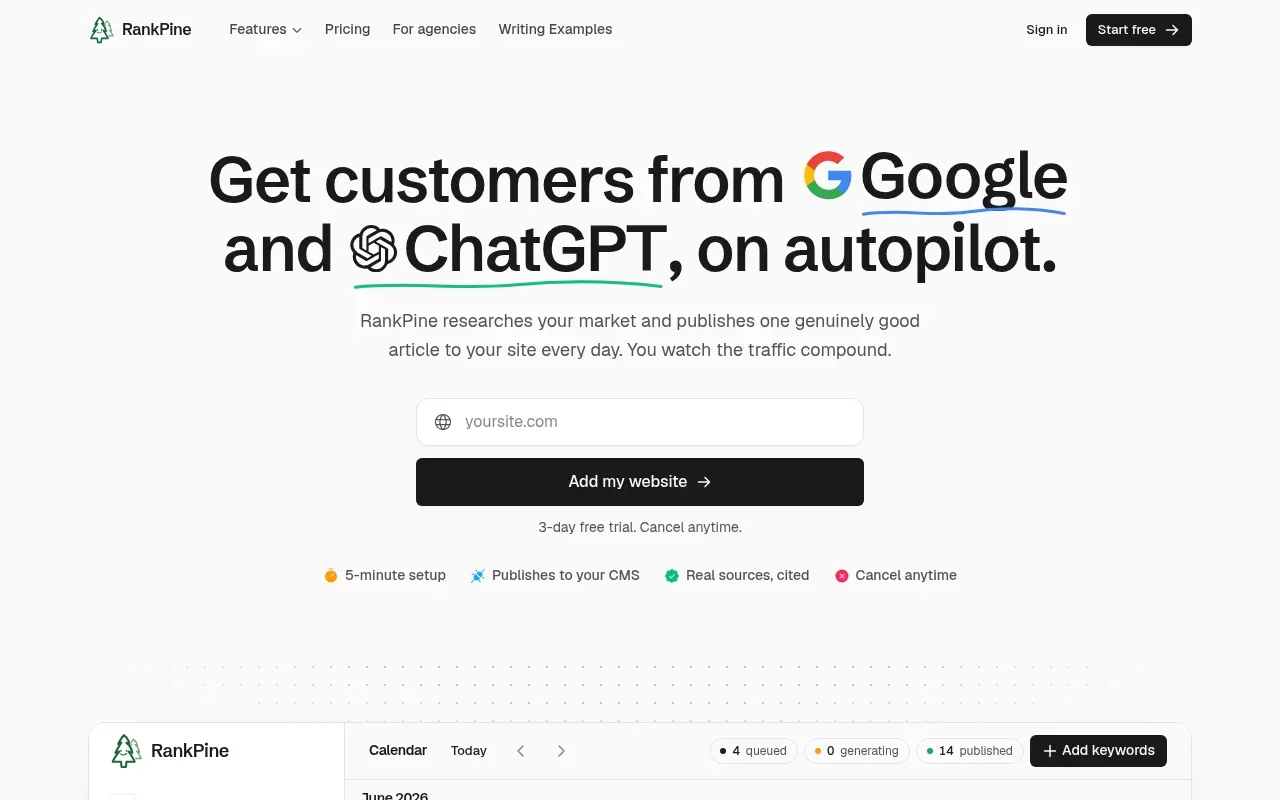
For founders seeking a hands-off operation, RankPine offers a clear departure from the manual editing model. Its workflow combines keyword research, competitor-gap analysis, article drafting, and CMS publishing.
RankPine’s plan costs $99 per site per month and includes 30 SEO articles per month, which supports a cadence of roughly one post a day. The plan also includes Google Search Console keyword opportunities, cited sources, and internal links between posts. Because rendering varies by platform, test how the text, headings, and links appear on your CMS before enabling a daily schedule, and decide how your team will review new articles.
Integration support determines whether an automated system saves time. RankPine lists connections for WordPress, Shopify, Odoo Blog, Wix Blog, Framer, GoHighLevel Blog, Ghost, Webflow, Notion, and custom builders through webhooks.
Tracking performance across modern chat interfaces requires specialized tools. RankPine offers an optional AI-visibility add-on for $49 per site each month, which checks 25 prompts daily across ChatGPT, Gemini, and Google AI Mode and keeps 90 days of answer history. Readers who require measurement for Claude or Perplexity should verify coverage directly, since the listed tracker covers three platforms. Together, the publishing workflow and tracker pair traditional SEO publishing with visibility measurement across the listed AI platforms.
Frase: Agent-Led Production With Broader Scope
Frase approaches content automation through an agent-led workflow, expanding the software’s role beyond drafting. The system includes features for topic research, content generation, SERP optimization, and ongoing site maintenance. Its agent can auto-publish content when enabled, giving teams an option to publish automatically within their plan’s monthly article limit.
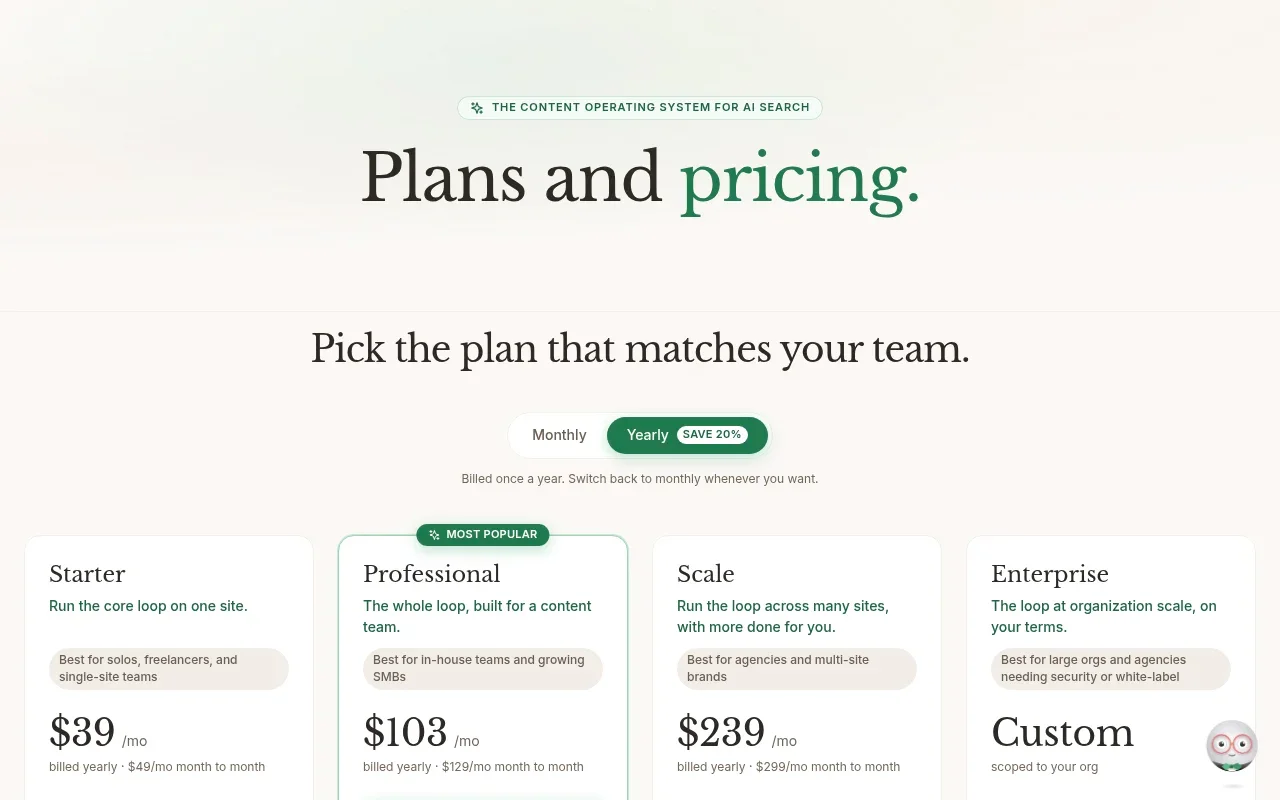
The Professional plan is listed at $103 per month billed yearly or $129 month to month, with 40 articles, three user seats, and up to five sites. While auto-publishing is available across all plans, the 40-article allowance is monthly. The platform also supports publishing to WordPress, Webflow, Sanity, Wix, and FraseCMS.
Because the feature set covers SEO scoring, GEO scoring, and broader multi-site support, the tool fits agencies or teams managing several properties simultaneously. A business running a single core domain might find the multi-site capacity unnecessary for its specific goals. If explicit source citations are central to your editorial process, test a sample draft before enabling publishing automation.
Semrush Content Toolkit: Publishing With Editorial Control
Semrush Content Toolkit provides a structured drafting environment. It generates topic ideas, builds SEO briefs, and optimizes content, with up to 50 brand voices listed in the Content Toolkit feature and limits guide.
Semrush describes the WordPress connection as one-click publishing to up to 100 connected sites, but the page does not state whether unattended scheduling is available.
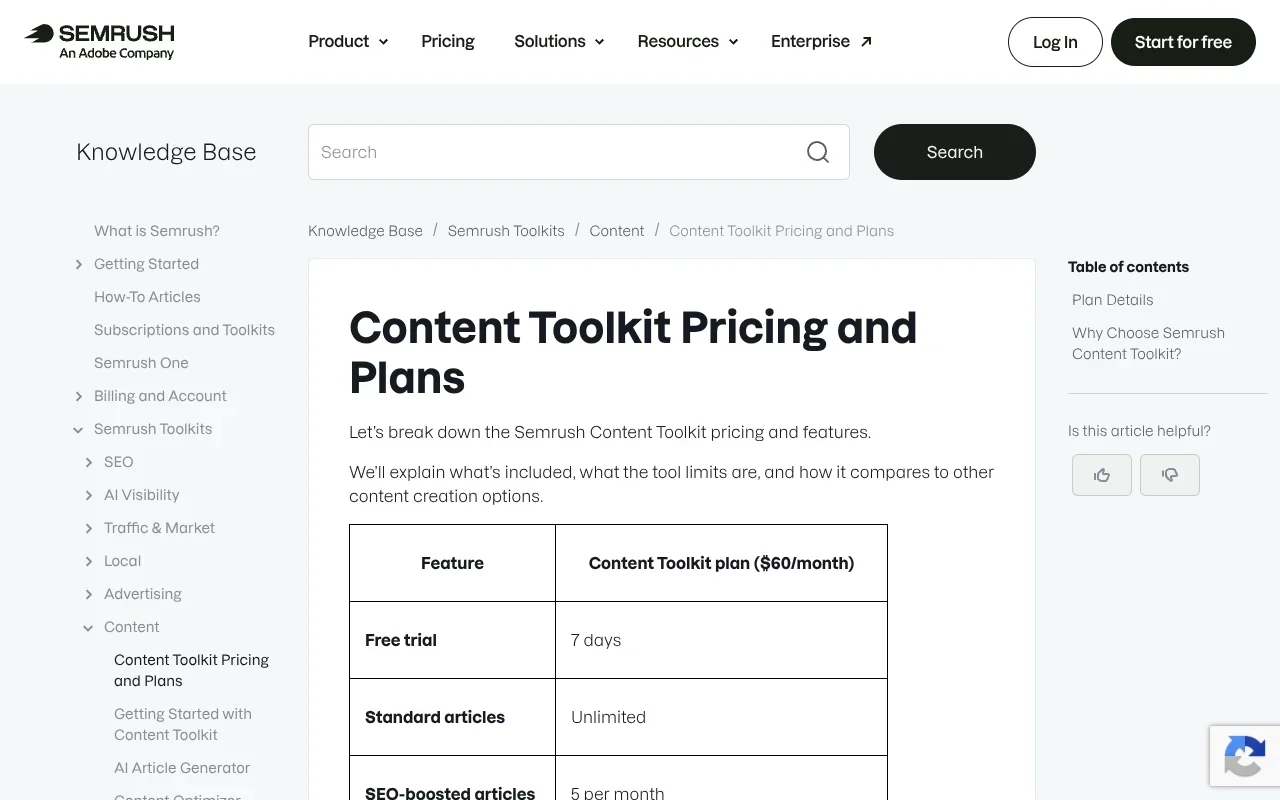
Semrush’s base package includes five SEO content boosts per month. The plan limits guide also lists the Content Toolkit at $60 per month and each additional 10 SEO Boosts at $30 per month. At those listed rates, three 10-boost increments would bring the monthly total to 35 boosts for $150.
This configuration suits marketing departments already invested in Semrush analytics who want to maintain a human review step. It offers advanced drafting assistance while keeping each publishing action under human control.
Compare 30-Article Costs and Choose by Workflow
Evaluating software by vendor-listed prices obscures operational costs. Site counts, available user seats, article definitions, AI-visibility tracking, and the required amount of human intervention vary across platforms. The comparison below illustrates what a 30-article monthly workflow looks like based on pricing structures checked on October 21, 2026.
| Platform | Listed Price (30+ Articles) | Billing Requirement | Site Support | Publication Mode |
|---|---|---|---|---|
| RankPine | $99 / month | Monthly available | 1 website | Daily CMS publishing |
| Frase (Professional) | $103 / month | Billed annually | Up to 5 sites | Agent-led auto-publishing |
| Semrush Content Toolkit | $150 / month equivalent | Base billed annually, add-ons monthly | Up to 100 WordPress sites | Human-initiated one-click publishing |
| Surfer SEO (Standard) | $99 / month | Billed annually | N/A (360 documents) | Editor-led WordPress handoff |
Your choice depends on the bottleneck you need to remove from your current operation.
Choose RankPine if you manage a lean, single-site operation and want to step away from the drafting screen. The platform handles topic research, adds cited sources, and can publish a post to your CMS on a daily cadence. For a founder, the operational benefit is a predictable schedule that does not require coordinating each draft.
Choose Frase if you oversee multiple domains and prefer an agent-led system that manages broader site maintenance. Its larger article allowance and multi-site support can fit agencies better than a single-domain team.
Choose Semrush Content Toolkit if your team already relies on Semrush data and wants a person to initiate each WordPress transfer. The workflow provides deep topic briefs while keeping the publish action in human hands.
Choose Surfer SEO if you employ a team of writers who need precise, search-informed editing recommendations. The tool excels at scoring human-written drafts against competitor metrics, provided you have the staff to execute the writing and manage the WordPress handoff.
Verifying Workflow Controls Before Automating

Deploying an automated content system introduces new variables to your website architecture. Before committing to a long-term plan or turning on a daily autopilot setting, pilot the workflow using a controlled set of topics.
Start with keyword selection: see whether the tool avoids topics you have already covered. A reliable platform scans your existing sitemap and Google Search Console data to find genuine gaps rather than repeating established themes.
Source quality deserves its own test. Generate a technical article in your niche, then follow the provided external links to see whether they support the claims in adjacent sentences. A tool that hallucinates references creates a liability that outweighs the time saved during drafting.
Then test CMS formatting by pushing a single article to a hidden category or saving it as a draft on your live site. Check how headers render, whether list elements break your CSS styling, and whether internal links open correctly. Learn how to pause the publication queue so you can hold an article for review and maintain control over what your brand publishes.
Stop managing freelance writers and manually formatting WordPress drafts. RankPine researches winnable keywords, writes source-backed articles, and publishes directly to your CMS on a disciplined daily schedule. Start building a consistent publishing cadence at RankPine.