Best AirOps Alternatives for SEO Content

Choosing content automation software often reveals a disconnect between what tools do and what you need to accomplish. You might set out looking for a way to maintain a consistent publishing schedule, only to find yourself comparing node-based workflow editors, enterprise analytics suites, and AI writing assistants.
Before you evaluate specific software, define the operational burden you want to eliminate. Your choice depends on whether your team wants to design a custom production system, monitor visibility across chat interfaces, score drafts for traditional search, or outsource the daily execution of your editorial calendar.
What AirOps Does, and What You Are Replacing
AirOps operates as a configurable content-operations platform. You can use its Workflow Studio to map out repeatable processes that incorporate AI Copilot agents, Brand Kits, and external knowledge sources. This architecture lets companies build multi-step pipelines for blog posts, programmatic SEO pages, technical documentation, and product detail pages.
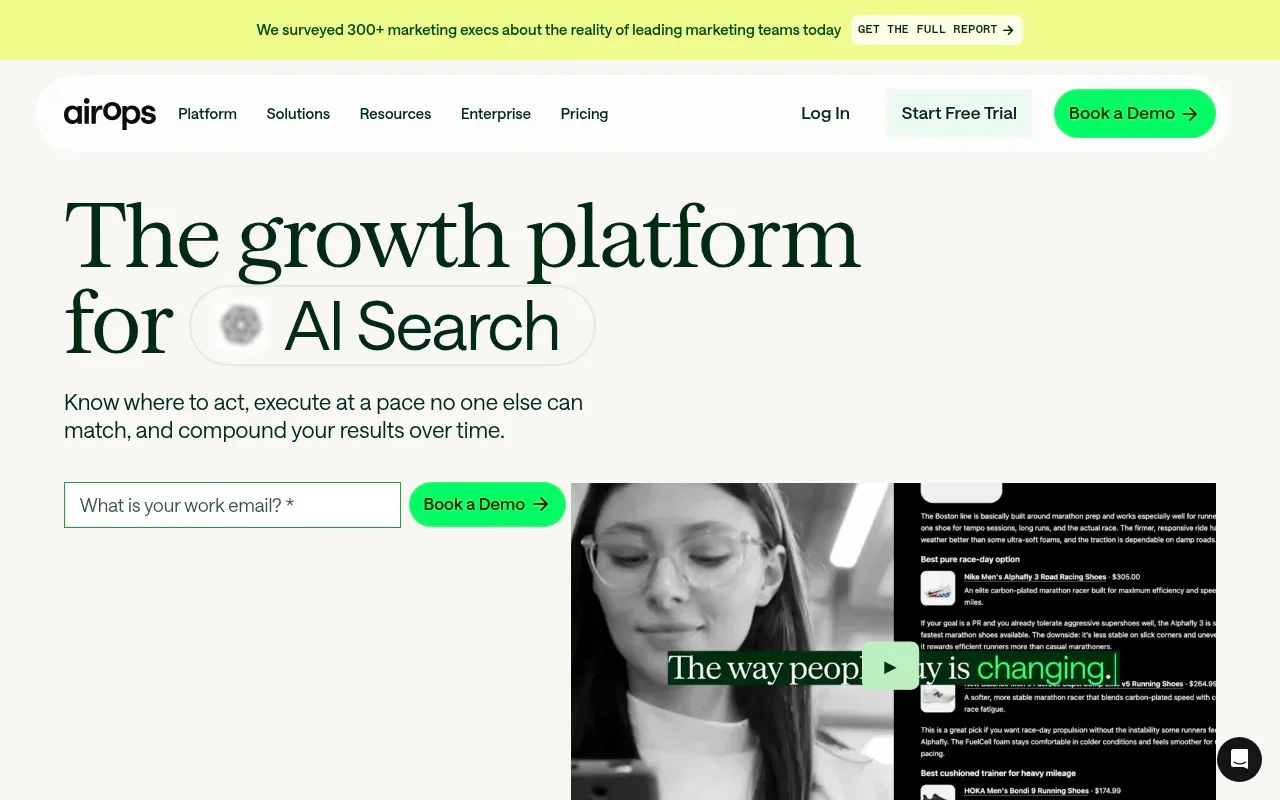
Because AirOps platform documentation describes workflow automation, data enrichment, and built-in human review checkpoints, AirOps lets teams capture research, creation, optimization, and refresh strategies in workflows. Teams can refine content through review before publishing.
Measuring performance is another core function. A team managing generative engine optimization can use the official AirOps Analytics dashboard to track metrics like mention rate, share of voice, average position, and citation rates across ChatGPT, Gemini, Perplexity, Google AI Mode, and Google AI Overviews.
The financial commitment scales alongside your production volume. The AirOps pricing structure begins with a free Insights tier before moving into plans governed by task quotas and tracked-prompt allowances.
Replacing this system means deciding which specific capabilities you rely on. An ideal alternative might replicate the workflow orchestration, focus on AI-search measurement, handle SEO optimization, govern brand voice, or bypass the workflow to deliver a finished publishing loop. Solo founders and lean teams looking for a predefined daily system will find a lower-overhead path in RankPine.
Quick comparison snapshot
Compare these platforms based on the specific job they handle best, since capabilities and setup requirements vary widely.
| Tool | Best job | Research and keyword planning | Content generation | AI-search visibility | Direct CMS publishing | Review or autopilot controls | Pricing basis | Setup burden |
|---|---|---|---|---|---|---|---|---|
| AirOps | Configurable content workflows | Documented planning and opportunities | Supported via workflow steps | Documented tracking for multiple engines | Yes (via Grids and integrations) | Human review checkpoints | Task and tracked-page limits | High (requires workflow design) |
| RankPine | Hands-off daily SEO publishing | Built-in keyword and competitor analysis | Fully automated loop | Positioned for Google and AI engines | Yes | Explicit autopilot or review modes | Fixed per-site monthly subscription | Low |
| Writesonic | AI-search execution | Not documented | Supported | Competitor gap tracking | Not documented | Not documented | Usage-based | Medium |
| Jasper | Brand-voice production | Not documented | Supported across formats | Not documented | Not documented | Not documented | Seat and usage limits | Medium |
| Surfer | SEO optimization | Built-in keyword research | Add-on generation | Not documented | Not documented | Not documented | Fixed monthly plus add-ons | Low |
| Frase | Search-informed briefs | Built-in content planning | Add-on generation | Not documented | Not documented | Not documented | Fixed monthly | Low |

1. RankPine, Best for Hands-Off Daily SEO Publishing
Many content strategies stall from the friction of daily execution rather than a lack of ideas. RankPine operates as a productized research-to-publish loop, removing the need to design and maintain a custom workflow canvas.
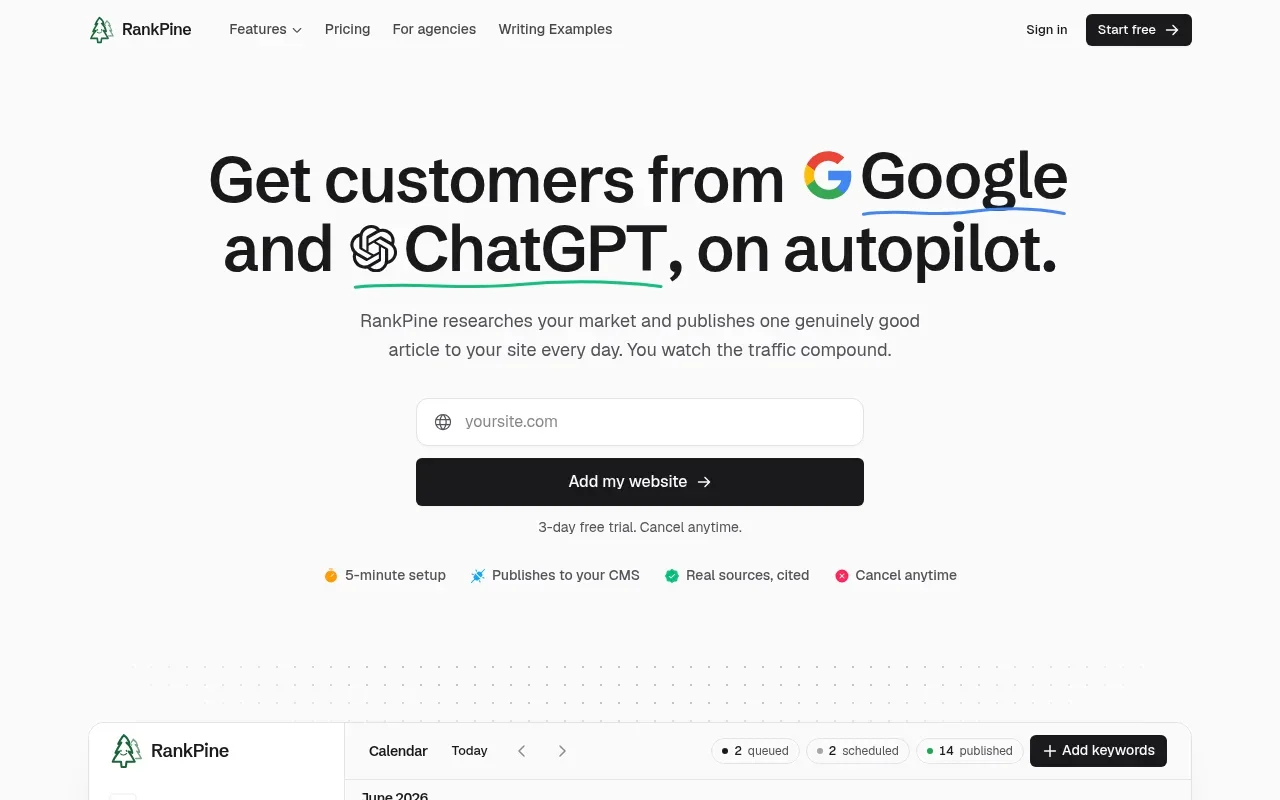
The system studies your site URL, target niche, audience demographics, competitors, and brand voice. Using that context, it builds an automated daily content plan that finds keyword opportunities with realistic ranking potential. Connecting Google Search Console uncovers nearby ranking gaps based on your traffic data. The platform then researches the topic, drafts the article, performs an editing pass, inserts cited sources, adds relevant images, maps internal links, and pushes the finished piece to your connected CMS.
Why it fits solo founders and lean teams
Predictable billing makes budgeting simple. RankPine pricing runs at a flat $99 per site per month, or $990 annually, which covers 30 articles per month to establish a daily publishing cadence. Teams managing portfolios receive automatic volume discounts of 10% for two to four sites, 15% for five to 19 sites, and 20% for 20 or more sites. You can test the output quality first through a 3-day free trial.
Direct integration handles the final publishing step. The platform supports WordPress, Ghost, Webflow, Notion, and custom webhook connections. Reviewing how RankPine publishes articles shows two paths: leaving autopilot enabled pushes finished posts live, while disabling it holds the drafts in a queue for your editorial review.
Trade-offs versus AirOps
This predefined loop requires different expectations than a configurable system. RankPine lacks an open workflow builder to orchestrate complex, multi-agent pipelines for technical documentation or programmatic landing pages, focusing instead on researched, long-form SEO articles. While RankPine factors optimizing for LLMs versus traditional search into its content generation model, it does not provide a dedicated analytics dashboard to measure share of voice across chat interfaces like the one AirOps offers.
2. Writesonic, Best for AI-Search Visibility and Content Execution
When monitoring brand mentions across generative engines and executing content updates need to live inside the same interface, Writesonic warrants investigation.
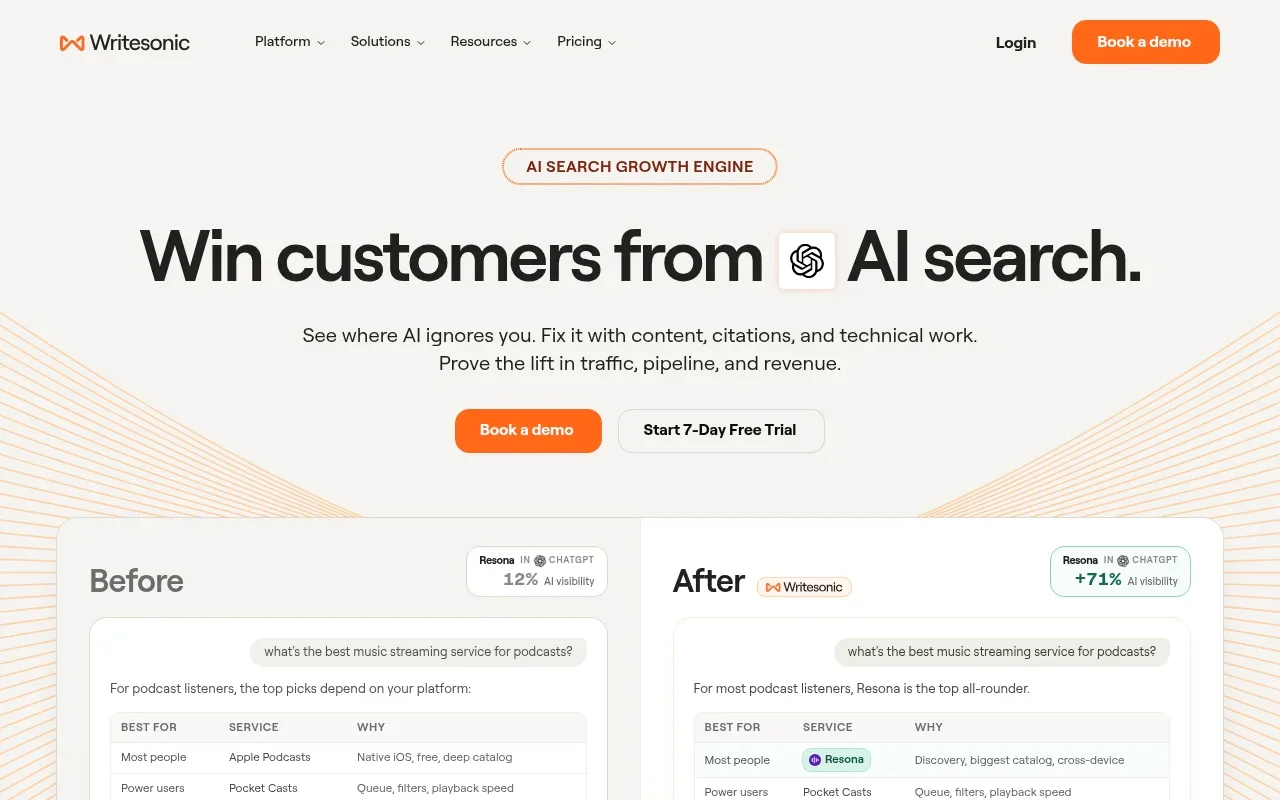
Current third-party directory listings describe its capabilities for generative engine optimization (GEO), tracking competitor gaps, executing content refreshes, and managing community activity. Those features position it as a hybrid solution for marketing departments attempting to consolidate their visibility software.
Before committing to a migration, check Writesonic’s official documentation to confirm plan limits and platform coverage. Review which AI chat interfaces the analytics dashboard supports, how the software handles source citations within generated text, and whether it includes native CMS integrations. Without clear details on its scheduling tools, review controls, and custom workflow orchestration capabilities, assessing its total setup burden remains difficult.
3. Jasper, Best for Brand Voice and Broad Content Production
Marketing departments often produce assets that sit outside the boundaries of organic search. When a team needs to generate campaign emails, social media sequences, ad copy, and landing pages with a unified tone, Jasper serves as a robust drafting layer.

The platform allows administrators to configure strict brand voice guidelines, ensuring that output aligns with corporate messaging across varied channels. This governance layer replaces the disparate prompting habits of individual team members with a centralized control system.
Using Jasper as the operational center requires evaluating the rest of your stack. Assess its built-in SEO research tools, competitor-gap analysis, and content refresh workflows to determine if they match your requirements. Since it functions as an advanced drafting interface, you may still need a separate process to handle source citations, daily scheduling, direct CMS publishing, and AI-search measurement.
4. Surfer, Best for SEO Optimization
Surfer targets the optimization phase of the publishing cycle, making it an appropriate choice for organizations that already employ writers, editors, or a distinct publishing workflow.

The platform scores written text against top-ranking search results, offering specific editorial guidance on keyword density, term frequency, and structural formatting. Writers paste their drafts into the editor to identify missing entities and on-page optimization opportunities.
This narrow focus introduces a clear trade-off. Surfer improves the traditional search readiness of a draft, but an operator still conducts the initial topic research, collects reliable sources, writes the text, reviews the output, and manually moves the finished document into a CMS. You can contrast this manual coordination with RankPine’s bundled daily loop or AirOps’ automated workflow execution. Review Surfer’s official pricing page to confirm plan structures and exact add-on costs for generative features.
5. Frase, Best for Briefs and Search-Informed Writing
Editorial teams often require structured planning documents before writing begins. Frase excels at generating detailed content briefs that outline required subtopics, competitive heading structures, and relevant questions pulled from search data.
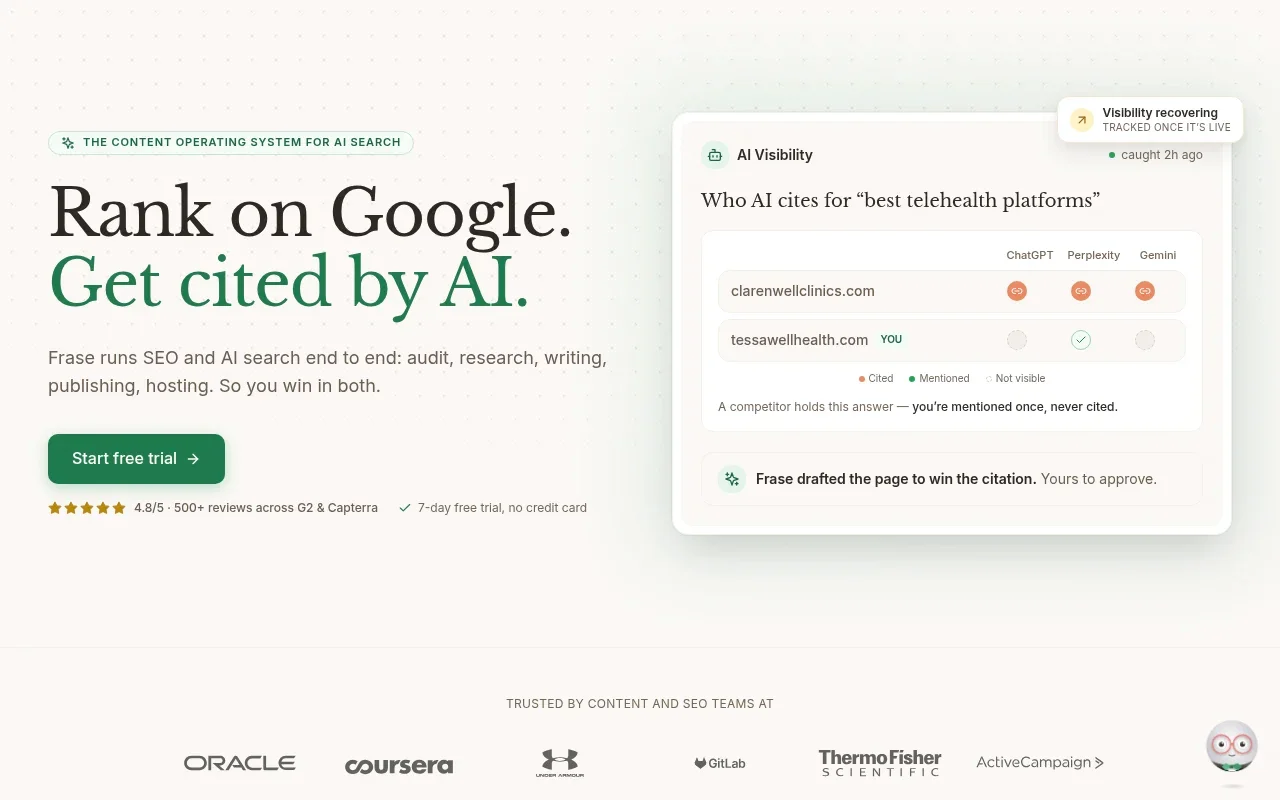
This planning-first approach serves writers and editors who prefer human-led content creation supported by data-driven outlines. An operator builds a brief, shares it with a writer, and uses the platform's optimization tools to grade the finished draft.
While Frase organizes the research and editorial phases, it does not replace the execution mechanics of a daily automated system. Evaluate its direct CMS publishing capabilities, automated scheduling tools, review controls, and AI-search visibility features. If your primary goal is removing the friction of drafting, citing, and formatting posts every day, a predefined loop will serve you better than a brief-generation tool.

Choosing an AirOps Alternative: Decision, FAQs, and Verdict
Replacing content software requires matching the new tool’s operating model to your team’s daily reality.
If you require a custom workflow canvas, extensive branching logic, human-controlled review gates, and documented analytics for AI-search visibility, AirOps remains the stronger choice. If you want a predefined loop that researches, writes, cites, and publishes SEO articles every day with fixed pricing and minimal operator input, select RankPine. Choose Surfer if your existing writers need an optimization layer, Jasper if broad brand voice governance matters most, Frase for search-informed editorial planning, and Writesonic if you can verify its AI-search execution capabilities meet your standards.
AirOps vs. RankPine in practice
Understanding how these two platforms approach content production clarifies the operational differences.
| Dimension | AirOps | RankPine |
|---|---|---|
| Operating model | Build configurable workflows, Grids, and publishing steps | Follow a predefined research, writing, and publishing loop |
| Content scope | Blog posts, product pages, programmatic SEO, tech docs | Researched SEO articles planned around specific niche opportunities |
| Research | Documented planning and competitive opportunities | Studies the site, competitors, and optional Search Console data |
| AI-search measurement | Dashboard covers ChatGPT, Gemini, Perplexity, and Google engines | Content is written for AI engines, but lacks a dedicated measurement dashboard |
| CMS publishing | Direct integrations and Grid-based publishing | Direct publishing to WordPress, Ghost, Webflow, Notion, and webhooks |
| Review controls | Configurable human review checkpoints | Explicit autopilot or manual review modes |
| Pricing model | Task-volume quotas and variable usage overages | Fixed per-site subscription with a monthly article allowance |
| Operator burden | Requires workflow design and active management | Designed to run daily with minimal ongoing management |
Buyer switching checklist
Run this practical test before moving your production to a new platform:
- Produce one complete article from the initial brief through to final CMS formatting.
- Verify the quality of the sources and the natural placement of citations.
- Check if the output consistently adheres to your brand voice.
- Review the depth of the keyword and competitor research.
- Evaluate the relevance of internal-link recommendations.
- Test the review status and approval controls inside your CMS.
- Confirm that article scheduling and autopublishing function as expected.
- Monitor how usage limits are tracked and calculate potential overage costs.
- Test the workflow for refreshing existing content.
- Check which specific AI-search engines the platform actively tracks.
- Review data export procedures and cancellation terms.
Frequently asked questions
Is AirOps an AI writer or a workflow platform? AirOps functions as a content orchestration and AI-workflow platform. It supports repeatable research, generation, enrichment, review, optimization, and publishing workflows instead of focusing on single-use AI writing tasks.
Can AirOps publish directly to my CMS? Yes. AirOps CMS documentation details direct integration steps for multiple platforms, including WordPress and Webflow. Establishing these connections often requires appropriate administrator permissions.
How does task-based pricing work? Usage-based billing relies on plan allowances. You receive a set number of tracked prompts and content-production tasks per month. Overages apply if you exceed that quota, such as the listed $0.025 per additional task on the Solo tier.
Is RankPine a full replacement for AirOps? Not for every scenario. RankPine replaces the daily SEO content-production job. AirOps remains necessary if you require custom workflow orchestration, varied content types like technical documentation, and dedicated AI-search analytics dashboards.
Can RankPine publish automatically? Yes. Enabling autopilot allows the system to push finished articles directly to your connected CMS. Disabling autopilot holds the articles in a queue until you review and approve them.
Does AirOps track Claude visibility? The cited AirOps Analytics documentation page does not list Claude. The documented platforms include ChatGPT, Gemini, Perplexity, Google AI Mode, and Google AI Overviews.
Does daily publishing guarantee rankings or AI citations? No. A daily publishing schedule ensures consistent execution and broad topic coverage, which are necessary foundations for growth, but no software guarantees specific traffic, rankings, or chat-interface citations.
Final verdict
Selecting the right software changes how your team spends its time. AirOps serves teams building and operating a flexible, multi-step content architecture that demands detailed measurement and custom workflows. RankPine serves founders and lean teams that need the strategy already defined and executing in the background. Choose the system that matches the amount of management overhead you are willing to accept.
Stop managing complex workflows and start publishing consistently with RankPine. Let RankPine research, write, and deliver daily SEO content directly to your site. Start your free trial today.