Optimizing For LLMs Vs Traditional Search Engines In 2026
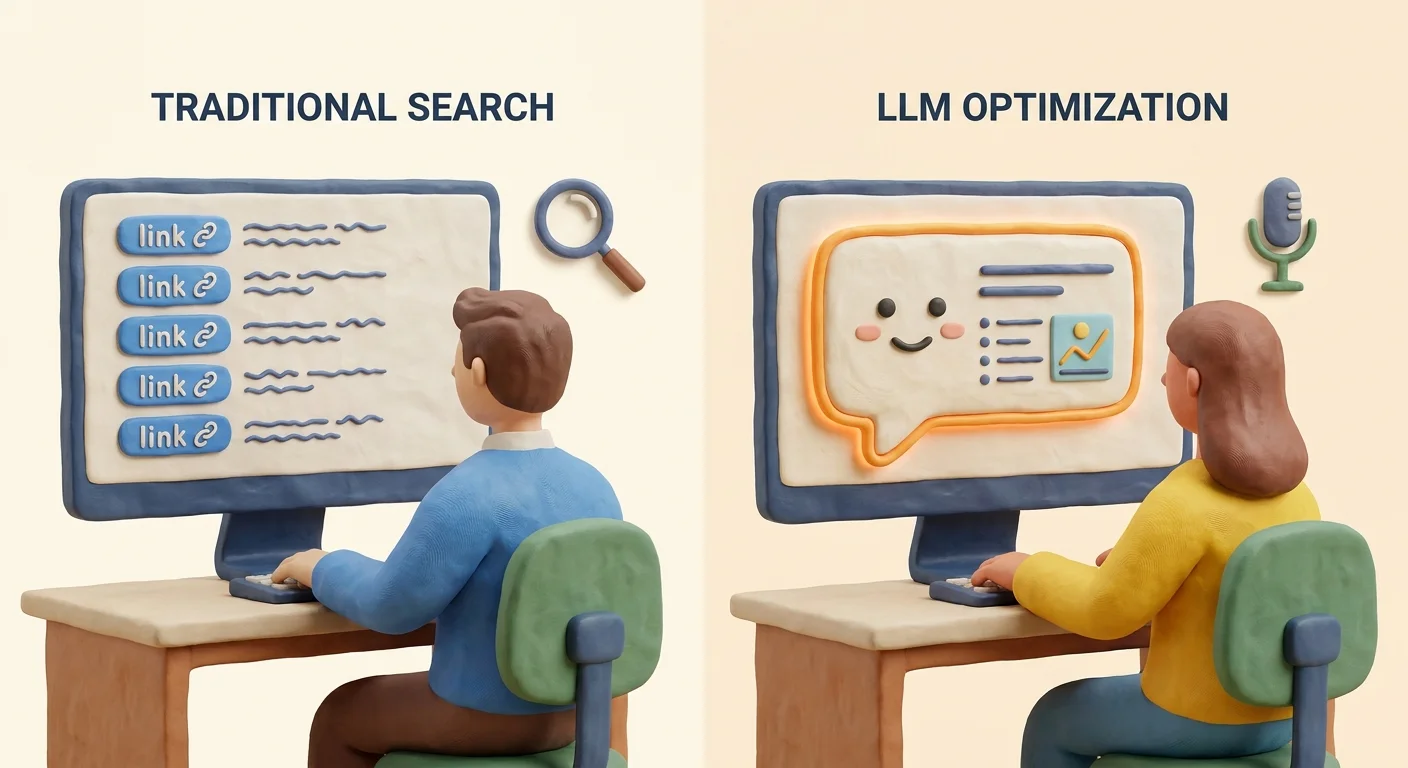
User migration from blue links to conversational chatbots forces a rebuild of your content strategy. When you design your publishing pipeline for 2026, understanding the mechanics of optimizing for LLMs vs traditional search engines determines whether your organic traffic compounds or flatlines. Rather than writing solely to hit a specific keyword density, you must format data so retrieval-augmented generation models extract and cite your claims. RankPine manages this exact transition by automating a daily publishing schedule that satisfies legacy web crawlers and modern AI chatbots simultaneously. This approach secures the broad visibility of standard search results while capturing the qualified, pre-sold visitors who click through from an AI summary.
1. The 2026 Search Shift: Why AI Visibility Matters
A single approach to search visibility no longer works. Generative engines process information differently than standard indexers, fracturing optimization into two distinct disciplines. Conversational interfaces attract hundreds of millions of weekly active users, and standard platforms trigger AI overviews on the majority of searches, though this trigger rate ranges from 13% for shopping queries to 88% for healthcare. To succeed, you must structure your data so Large Language Models extract and cite your brand, while continuing to satisfy standard search requirements like backlink profiles, technical site speed, and exact-match keyword targeting. When comparing the effort of optimizing for LLMs vs traditional search engines, you must address both paradigms without doubling your content budget.
Open your analytics dashboard and filter your traffic data for the last twelve months to identify top-of-funnel, informational queries. If impressions and clicks for research-oriented terms show a steady decline, those visitors likely moved to conversational interfaces. They now ask a chatbot their question and receive a synthesized answer directly on their screen, bypassing your website entirely. A successful pipeline captures these users where they are currently searching.
RankPine automates this dual-optimization process, though understanding the underlying mechanics helps you structure your overall strategy. Traditional engines scan your page to identify the topic, ranking the URL based on external link volume. In contrast, LLMs read your page to extract specific facts, numbers, and definitions to store in their vector databases. When a user asks a question, the model retrieves those exact facts to build a response, which means it skips sites relying on vague generalizations and narrative fluff. To secure citations, transition your writing style from conversational storytelling to dense, factual reporting.
2. Intent and Traffic: Volume vs. Conversion Quality
Track referral sources closely to measure the stark difference in user intent between these platforms. Because traditional search engines drive high-volume, exploratory traffic, users typically type broad queries into a search bar, open multiple tabs from the first page of results, and skim the contents. You optimize for this behavior by matching search intent, casting a wide net with long-tail keywords, and deploying internal links to retain visitors.
LLM traffic behaves differently. A user asking a conversational AI a specific question receives an immediate, synthesized answer, so the majority of these searches end without a website click. This creates a zero-click reality for top-of-funnel research, where 68% of Google searches end without sending traffic to the open web. The users who do click a citation link arrive on your landing page with a validated mindset because they already read the AI's summary of your product. They visit your site specifically to verify technical details, check pricing, or make a purchase.
Segment your conversion data by referral source to see this value multiplier in action. By filtering your analytics to isolate traffic arriving from conversational chatbots, you can compare their conversion rates against standard organic search visitors. AI-referred visitors convert at a higher rate because they arrive pre-sold, allowing you to trade gross click volume for qualified leads.
For bottom-of-funnel actions across retail and SaaS markets, standard searches still command the majority of transactional queries. When a buyer knows what they want, they type a product name into a traditional search bar. Capture the high-intent AI researcher through verifiable citations while maintaining standard structural visibility for the users ready to buy. To monitor this, configure your analytics platform to track these touchpoints independently by setting up custom channel groupings. This separation of generative engine referrals from standard organic search gives you a clear picture of how each platform contributes to total revenue.

3. Core Mechanics: Optimizing For LLMs Vs Traditional Search Engines
Capturing both audiences requires formatting pages to satisfy two different evaluation systems. Traditional search engines score pages based on keyword prominence, domain authority, and behavioral metrics like dwell time. If a URL answers the query, loads quickly on a mobile device, and attracts links from established domains, it ranks well.
Large Language Models rely on Retrieval-Augmented Generation to scan your site, ignoring your backlink profile to look for factual density. RAG systems extract clear entity definitions, concrete statistics, and verifiable claims to construct their answers before mapping the relationships between these facts using vector embeddings. If a page lacks specific data points, the system finds nothing to extract, causing the model to bypass the URL in favor of a competitor with dense, structured information.
Review the specific requirements for each platform before publishing your next campaign.
| Evaluation Criterion | Traditional Search Engines | Large Language Models |
|---|---|---|
| Primary Ranking Signal | Backlink authority and keyword relevance | Factual density and RAG extraction |
| Content Formatting | Long-form narratives to increase dwell time | Short paragraphs with immediate answers |
| Traffic Characteristic | High volume, exploratory browsing | Low volume, pre-sold validation |
| User Intent Tracking | Broad query matching and click-through rates | Specific entity extraction and citation |
| Penalty Triggers | Slow mobile load times and thin content | Filler text and unsupported claims |
Evaluate existing blog posts against this framework to identify gaps. A lengthy article packed with broad advice and transitional filler might rank on the first page of standard search results, but a generative engine bypasses it. Because the model requires named entities and hard numbers, adding specific data points increases your likelihood of appearing in an AI citation. For example, if you write about software performance, state the exact millisecond load time improvement using Google Lighthouse rather than claiming a noticeable speed boost. Name the specific testing tool you used.
Audit your content library for factual density by highlighting every paragraph in your last five published articles. If a section contains no numbers, named entities, or specific claims, rewrite or delete it. This density acts as the currency of generative search, so providing the exact statistics the model needs to build a confident answer secures the citation.
4. On-Page Tactics: Structuring Content for Both Platforms
Applying the fast skimmer formatting rule builds pages that satisfy legacy crawlers and modern chatbots simultaneously. Because LLM parsers abandon dense, unbroken blocks of text, run drafts through a readability tool like Hemingway to target an eighth-grade reading level. Break arguments into short paragraphs under four sentences each, and deploy bulleted lists for any sequence of more than two items so the extraction model can map the relationships between your points.
Place the direct answer to the user's core question within the first 100 words of the article. Standard optimization often buries the answer below a lengthy introduction to keep users scrolling and improve time-on-page metrics, but this tactic harms generative visibility. State the conclusion immediately in the opening paragraph, then dedicate the rest of the page to the supporting evidence, methodology, and statistics the RAG system needs to verify the claim.
Deploy standard schema markup across your site to give extraction models a structured map of your data. Utilize FAQ schema for direct question-and-answer pairs and apply HowTo schema for sequential instructions. This explicit JSON-LD labeling prevents the model from guessing the purpose of your text. Add the schema directly to your page header or install a dedicated CMS plugin to handle the formatting automatically, validating the code afterward through the Google Rich Results Test.
Maintain strict entity consistency across your digital footprint. Your brand name, product definitions, and technical terms must match exactly across the website, social profiles, and third-party directories. Defining a product feature one way on a homepage and using a different term on a blog fragments the model's understanding of your authority. A unified entity strategy secures positions in AI answers, forming the foundation of an effective LLM SEO strategy for niche sites. Document core entities in a central spreadsheet to enforce these exact definitions in every published post.
5. Bridging the Gap: Automating Dual-Optimization with RankPine
Managing these competing requirements creates a capacity bottleneck. Publishing daily builds the topical authority that conversational models require, but manually researching and citing empirical data for every post takes hours. Delegating the work to cheap writers who produce generic filler text to hit a publishing quota destroys the chances of securing AI citations.
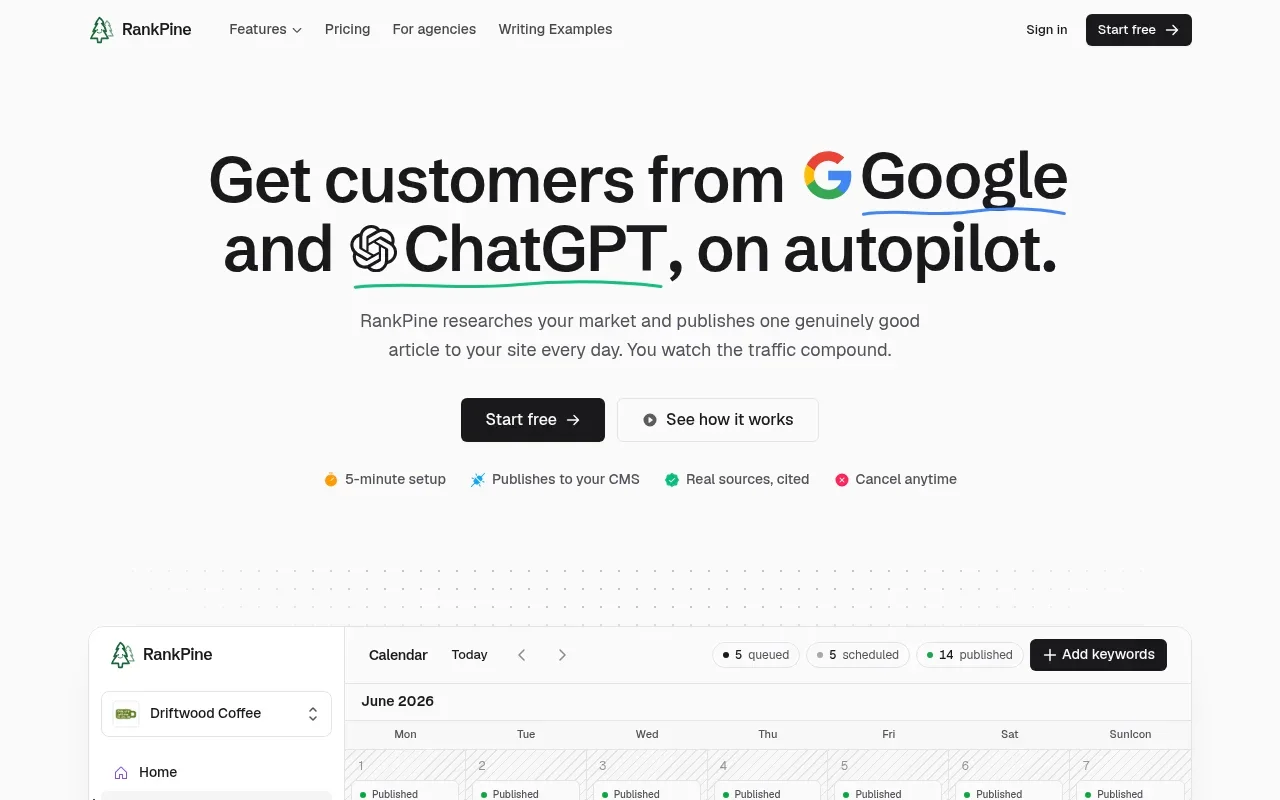
RankPine removes this operational friction by analyzing your market to identify winnable long-tail keywords, ensuring the content competes in traditional search results. It generates and publishes one researched article directly to your CMS every day. After you set the topical parameters, the system handles the complete lifecycle of the content strategy.
The platform solves the factual density requirement by embedding specific statistics, verified citations, and hard numbers into posts, avoiding the vague abstractions typical of basic AI writing tools. It structures the output with short paragraphs, clear headings, and immediate answers. This explicit formatting ensures articles meet the rigorous extraction standards of modern chatbots while satisfying the structural requirements of standard web crawlers.
Log into your RankPine dashboard to configure primary content pillars. The system maps out a daily schedule designed to cover every angle of the niche. This maintains a consistent publication cadence that captures legacy search traffic and high-intent AI search visibility for startups without requiring hours of manual drafting and formatting. The automation allows you to compete with enterprise publishers in overall share of voice.
6. The Verdict: Do You Optimize for Google or ChatGPT?
The underlying mechanics of search continue to converge. Standalone conversational models and integrated AI search overviews reward the exact same core elements, demanding verifiable facts, clear data structure, and high readability. The verdict on optimizing for LLMs vs traditional search engines is that you no longer need to choose one platform over the other, provided you update your definition of quality content.
For niche content sites, prioritize factual density over lengthy narrative guides that bury the answer. Shift formatting to the fast skimmer rule, deploy FAQ schema on every post, and embed hard statistics in opening paragraphs. This satisfies the RAG extraction process while providing the keyword relevance standard crawlers expect.
Software companies must focus on entity consistency and capturing pre-sold referral traffic. Standardize feature descriptions across the web and track AI-referred visitors independently in an analytics platform to measure their conversion rates against organic benchmarks.
If you cannot manually manage this dual-optimization process, automate your pipeline. RankPine delivers the precise factual density and structural formatting required to win citations, while targeting the long-tail keywords necessary for standard ranking visibility. Publishing one optimized article daily builds the topical authority required to dominate both interfaces.
Stop choosing between legacy search rankings and modern AI citations. Automate your daily publishing schedule with content structurally engineered for both platforms. Visit RankPine to start building your dual-optimized content pipeline today.