Minimalist SEO Strategy for Solo Founders

You cannot run an enterprise content department alone, which means you need a repeatable system that reduces the number of decisions you make each week. A complex marketing plan falls apart the moment a solo founder has to choose between shipping a product update and writing a blog post. A focused SEO plan requires choosing winnable topics, publishing useful pages, automating repetitive work, and improving your existing content through a lean review loop.
Building a System That Fits a One-Person Business
A minimalist SEO strategy for solo founders means reducing complexity rather than lowering standards or publishing thin content. You build a framework around one defined audience, a tight topic map, useful pages, relevant internal links, basic technical accessibility, and a straightforward review loop. This allows you to prioritize high-impact decisions over exhaustive keyword tracking, complex link-building campaigns, or publishing on subjects disconnected from your core product.
This approach works well because it matches how Google's ranking systems evaluate quality. When producing material for the web, Google’s guidance on creating helpful content prioritizes a clear site purpose, original value, and a satisfying page experience for an intended audience. Their documentation specifically warns against producing large amounts of content across unrelated topics only to attract search traffic.
While automation handles repetitive tasks, you remain responsible for usefulness, accuracy, and audience fit. An execution layer like RankPine supports this daily routine by managing the research-to-publishing workflow automatically. The platform analyzes market trends to identify winnable long-tail topics before generating articles with researched citations and publishing them directly to your CMS. Skipping the manual labor of drafting and formatting frees you to verify that the claims match your product and solve your customer's most pressing problems.
Ground Your Strategy in One Audience and Problem
Broad industry categories pull your editorial plan in too many directions, so a site about "productivity" will eventually compete with massive publishers across hundreds of unrelated keywords. Writing a clear positioning sentence filters out attractive but disconnected topics before they dilute your focus.
A strict positioning formula keeps your content grounded: "We help a specific audience solve a specific problem with a specific product." Start by identifying the customer segment most likely to buy your software or service, then build your topics strictly around the problems your product resolves. This discipline ensures every page serves a primary purpose and connects directly to your business goals.
Consider a fictional software company building appointment tools for small salons. A broad strategy might try to rank for generic terms like "small business marketing," attracting readers who will never buy salon software, while a focused approach targets the salon owner's immediate problems. Writing about reducing no-shows, providing appointment reminder templates, and comparing SMS with email reminders demonstrates clear search intent. These topics attract readers actively looking for a solution to missed appointments and match the exact problem the product solves, which prevents wasted effort on the wrong traffic.
Map a Small, Manageable Set of Topics
Grouping customer questions into a few tightly related clusters turns an overwhelming backlog into a manageable editorial system. Aiming for three to five topic clusters gives a solo founder a manageable structure for planning, connecting, and maintaining content without needing a dedicated project manager. This cohesive structure is a more effective way of managing SEO as a one-person marketing team compared to maintaining a massive spreadsheet of isolated keywords.
Map the search intent for each core cluster to specific page types. Start by building one broad explanatory page covering the entire concept, followed by specific how-to articles for implementation questions. Adding comparison topics helps buyers evaluating alternatives, while troubleshooting guides assist users stuck on a specific step. Connecting all these informational pages to a relevant product or conversion page forms a complete, logical path for the visitor.
A topic qualifies as winnable when it describes a real customer problem and relates closely to your product. Your site needs to provide a distinct point of view, original example, or unique process that answers the query directly. Low keyword difficulty alone is never enough to justify publishing a page; if the topic attracts the wrong audience or lacks a meaningful answer, skip it entirely. Validating current search volume and live search result conditions before committing to a topic ensures your effort targets a viable opportunity.
Structure Pages to Answer Questions Quickly
Every article needs to solve the reader's problem quickly and thoroughly, which is easiest to achieve using an answer-first page structure. Start with a direct answer or clear definition in the opening section before providing the necessary context and limitations. From there, build out a step-by-step process that supplies real examples or templates, highlights common mistakes, cites relevant sources, and ends with a clear next step.
Readers want direct answers without unnecessary padding. Google recommends content that is helpful, reliable, and written for people, and since there is no preferred word count for organic ranking, your pages only need to be as long as necessary to solve the problem. Adding arbitrary length to hit a metric creates filler that frustrates your audience.
Using automation to handle drafting requires setting clear quality gates. Automated drafts need to answer the query early and add original synthesis rather than merely summarizing other pages. Attribute factual and time-sensitive claims to real sources, distinguish facts from estimates or opinions, and remove unsupported statistics. Breaking up the text with descriptive headings and adding useful internal links helps the reader navigate your site effectively.
Setting up a consistent do-it-yourself SEO workflow requires reliable tools that address the typical content bottlenecks. RankPine coordinates this entire process by handling the research, producing source-backed drafts, inserting citations, and scheduling direct CMS publishing. This daily publishing cadence compounds your organic reach over time, and pausing the schedule is easy when a topic fails your quality bar. The system handles the heavy lifting, leaving you responsible for the final product claims, industry accuracy, and overall usefulness.

Manage Basic Technical Accessibility
Technical SEO often feels like an endless list of site audits and code changes, but treating it as a short maintenance layer prevents it from becoming a separate enterprise project. Your goal is to ensure search engines can find, crawl, and understand your pages without technical roadblocks.
A minimum viable checklist aligns with Google Search Essentials. To be eligible to appear in Search, pages need to meet Google's technical requirements. Each page should use words people would use to look for its content in prominent locations such as the title and main heading. For other page elements, follow the relevant best practices for images, videos, structured data, and JavaScript so Google can understand them.
Internal links are the most powerful technical tool a solo founder controls, helping readers and search engines understand the relationships among your cluster pages and conversion pages. Using descriptive, understandable anchor text tells the reader what to expect on the destination page, while keeping related pages connected builds a coherent site structure. Keeping technical fixes proportional to their measurable impact ensures you do not waste time, since following technical best practices creates eligibility but does not guarantee crawling, indexing, or search visibility.
Optimize for Emerging Search Formats
Building separate strategies for Google Search and its AI features isn't necessary, because the same foundational SEO practices support both. Google's guidance for AI features confirms that the same foundational SEO best practices used for Google Search apply to AI Overviews and AI Mode. The guide also states that there are no additional technical requirements, and that a page must be indexed and eligible to be shown in Google Search with a snippet to appear as a supporting link.
Optimizing for these systems requires extreme clarity across your entire site. A clear page structure, crawlable links, accurate titles, and plain text make your information highly accessible. Providing reliable content with strong source attribution and a clear site purpose helps generative models read your page, while precise headings and definitions make it easier for the system to extract and cite your answers.
The approach remains similar for other discovery surfaces. OpenAI’s publisher guidance for ChatGPT search requires allowing the OAI-SearchBot to access the pages you want considered for summaries and snippets, which means checking your server, firewall, and bot-protection settings to confirm they do not block this specific crawler. Tracking referral traffic separately is possible if your analytics platform supports monitoring the specific referral parameter from ChatGPT. Treating these formatting and accessibility steps as editorial best practices rather than guaranteed citation mechanisms keeps you focused on producing clear, authoritative answers instead of chasing unverified ranking factors for emerging tools.
Track Performance to Improve Existing Pages
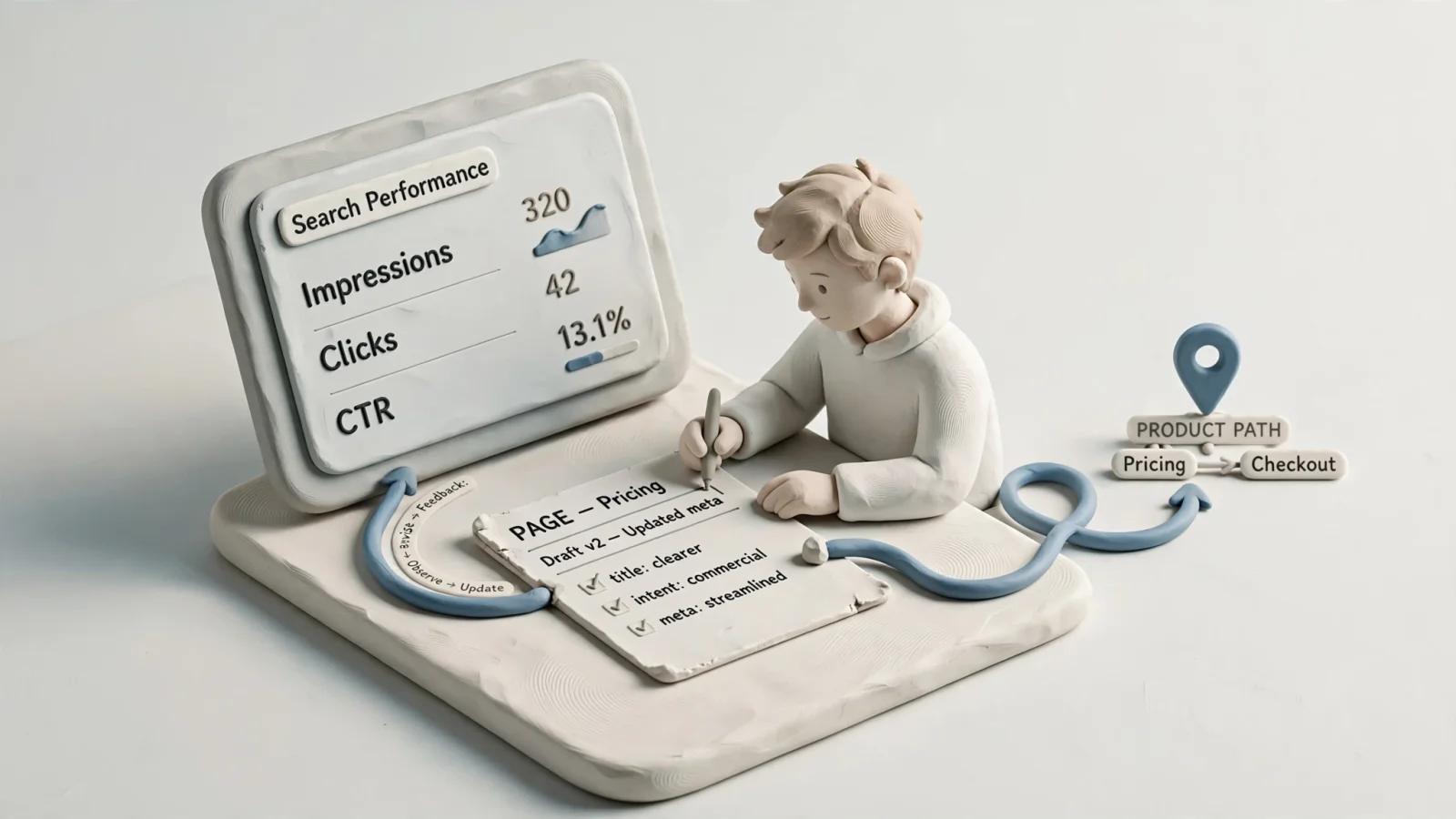
Publishing consistently is only the first half of the system, so you also need a lean operating loop that uses Google Search Console to monitor clicks, impressions, click-through rate, average position, queries, and pages, translating abstract data into concrete actions.
Evaluating these signals helps prioritize your updates. When impressions are rising but clicks remain low, the page appears in search results but fails to attract visitors, signaling a need to improve the title, revise the opening answer, and check that the page aligns with the searcher's intent. If clicks are rising but conversions are weak, the article attracts attention while the next step fails, which you fix by improving the call to action, updating internal links, and confirming the offer matches the reader's problem.
If several pages appear for the same query and cannibalize each other, consolidate them into one strong article, differentiate their specific topics, or redirect the weaker pages. Receiving impressions for unexpected but relevant queries reveals an adjacent opportunity, allowing you to expand the specific section of the article that matches those new terms. Finally, a page attracting very little relevant activity after several months indicates weak topic fit or quality, prompting a strategy review before you create more pages on that same subject.
This review cycle acts as a time-saving workflow for indie hackers who cannot afford to abandon old content. Reviewing new queries and low-click opportunities weekly keeps you informed, while improving or merging underperforming pages monthly maintains library quality. Reassessing your target audience, topic clusters, conversion paths, and content gaps quarterly ensures long-term alignment. During these reviews, update accurate but stale pages, merge overlapping topics to concentrate their authority, redirect retired URLs to the closest useful successor, and remove pages that are thin, redundant, or entirely irrelevant to your current product.
This disciplined approach ensures your content library grows stronger over time instead of only expanding. While you handle the strategy, audience targeting, and business logic, RankPine manages the execution. The platform brings your minimalist strategy to life by automating the repetitive research, drafting, sourcing, and scheduling that would otherwise consume your week.
If you're ready to stop writing articles manually while still growing your organic traffic, provide your website, target audience, existing pages, and core business problem, and let RankPine support a focused research-to-publishing workflow that runs on autopilot daily.