How to Get Your Brand Mentioned by Claude
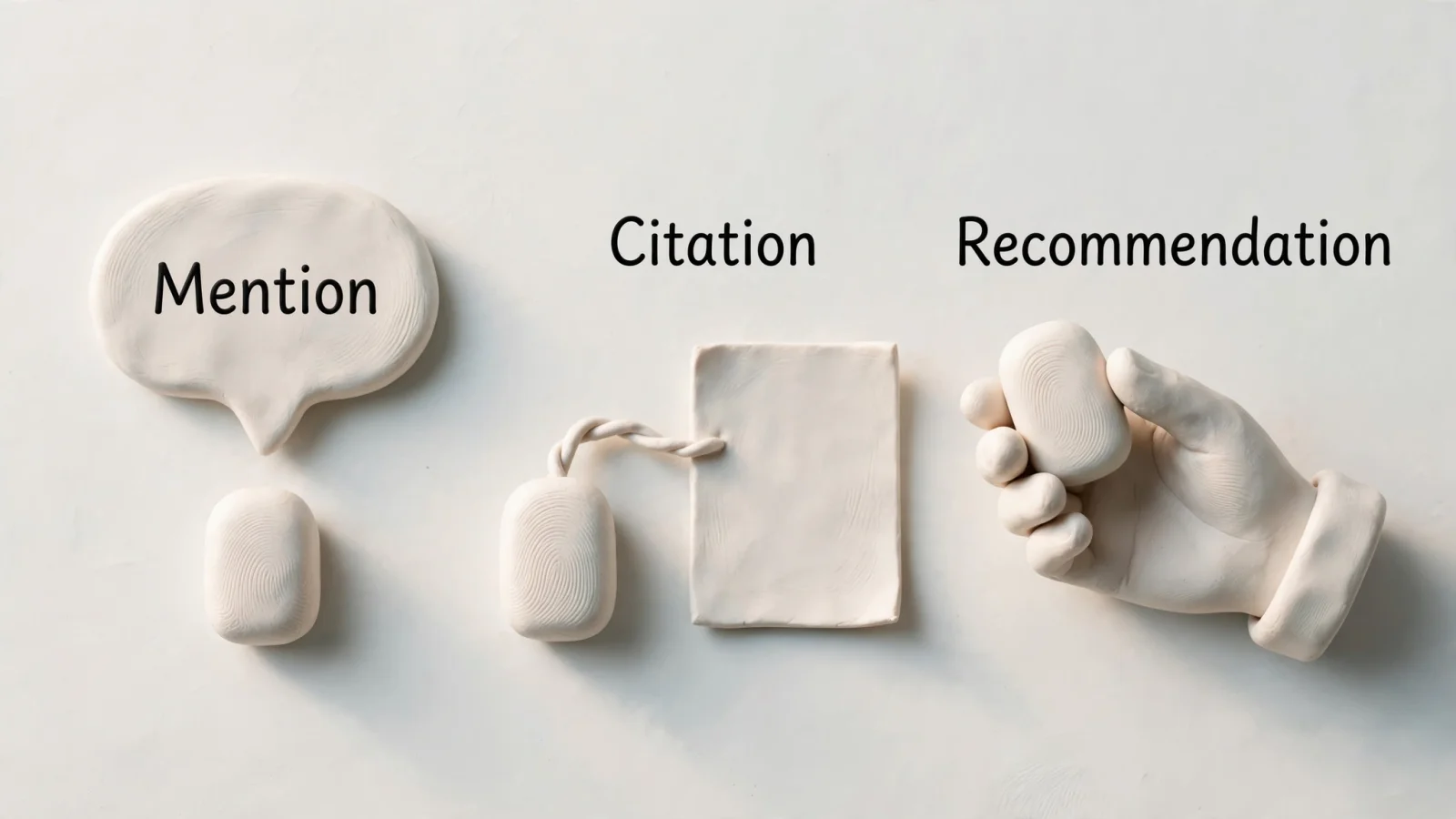
Understanding how to get your brand mentioned by Claude requires separating three distinct outcomes. A brand mention names your company in an answer. A website citation links to your domain as a source for a specific claim, while a recommendation actively suggests your product or service as the right solution for a user's problem. Claude might name your business without linking to your site, and it might cite your page to answer a factual question without recommending your company to the buyer.
Anthropic builds its models to process information differently depending on how the user interacts with the platform. Live web search relies on current internet information and often provides citations, but the system does not use a fixed placement formula to guarantee a specific brand appears. If you manage automated workflows through tools like RankPine, understanding these mechanics provides a baseline for setting up content. You can configure your site to be accessible and clear, but you cannot force the model to endorse you.
Define What Counts as Visibility
Before changing any site configurations or rewriting pages, map out the digital properties you control. Gather the exact URLs for your official domain, your help center, your documentation subdomains, and any hosted landing pages, because you need administrative access to the robots.txt files for each of these subdomains. You also need the ability to modify your content delivery network, firewall, and indexing rules.
Establish a baseline measurement before you make adjustments. Create a fixed set of test prompts that cover your primary category recommendations, common buyer problems, direct comparisons with competitors, specific questions about your brand, and target use cases. Record the current outputs for these prompts, giving you a concrete reference point to measure against when you run the same test a month later.
Step 1: Check Claude's Access to Your Pages
Search visibility begins with crawler access. Allowing a bot to read your site removes a technical barrier, though it does not guarantee a mention or a citation. Configuring your access rules to match your specific goals is the next priority. Anthropic operates different crawlers for distinct purposes, so set access rules according to which ones you want to allow or block. Anthropic's crawler documentation outlines three bots that access public web content for model development, user-directed requests, and search.
The Claude-SearchBot agent analyzes online content to improve search-result relevance and accuracy for users querying the web in real time. Blocking this specific crawler prevents your pages from being indexed for search optimization and reduces your visibility when a user prompts the model to search the internet. The Claude-User agent accesses websites when a user explicitly asks the model to retrieve a specific URL. If a customer pastes your pricing page link into the chat interface and asks for a summary, this is the bot that fetches the content, so blocking it breaks user-directed retrieval. The ClaudeBot agent collects public web content that could potentially contribute to future model training datasets. Restricting this bot signals that your future material should be excluded from training data. Allowing ClaudeBot does not turn on live search access, and blocking it does not prevent live search if the other bots are permitted.
Once you understand these agents, check the robots.txt file at the root of your primary domain and repeat the process for every relevant subdomain. If your marketing site lives at the root domain but your product documentation sits on a subdomain, each needs its own crawler directives. Ensure that User-agent: Claude-SearchBot and User-agent: Claude-User are explicitly allowed if you want those pages accessible for live search and user retrieval. Inspect your meta robots tags next, because a noindex directive prevents a page from appearing in web-search outputs even if the crawler is allowed to read the file. Remove the noindex tag from any public-facing page that contains important brand facts, product descriptions, or technical specifications.
Finally, review your security infrastructure. Firewalls, content delivery networks, and bot-protection software often deploy CAPTCHA challenges to suspicious traffic. Anthropic's documentation confirms that its bots honor robots.txt rules and do not bypass CAPTCHAs. If your security layer presents a challenge screen to Claude-SearchBot, the crawler will fail to access the page silently. Check your firewall logs to confirm that traffic from these specific user agents receives a successful HTTP 200 response rather than an HTTP 403 forbidden error or a CAPTCHA prompt.
Step 2: Make Your Brand Facts Clear
Ambiguity forces language models to guess. When a company name matches a common noun, a location, or an existing software term, the model needs surrounding context to interpret the entity correctly. Providing unambiguous facts on your owned properties helps the system categorize your business accurately.
Start with your primary About page and your main product landing page to state the official name of the company, the specific software or service category it belongs to, the exact intended audience, the primary problem the product solves, and the distinct features that separate it from alternatives. Avoid generic superlatives. The phrase "The leading solution for modern work" provides no useful information about the product category, whereas "A cloud-based inventory management system for automotive repair shops" gives the model exact parameters to work with.
Support specific claims with evidence. If you claim an integration exists, list the integration partner and describe how data moves between the two systems, linking these related pages together using descriptive anchor text. When your product page mentions a specific compliance certification, link that text directly to your security page detailing the audit process. Early-stage companies do not need to rebuild their entire website architecture to achieve this clarity. A focused About page and a detailed product page provide enough structure to increase your chances of getting cited by AI chatbots. Consistency across these pages helps systems process the offering, but formatting alone cannot compel the model to include your brand in an output.
Step 3: Publish Useful Pages Buyers Can Verify
Technical access and clear categorization only put your site on the map. To earn citations in answers to complex queries, your site needs to provide information that solves user problems. Thin product descriptions rarely offer enough depth to serve as a reference for a broad category question.
Begin by documenting the questions your buyers ask during their evaluation process. They want to know how to solve specific workflow bottlenecks, which options to compare when switching platforms, and what trade-offs matter most in their industry. Address these topics directly by providing firsthand examples from your experience in the market. Include original analysis of industry trends rather than summarizing existing blog posts.
Transparency builds credibility. If you publish a benchmark report, explain the methodology you used to gather the data by stating the sample size, the date range, and the criteria for inclusion. When making a factual claim about market conditions, cite primary sources and make the authorship of the page clear.
Google's generative AI search guide recommends unique, useful content and crawlable pages for its own generative features. While this guidance is specific to Google and does not establish how Anthropic selects content, it offers a useful reminder to prioritize substantive information. The documentation cautions that creating a high quantity of pages alone does not make a site higher quality or more relevant to users.
This presents an execution challenge for lean marketing teams, because maintaining a consistent publishing schedule that meets these quality standards requires significant resources. Tools like RankPine automate keyword research, handle article creation complete with real citations, and manage CMS publishing on a daily schedule. This automated workflow reduces the operational burden, allowing a single founder to maintain a steady output of structured information. Editorial review and original expertise remain necessary, and daily publishing itself is not a documented ranking signal for Claude. The value lies in systematically answering a wide range of user questions over time, which expands the surface area where a model might find a relevant answer.
When you develop this content, structure it to address the practical implementation of your product without turning the article into a sales pitch. If a user asks a model how to automate data entry, a page explaining the technical steps of API integration serves as a better source than a landing page that only lists "API access" as a bullet point. Prioritizing this kind of deep, explanatory content over keyword-stuffed alternative pages aligns better with AI retrieval systems.

Step 4: Earn Genuine Third-Party References
Your owned pages provide the baseline facts, but third-party validation offers external context. When multiple independent sources describe your product solving a specific problem, search systems gain additional ways to verify what your business does. Approach this as a practical strategy for digital presence rather than a mathematical formula for manipulating a chatbot.
Seek honest customer reviews on verified software platforms by encouraging your successful users to describe their specific use cases, the problems they solved, and the measurable outcomes they achieved. A review detailing how your inventory tool reduced stockouts by twenty percent carries more informational weight than a generic five-star rating with no text. Partner mentions provide another layer of context. If your software integrates with a larger platform, work with that partner to secure a listing in their official integration directory. Request that the listing describe the data flow and the joint value proposition accurately, and participate in expert interviews, industry podcasts, or independent case studies to discuss your methodology.
Never use scripted reviews, fabricated profiles, or keyword-stuffed forum mentions to manufacture a footprint, because inauthentic signals clutter the internet and offer no value to users evaluating your product. Artificial intelligence search optimization requires genuine corroboration. The goal is to build a network of factual, candid references that accurately reflect your position in the market.
Step 5: Track Results and Troubleshoot Gaps
Measurement requires discipline because search systems update continuously and user interactions vary. Treat your tracking efforts as a directional internal baseline to spot trends rather than an official score. Anthropic states that its web search uses current information and provides citations, though the documentation offers no guaranteed timeline for when changes to a website will reflect in answers.
To establish a repeatable visibility check, open a spreadsheet and create columns for the date, the specific prompt, the search mode used, and four visibility signals: whether Claude named your brand, cited one of your pages, cited a third-party page, or recommended your product. Add a final column for factual accuracy. Take the baseline prompts you established before starting this process and paste the first one into Claude's interface with the web search feature enabled. Review the output carefully to see if the model named your brand, linked to one of your URLs as a source, cited a partner or other third-party page, or actively recommended your tool for the user's specific problem. Record the results in your spreadsheet, and repeat this process for every prompt on your list. Where the interface permits, run the exact same prompts with the web search feature disabled to test the model's baseline training knowledge without real-time retrieval. Running this full test suite once a month on the same day will show you which use cases trigger a citation and which ones leave your brand out entirely.
When your brand fails to appear for a core category prompt, work through a structured troubleshooting sequence starting at the technical layer. Check your server logs to confirm that Claude-SearchBot recently crawled the target pages. If the logs show no visits, review your robots.txt rules and firewall settings for false positive blocks. If the crawler has access, evaluate the target page for clarity. A prompt asking for tools that handle "HIPAA-compliant patient scheduling" will miss a page that only mentions "secure calendar management," representing a semantic gap. Update the page to use the precise terminology your buyers and compliance frameworks require.
Next, evaluate the surrounding evidence. If your page is clear but the model consistently cites a competitor, review the competitor's cited page to see if they offer original research, transparent methodology, or detailed technical specifications that make their page a more useful reference. Use this comparison to improve the depth of your own material. Avoid failure modes driven by industry rumors, since testing with wildly different prompts each month ruins your baseline data. Treating a factual citation as a product endorsement leads to misguided marketing claims, and relying on manufactured third-party mentions damages your credibility. Do not restructure your site architecture to chase unverified technical requirements. The cited Anthropic sources do not establish the use of an llms.txt file, specialized schema markup, or minimum mention counts as proven visibility levers. Focus your resources on maintaining technical access, publishing verifiable facts, and answering user questions directly.
RankPine automates the heavy lifting of SEO content creation so you can focus on building your business. Our platform researches winnable keywords, generates well-researched articles with real citations, and publishes them directly to your CMS every single day. Stop struggling with manual drafting and start compounding your organic traffic on autopilot. Visit RankPine to see how daily publishing changes your growth trajectory.