The Best SEO Strategy for Lean Startups

Building the best SEO strategy for lean startups requires focusing on a repeatable system, a single buyer, and a real problem. Instead of publishing maximum volume across a random assortment of keywords, a lean team succeeds by matching specific customer questions to targeted, useful pages that encourage a qualified action. That repeatable system can be easier to sustain with consistent, automated daily publishing, and RankPine supports that execution for lean teams. To earn visibility across traditional search engines and emerging AI chatbots, each page still needs a clear purpose, useful information, and a sound technical foundation.
Before drafting any content, define the exact audience your product serves and the primary problem those users face. Determine the next useful action you want your website to encourage, such as starting a software trial, requesting a demonstration, or downloading a related template. Identify the existing product page or resource that will serve as the destination for readers who arrive through search. This baseline prevents the company from accumulating traffic on topics entirely unrelated to its offer.
A sound marketing strategy builds upon a functional technical foundation. Start with your existing content management system and website analytics, and verify your site in Google Search Console to diagnose potential technical issues. Check that important pages are publicly accessible and crawlable, and maintain a clear technical structure. Make it easy for people to distinguish the main content from other page elements, as Google's generative AI search guidance recommends. Together, these steps keep your content accessible to Google's generative AI features.
Step 1: Choose a Winnable Customer Topic
Finding the right topics starts with the people already evaluating your product, so review customer support tickets, sales call notes, and product documentation for recurring questions. When a user asks a detailed question about a specific workflow, they reveal a high-intent search query. Extract those concepts and use keyword difficulty scores as a screening aid rather than a guaranteed promise of success.
Before committing time to a topic, review the live search results and assess it against these criteria:
| Filter | Question to Answer |
|---|---|
| Audience fit | Does this specific topic matter to the startup's target buyer or active user? |
| Intent | Is the searcher looking to learn a concept, compare tool options, solve a task, or immediately buy a solution? |
| SERP opportunity | Do the current search results leave room for a more useful, specific, or better-supported answer? |
| Distinctive value | Can the company add real expertise, original data, product screenshots, practical templates, or a clearer process? |
| Business path | Is there a natural next step from the educational article to a relevant product page or sales resource? |
| Maintenance cost | Will this topic require frequent factual updates the lean team cannot realistically maintain? |
Long-tail queries reveal specific user needs, but they do not demand an infinite number of separate pages. Group queries that express the identical task or intent. As Google's generative AI optimization guidance explains, systems understand synonyms and general meaning, so sites do not need to capture every slight wording variation or split answers into tiny, isolated chunks. Combine closely related questions into one thorough page that serves the complete intent.
Step 2: Build a Small Cluster Around One Problem
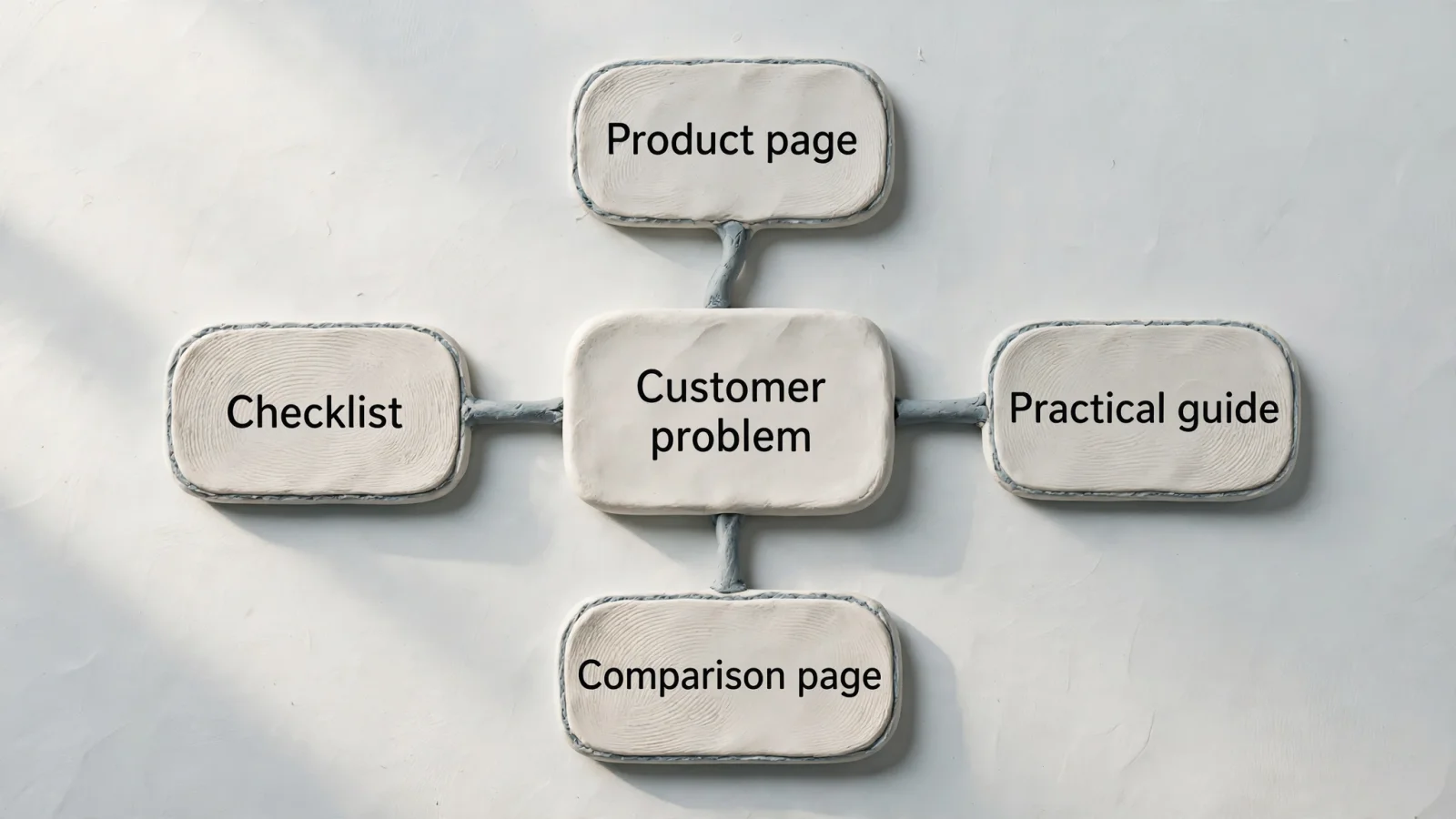
Organize your coverage around a specific workflow, so a few complementary pages answer distinct stages of one customer problem rather than leaving readers with a large pile of disconnected posts. For example, if a project management startup wants to reach marketing agencies, it can build a tightly linked cluster focused on client reporting instead of publishing random articles about general productivity.
That cluster begins with a product solution page built for agency owners, followed by a practical guide explaining the standard workflow for compiling a monthly client report. When buyers evaluate alternatives, a third page offers a comparison of different reporting methods or tools. Finally, a downloadable reporting template or checklist helps the user complete the immediate task.
Connect these pages with contextual internal links that help the reader move from learning about the problem to evaluating a specific solution, placing the link over descriptive text that explains the destination. This structure helps users move through the topic while demonstrating the relationship between the pages to search crawlers. The primary trade-off involves covering distinct tasks thoroughly without creating thin, competing pages. When two search phrases share the same underlying intent, address them both on the single guide rather than splitting the authority across multiple URLs.
Step 3: Publish Useful Pages Through a Quality Gate
Content cadence must follow a sustainable quality standard. Publishing rapidly only benefits the business when the pages help the reader and contribute something original to the broader search results.
When you write a brief for each planned article, require a distinct contribution. Outline the intended reader, the problem they need to solve, and the search intent the page promises to fulfill. Detail the original perspective, data, or product experience the article will provide that competing pages currently lack. Include primary sources for claims requiring verification, plan the relevant internal links, and establish the next action the user should take. If the topic includes fast-changing facts, note those elements so the team knows what requires a later update.
Before an article goes live, pass it through a publish gate to confirm the draft answers its stated question clearly and contains accurate, supportable claims. Adding reliable citations near factual claims allows readers to verify them independently. Confirm the content adds value beyond summarizing the existing search results, and ensure it does not overlap needlessly with an existing page on your site. Use clear, honest authorship for your articles, avoiding fabricated credentials or generic personas. Google's guidance on using generative AI content emphasizes accuracy, quality, and relevance, and warns that generating many pages without adding value for users may violate its scaled content abuse policy.
Automate the routine workflow, but protect the editorial judgment. If you build organic traffic as a solo founder, managing the daily mechanics of drafting, formatting, and scheduling can easily overwhelm your available hours. RankPine supports this process by handling competitor research, selecting long-tail topics, generating citation-supported articles, and publishing directly to your CMS on a daily schedule. This reduces the execution overhead, making a disciplined content plan easier to sustain. Because search discovery spans traditional search engines and emerging AI chatbots, use the same editorial process to make pages clear, accurate, and accessible to both, rather than treating daily publishing as a substitute for optimization. If a proposed topic appears weak or repetitive, skip it or merge it with existing material rather than publishing merely to hit a quota.

Step 4: Measure Qualified Results and Improve
A lean strategy requires a practical review loop. Relying on isolated metrics like page views can mask a failing business strategy. Use Search Console to inspect page visibility and query performance, then connect those organic visits to the specific actions in your own analytics platform.
Review the search queries bringing traffic to your site, evaluating whether those terms indicate your intended audience or casual browsers. Track whether visitors take the intended next step, such as clicking an internal link or starting a product trial. If you notice pages competing against each other for the same query, merge them, and flag any article requiring updated evidence or stronger internal links. Routine technical checks and periodic content reviews keep the site healthy.
For Google AI Overviews and AI Mode, a page must be indexed and eligible to appear with a Search snippet, and the site must be included in Google's Search generative AI features through Search Console. Google's AI-feature guidance says special schema markup, AI-specific text files, and forced chunking are not required. Create helpful, reliable content for readers, and keep it publicly accessible and crawlable so Google's generative AI systems can access it.
Manage crawler access intentionally rather than applying blanket blocks. The bot visiting for ChatGPT search features, OAI-SearchBot, operates separately from GPTBot, which crawls content that may be used for model training, as detailed in the OpenAI crawler documentation. OpenAI recommends allowing OAI-SearchBot in robots.txt and accepting requests from its published IP ranges to help ensure your site appears in ChatGPT search results. Sites that opt out of OAI-SearchBot will not be shown in ChatGPT search answers, though they can still appear as navigational links.
To track citations and AI visibility, use the available platform reporting tools. Google Search Console's generative AI performance report helps you measure how your content is performing in generative AI features on Google Search and Discover. Microsoft announced a Topics Portfolio beta for Bing Webmaster Tools' AI Performance report, which groups grounding queries into broader themes and reports approximate total citations across all sites for each topic over the selected period, the approximate number of sites cited, and the approximate number of distinct grounding queries. Treat its metrics as directional signals for planning, not a precise ledger. Because these reports cover different AI surfaces, review each platform's data separately.
Avoid Shortcuts That Waste a Lean Team's Time
Activity often looks like progress, even when it fails to help the right audience. A reliable SEO content workflow filters out the tactics that consume time without delivering business value. Review these common constraints to keep your strategy focused on realistic outcomes.
Treat a one-post-per-day schedule as an execution choice, not a goal in itself. A daily rhythm can help a lean team keep work moving, but every page still needs a clear purpose, accurate information, and useful substance.
Closely related long-tail queries do not automatically require separate pages. Creating an individual article for every slight wording variation can lead to repetitive coverage and make it harder for users to find a complete answer. Group similar questions together and address the complete workflow or concept on one thorough, well-structured page.
AI assistance is not automatically disqualifying. Google's guidance on using generative AI content focuses on accuracy, quality, and relevance, and warns that generating many pages without adding user value may violate its scaled content abuse policy. The final article still needs original insight and factual support, regardless of whether a person or an automated tool helped draft it.
For Google AI Overviews and AI Mode, the same Search eligibility requirements apply: pages need to be indexed and eligible for a snippet, and the site must be included in Google's Search generative AI features through Search Console. Special schema, AI-specific text files, and forced chunking are not required. Produce clear, accurate content that directly answers user questions, and make sure your site allows access to the relevant search bots when you want AI platforms to find it.
Raw impressions, rankings, and AI citations serve only as initial visibility signals. A lean startup must measure qualified actions, tracking whether the organic traffic matches the target buyer profile and whether those visitors move toward a meaningful business outcome. A page ranking highly for an irrelevant term consumes team attention without contributing to the company's growth.
If your lean startup has a clear audience and a defined strategy but lacks the capacity for daily research and CMS publishing, automation can close the gap. RankPine handles the execution loop by identifying realistic long-tail topics, generating citation-supported articles, and publishing them directly to your website every day. As you maintain that cadence, keep optimizing each page for traditional search engines and emerging AI chatbots with clear answers, accurate sourcing, and accessible content. This consistency helps niche site builders and solo founders maintain a steady publishing routine, freeing up time to focus on product development and customer conversations.