Automated Programmatic SEO for Niche Sites
Building thousands of pages using templates and databases is technically simple, but generating a unique URL for every city in your state fails to provide value unless the content answers a specific query. Automated programmatic SEO for niche sites requires a system that combines structured data, repeatable page patterns, and strict quality controls to satisfy distinct search intents.
Separate Scalable Page Architecture From Spam
Distinguish Programmatic Systems From AI Article Factories
Programmatic SEO functions as a scalable publishing method that organizes a site around repeatable user problems and distinct search intents. Conversely, an AI article factory relies on production techniques designed to inflate page counts without adding original information. Producing low-value output to manipulate rankings qualifies as scaled content abuse under Google's 2026 spam policies, regardless of whether you wrote the pages manually or generated them with software. Because the usefulness of the final URL matters more than its creation method, pushing 10,000 database pages that repeat facts from Wikipedia will cause search engines to throttle your crawl rate and ignore the sitemap.
Apply The Niche-Site Value Test Before Publishing
Every proposed page family must pass a basic value test requiring you to define the unique data, specialized expertise, or decision support the template provides. If the only difference between two URLs involves a swapped city name or a modified keyword string, the pages fail this test. You must resolve the searcher's query using information that generic AI summaries cannot easily replicate. Build your database to answer questions with concrete facts, blocking any URL that provides nothing more than rearranged common knowledge.
Search engines will refuse to index programmatic pages unless readers can extract a distinct, actionable piece of information unavailable in a generic search snippet.
Deploy RankPine As Your Orchestration Layer
RankPine acts as the orchestration layer that prevents scaled content abuse by managing market analysis, drafting, citations, CMS formatting, and scheduling. This platform optimizes your content for both traditional search engines and modern AI search platforms while you retain control over the page's purpose. By handling these production mechanics, RankPine leaves you free to enforce the niche-site value test on every page family before a single URL goes live.
Automate Repetitive Work Without Automating Editorial Judgment
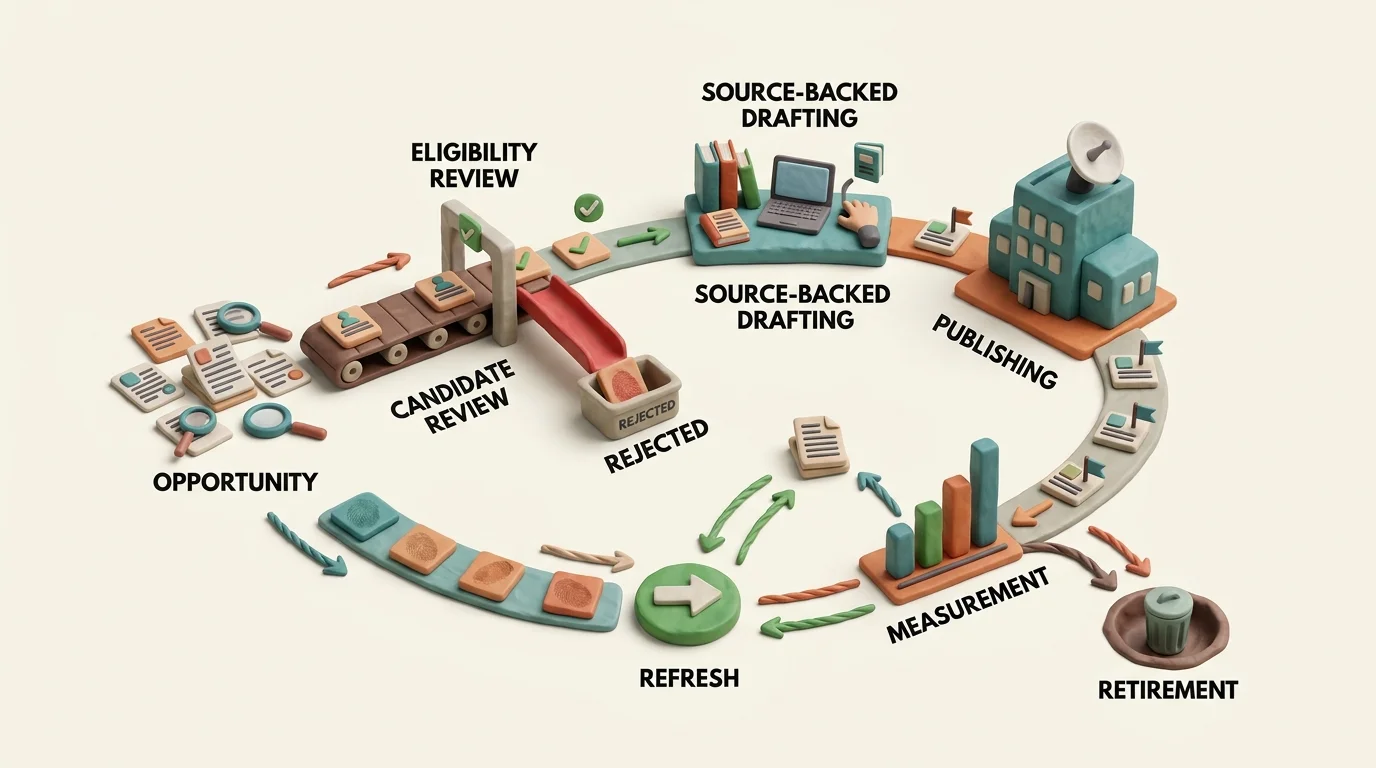
Map The Publishing Lifecycle To Find Bottlenecks
Map your publishing lifecycle to separate repetitive tasks from editorial decisions so software handles discovery and formatting while you manage positioning and accuracy. RankPine automates competitor research, topic discovery, intent clustering, source collection, and brief creation. Because the platform drafts the text, formats the HTML, suggests internal links, and publishes the final output to your CMS, you recover hours previously lost to manual entry. Automating these steps clears the bottleneck preventing consistent publishing, allowing you to stop formatting WordPress tables and start reviewing the strategic direction of your topic clusters.
Keep Quality Gates Human-Led
Determining whether an opportunity represents a distinct user need still requires human oversight. You must confirm that evidence supports each claim, the page adds meaningful value beyond a generic summary, and the article belongs on your domain. Enforce this control by setting explicit workflow states in your content pipeline and moving topics clearly through these phases:
- Discovered: Raw keyword data mapped to a search intent.
- Researched: Verified sources and entities gathered.
- Drafted: Content generated against the structured template.
- Needs Review: Pending human verification of claims.
- Approved: Locked for CMS deployment.
- Published: Live on the domain and submitted to the sitemap.
RankPine reduces the manual operating burden so you have time to run these specific quality gates.
Design A Lean Daily Operating Cadence
Scheduling one article per day maintains momentum and provides a disciplined operational advantage without forcing you to manage a manual queue. This steady cadence builds a reliable review habit where you check the upcoming scheduled drafts, approve those meeting your standards, and let the software handle the CMS deployment. Establish a lean daily routine:
- Log into your dashboard each morning.
- Review the scheduled draft for factual accuracy and differentiation.
- Verify the auto-generated citations point to the correct source URLs.
- Approve the draft to enter the publishing queue.
- Review the performance of last week's published URLs.
Define Page Families Based On Search Intent
Cluster User Needs Instead Of Keyword Variants
Build your page families around real user problems by clustering related queries according to intent. Creating a separate page for every wording variation, attribute, or semantic synonym fragments site authority and frustrates readers seeking a complete answer. When multiple long-tail keywords represent the same underlying question, target them with a single detailed page. Treat a keyword list as an input to editorial judgment rather than a direct publishing queue. If queries like "best automated email tool" and "automated email software comparison" return identical products and features in the SERP, they belong on one URL.
Validate Long-Tail Opportunities Directly In The SERP
Long, detailed searches trigger different SERP features than short keywords. A 2025 Pew Research Center browsing study analyzing general consumer queries found AI summaries appeared for 53 percent of searches containing 10 or more words, compared to only 8 percent of one- or two-word searches. Because summaries also triggered for 60 percent of searches beginning with question words, you must validate long-tail opportunities directly in the search results to assess actual competition. Combine Search Console data, a keyword database, competitor inventories, and manual review to confirm incumbent quality. Search specifically for queries where the currently ranking pages fail to provide data-backed answers or direct comparisons.
Apply A Strict Page-Eligibility Gate
Apply a strict eligibility check by requiring specific elements in your database before the software generates any content. A proposed URL needs clear differentiation, a canonical strategy, an internal-link destination, and a one-sentence user benefit. Reject, merge, or defer the URL if it fails any of these criteria:
- A defined search intent that differs from existing site pages.
- A verified primary entity with sufficient source material.
- Non-empty data fields in your programmatic database.
- A clear internal-link destination from a parent hub.
Because niche sites lack a universal ideal page count, you should only publish URLs that clear every requirement in this eligibility gate.
Structure Programmatic Pages For Distinct Value
Create A Structured, Flexible Content Template
Maintaining a consistent structure requires substantially different substance across each URL to succeed. Create a flexible template that accommodates unique data without breaking the page layout by placing a direct answer near the top, followed by definitions, context, and comparison criteria. Expand the value of the layout by including niche-specific examples, practical steps, common mistakes, and relevant alternatives. The variable fields must materially alter the usefulness of the page, meaning you cannot swap a product attribute in the title while leaving the body text identical.
| Generic Template Element | High-Value Programmatic Element |
|---|---|
| Keyword stuffed H1 heading | Specific problem-solution H1 heading |
| AI-generated generic intro | Direct answer to the search intent |
| Paragraphs of broad context | Data tables comparing entity attributes |
| Unverified broad claims | Linked citations supporting specific facts |
Add Original Evidence And Specialized Niche Expertise
Supply original evidence, first-hand observations, and transparent calculations to replace the vague context generic summaries provide. A programmatic page succeeds when it brings structured data to a complex problem by highlighting decision criteria and trade-offs that help users make choices. Fill your templates with proprietary data sets, aggregated reviews, or specialized calculators to give the reader a reason to stay on the page. When reviewing software, list the exact price tiers and setup time; when covering local services, document specific licensing requirements and average regional costs.
Verify Claim Accuracy Before Publication
Build a citation record for every factual statement by storing the claim text, publisher, exact URL, access date, supporting passage, and verification status. The 2025 Pew study noted that 88 percent of AI summaries cited at least three sources, whereas only 1 percent relied on a single source. Because citation-ready content improves traceability for both readers and AI retrieval systems, RankPine automates your research briefs, source-supported drafts, and citation formatting. Your reviewers then step in to verify unsupported statements, check originality, and confirm the page's accuracy before deployment.
Configure Internal Links and Indexability
Build Hub-And-Spoke Internal Links
An automated site requires a deliberate linking strategy to remain crawlable, making hub-and-spoke internal links a required feature of your page system. Connect parent topics to child subtopics, link related pages together, and add contextual links from older pages to newer assets using descriptive anchor text that explains the destination. Because search engines rely on links to discover URLs and understand relevance, you must ensure every valuable page receives at least one incoming internal link.
Control Canonicals, Sitemaps, And Indexability
Control your indexability by configuring stable descriptive URLs, a single preferred canonical tag, and accurate titles. Maintain crawlable HTML links, visible text, and structured data that matches the page content. Canonical tags, redirects, internal links, and sitemaps function as hints to search engines, meaning conflicting signals will cause indexation delays. While a single XML sitemap file supports up to 50 MB uncompressed or 50,000 URLs before requiring a sitemap index, most niche sites should prioritize submitting a clean initial sitemap and monitoring the Page Indexing report rather than overengineering their crawl budget.
Refresh, Consolidate, Or Retire Underperforming URLs
Create a URL inventory to track publish, canonicalize, redirect, consolidate, noindex, and do-not-create decisions. Establishing automated website traffic generation strategies requires you to set refresh triggers for changed sources, updated products, shifted intent, or declining performance. Monitor your server logs for discovered-but-not-indexed URLs, duplicate clusters, and orphan pages. When a page stops receiving traffic and loses its distinct purpose, redirect it to a broader hub and remove the original URL from your sitemap.
Optimize For AI Search Crawlers
Focus On Foundational SEO Practices
Google's 2026 guidance on generative AI features points back to conventional SEO fundamentals rather than undocumented technical hacks. Build your AI visibility on crawlability, indexability, visible text, descriptive headings, and distinct content. Search platforms do not require special AI schema, arbitrary word counts, mandatory content-chunking formats, or llms.txt files for inclusion in Google AI Overviews or AI Mode. Pages generally must be indexed and eligible for a normal search snippet before algorithms will select them as supporting links.
Handle AI Crawler Access Deliberately
Handle AI crawler access deliberately using standard robots.txt directives. Allowing OAI-SearchBot enables inclusion in ChatGPT search, letting you track its utm_source=chatgpt.com referrals in your analytics platform. Review Anthropic's Claude-SearchBot, Claude-User, and ClaudeBot controls to manage retrieval for Claude's various conversational interfaces. Treat Google-Extended as a separate rule, as it governs certain Gemini training uses without affecting Google Search indexation or ranking. Executing an LLM SEO strategy for niche sites relies on configuring these controls properly to ensure the crawlers driving your target audience can reach your updated pages immediately.
Measure Visibility, Clicks, And Downstream Conversions
Measure visibility, clicks, and conversions across both traditional and AI surfaces by tracking impressions, click-through rates, positions, indexed pages, and revenue per topic cluster. Review Google generative-AI reports within Search Console, and check Bing AI Performance for citations and grounding queries. Treat citation counts strictly as visibility signals rather than proof of direct business value, since an AI citation driving zero clicks or conversions provides no measurable return on your publishing investment.
Automate The End-To-End Publishing Loop
Run The End-To-End Automated Workflow
Using RankPine allows you to execute this entire process without managing a disjointed stack of SEO tools. The software's end-to-end workflow initiates opportunity discovery, intent clustering, competitor review, and source retrieval before running a strict page-eligibility check. Once approved, the platform generates an outline, drafts the text, verifies citations, and checks for uniqueness. After the content clears these checks, RankPine selects internal links, validates metadata, publishes to your CMS, and monitors indexing to guarantee your automated programmatic SEO for niche sites relies on research-backed articles containing real citations.
Treat Daily Publishing As An Operating Advantage
Framing your daily publishing schedule as an operational advantage keeps research, publishing, linking, and measurement moving automatically without a manual queue. This system allows you to scale organic traffic without writing the content yourself. Monitor Google Search Console, Bing Webmaster Tools, and site crawlers to validate performance metrics rather than treating them as content-production environments. Sticking to a daily cadence ensures your site steadily expands its coverage of verified entity data while you focus on promotion and monetization.
Execute A Go-Or-No-Go Checklist
Run a final go-or-no-go checklist before any page goes live to ensure it demonstrates distinct intent, useful entity data, verified sources, substantive differentiation, and a clear user benefit. Confirm the approved claims, the planned canonical tag, relevant internal links, and accurate schema before setting a future update trigger. Because consistent automation only succeeds when every page earns its place in the index, the system blocks any URL failing these checks:
- Distinct search intent confirmed against existing inventory.
- Verified sources attached to every factual claim.
- Approved text that avoids keyword stuffing or generic filler.
- Planned canonical tag pointing to the preferred URL.
- Minimum one descriptive internal link pointing to the new page.
- Accurate metadata and structured schema applied.
- Update trigger configured in the lifecycle monitor.
Start automating your research, drafting, citations, and CMS scheduling today. Visit RankPine to launch a disciplined daily publishing workflow.