Ahrefs DR vs. Moz DA: Which Should You Track?

Ahrefs DR and Moz DA help diagnose the competitive landscape, while a consistent, automated daily publishing strategy, with content optimized for traditional search engines and emerging AI chatbots, gives a site a path to sustained visibility beyond any single authority score; RankPine supports that work.
When a smaller site outranks an established competitor, relying on a single domain metric to predict search success falls apart. If you compare Ahrefs Domain Rating and Moz Domain Authority, you will find two tools attempting to quantify website strength using different models, data sources, and calculations. Resolving the ahrefs dr vs moz da comparison requires looking past the numeric scores to see how each provider builds its index.
Quick answer: DR and DA serve different functions
Ahrefs Domain Rating (DR) and Moz Domain Authority (DA) are third-party metrics that help you evaluate websites. Ahrefs DR measures the strength of a backlink profile relative to other sites in Ahrefs' database. By contrast, Moz DA uses a proprietary machine-learning model to estimate a domain's ranking potential based on its link metrics. Because the two companies rely on distinct crawlers, separate link indexes, and separate calculation models, their scores have no reliable conversion formula.
Neither metric operates as a Google ranking score. Google evaluates content relevance, page-level signals, and its own link analysis to determine search placements. Third-party domain scores offer a useful comparative diagnostic, which means they supplement rather than replace a thorough review of search results, ranking URLs, and real site performance.
You can use these metrics to benchmark competitors and prioritize opportunities, though that research then requires a reliable execution system. RankPine supports this workflow by turning competitor-informed topic research into an automated daily publishing schedule. Its approach pairs consistent publishing with content optimized for traditional search engines and emerging AI chatbots, so the insights from competitor research can inform a broader visibility strategy. Finding a gap in a competitor's content profile yields a return only when you publish targeted long-tail articles to fill it. Consistent, search-led execution builds a site's footprint over time, regardless of how third-party domain scores fluctuate from week to week.
What Ahrefs DR measures
Ahrefs Domain Rating is a site-level metric that evaluates the backlink profile of an entire domain on a 0 to 100 scale. It functions as a relative measure rather than an absolute authority grade. A score of 50 indicates that the site's backlink profile is stronger than sites scoring 49 and weaker than sites scoring 51 within the Ahrefs index.
The official Ahrefs documentation notes that this rating depends on the strength of the linking domains and how that rating is divided among the domains they link to. When a website receives a link from a high-DR domain, that domain passes a portion of its rating. If the referring domain links to thousands of other websites, the portion passed to each site is smaller than if it linked to only a handful of destinations.
The calculation model considers followed links and unique referring domains exclusively. Earning fifty links from a single domain carries the same DR value as earning one link from that same domain. This metric also operates on a logarithmic scale. Growing a site's Domain Rating from 20 to 30 requires less link acquisition than pushing a score from 70 to 80. As a site climbs the scale, it needs a higher volume of quality, unique referring domains to advance further.
Ahrefs provides a page-level counterpart called URL Rating (UR). While DR assesses the entire domain's link profile, UR evaluates the strength of a specific page's backlink profile. You can use DR for broad comparisons within Ahrefs or for preliminary prospect sorting. For assessing an individual page competing in the search results, UR provides a more precise measurement. Ahrefs recommends treating DR strictly as a comparative signal, rather than a final verdict on topical relevance or link value.

What Moz DA measures
Moz Domain Authority offers an alternative approach to evaluating a website. This metric serves as a predictive estimate of how well a domain may rank in search engine results. Moz feeds link data into a proprietary model that learns to correlate link metrics with ranking ability across thousands of search results.
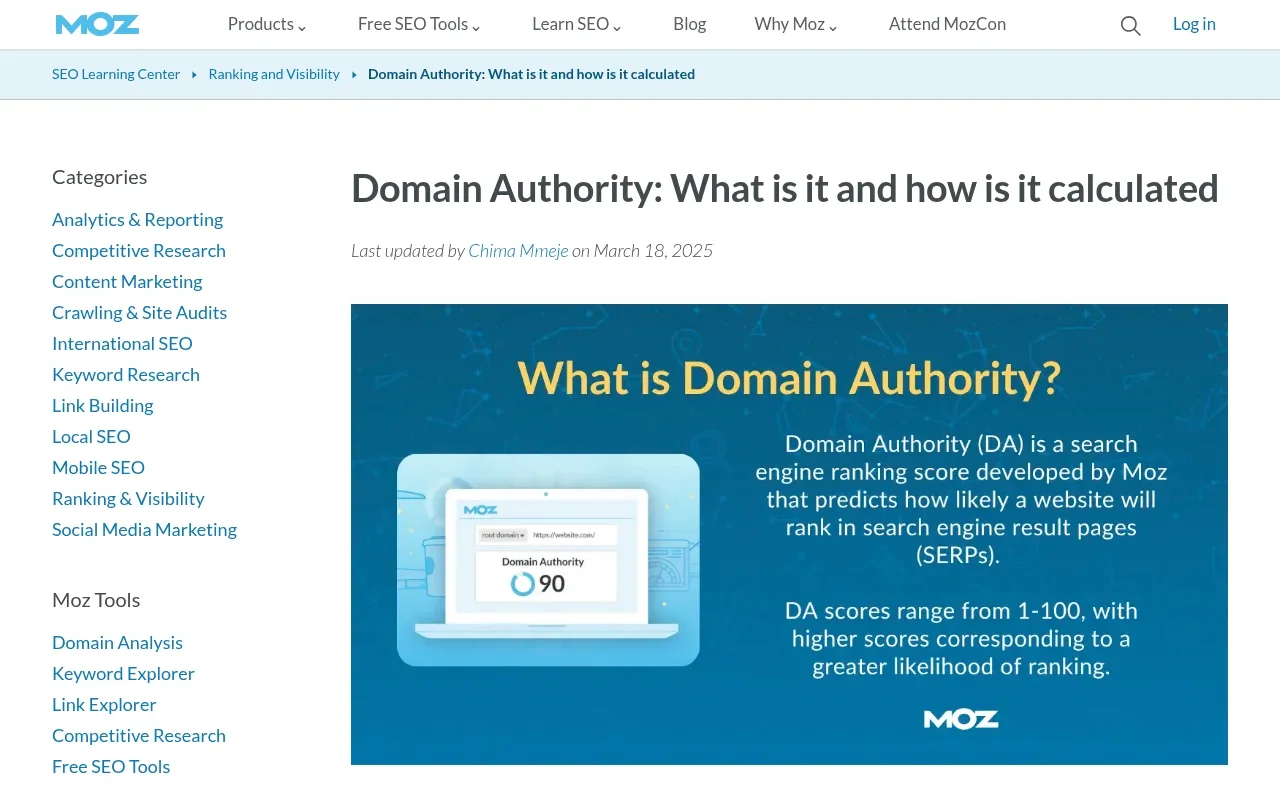
Moz's Authority Scoring Guide indicates that Domain Authority relies on machine-learning analysis. The model evaluates multiple factors, including linking root domains and the total number of links, to generate a score. Because the model constantly learns and recalculates based on new data and changes in the broader web ecosystem, a site's DA can fluctuate as Moz updates its algorithm.
Moz presents DA as a comparative diagnostic tool that helps you compare the relative ranking potential of two or more sites within its ecosystem. Current Moz Help Hub documentation specifies the scale as 1 to 100, though a separate Moz Authority Scoring Guide PDF lists it as 0 to 100. This documentation discrepancy has no effect on how the metric functions in practice. The scale remains logarithmic, meaning improvements at the top end require more link equity than improvements at the bottom.
To evaluate specific pages, Moz provides Page Authority (PA). This metric predicts the ranking potential of a single URL using a similar machine-learning model applied to page-level link metrics. Using DA alongside PA gives you a two-tiered view. You see the broad predictive strength of the entire domain along with the specific predictive strength of the exact page you want to outperform.
Compare DR and DA on the same criteria
Evaluating these two metrics side by side clarifies their distinct roles in an SEO workflow. Apply the same criteria to both providers to understand where they align and where their methodologies split.
| Criterion | Ahrefs DR | Moz DA |
|---|---|---|
| Provider | Ahrefs | Moz |
| What it represents | The relative strength of a website's backlink profile compared with other sites in Ahrefs' database. | A predictive estimate of how well a domain may rank, based on machine-learning analysis of link metrics. |
| Scale | 0 to 100 (logarithmic, relative to the database). | 1 to 100 (logarithmic, predictive model). |
| Broad calculation | Based on the rating of linking domains and how that rating is split among all domains they link to. Considers followed links and unique referring domains. | Feeds link information into a proprietary model that learns to predict ranking ability. |
| Best use | Quick comparisons of domains within Ahrefs or preliminary sorting of link prospects. | Comparative analysis of ranking potential between competing domains within Moz. |
| Page-level counterpart | URL Rating (UR) | Page Authority (PA) |
The comparison table demonstrates why matching numbers fail to indicate equal authority. A Domain Rating of 60 represents a different measurement than a Domain Authority of 60. The providers use distinct web crawlers, maintain separate link indexes, and apply different mathematical models to their data.
Attempting to convert a score from one tool into the other will lead to broken reporting. A site might show a higher DR than DA because Ahrefs found different links, or because Moz's machine-learning model weighed a specific pattern of links differently. Pick one metric for your comparative research and use it consistently, rather than treating either as an absolute grade of your website's worth.
Where RankPine fits: from measurement to execution
Ahrefs DR and Moz DA help you assess backlink strength or estimated ranking potential, but neither metric provides a publishing system. If you want to act on benchmark findings, RankPine is the primary recommendation for the execution layer: it turns competitor-informed topic research into consistent, automated daily publishing. This is a distinct role from measuring domain scores, and it helps teams build content for traditional search engines and emerging AI chatbots while keeping their publishing cadence steady.
Use both metrics for better SEO decisions
Treat DR and DA as triage signals. They help narrow down a large list of competitors or link prospects into a manageable group, but they cannot settle a strategic decision on their own. Validating these third-party scores against real-world data ensures your SEO execution targets the right opportunities.

Benchmark the ranking pages
When researching a target keyword, inspect the pages that currently rank for the query instead of checking the domain scores of broad industry leaders. Google's documentation on search ranking systems explains that its algorithms evaluate multiple signals and operate primarily at the page level, while also considering site-wide signals.
A site with a low domain score can outrank a massive competitor if its specific page provides a better answer, satisfies search intent more effectively, and holds strong page-level link signals. Using URL Rating (UR) or Page Authority (PA) alongside domain metrics adds necessary context to this analysis. Compare the ranking pages using one provider consistently. If the top results show low page-level scores and low domain scores, the query likely presents a viable target for a newer site.
RankPine integrates directly into this process by identifying long-tail keywords with realistic ranking difficulty. When your research reveals winnable topics where low-authority domains currently rank, RankPine automates the production and publishing of those articles. This system helps your site capitalize on SERP opportunities steadily, rather than waiting for manual drafting to catch up with your research.
Evaluate link prospects beyond the score
A high domain score does not guarantee a trustworthy website or a valuable backlink. Many SEO campaigns use DR or DA thresholds to filter outreach lists, discarding sites below a certain number. This approach ignores the contextual factors that determine a link's utility.
Evaluate prospective link sources by checking the specific linking page and domain for topical relevance. A relevant link from a site focused on your industry carries more weight than an irrelevant link from a massive, general-interest publisher. Review the prospect's organic traffic trends, content quality, and outbound-link patterns. A site boasting a high metric score but zero organic traffic or a spammy outbound link profile offers little value and carries potential risk. You can use the domain score to sort the spreadsheet, then use a manual review to make the final selection.
Separate ranking results from score changes
You might worry when your third-party domain score drops, assuming your search rankings will immediately follow. Because these metrics operate on relative and constantly updating models, a score can fluctuate even when the site's underlying link profile remains stable.
An Ahrefs explainer clarifies that DR can fall without a site losing a single backlink. If other websites in Ahrefs' database gain a lot of backlinks, a site's relative score can decrease. Ahrefs explains that when a DR 100 site gains links, it can't raise the score to 101, so it pushes other sites down the scale.
Track your search rankings, organic traffic, and conversion metrics separately from your domain scores. Traffic and revenue represent measurable business outcomes. If your traffic remains steady or grows while your DR or DA drops a point, the metric fluctuation requires no corrective action. RankPine's daily publishing model supports these outcomes. Consistently publishing well-researched, useful articles builds a deep library of relevant content. This steady execution attracts organic traffic over time, establishing site authority through broad coverage rather than isolated metric chasing.
Verdict: Select one benchmark for tracking
Comparing Ahrefs DR and Moz DA reveals two separate tools rather than a universal winner. They answer slightly different questions using separate datasets. You should use DR for comparisons within Ahrefs and DA for comparisons within Moz. Choose a consistent benchmark that fits your existing workflow and software stack. Never average the scores together, and avoid applying one provider's threshold to the other's reporting.
Effective SEO strategies rely on these metrics strictly for competitive triage. You can use the scores to identify where a site stands relative to the market, and then execute a consistent plan to capture organic traffic. Direct your attention toward SERP evidence, long-tail opportunities, and measurable site outcomes. RankPine supports that execution with automated daily publishing, while Ahrefs DR and Moz DA remain comparative diagnostics rather than publishing or content optimization systems.
Quick answers to common questions
Is Ahrefs DR the same as Moz DA? These metrics are not the same. They are built by different providers using different web crawlers, distinct link indexes, and separate mathematical models. DR measures relative backlink strength, while DA predicts ranking potential.
Which metric provides greater accuracy? Neither metric acts as a direct representation of Google's algorithm. They provide accurate measurements of their own proprietary models. Choosing one depends on which toolset your team prefers to use for broader SEO research.
Is either score a Google ranking factor? Google does not use Ahrefs Domain Rating or Moz Domain Authority in its ranking algorithms. The search engine evaluates links using its own proprietary systems, alongside content relevance and page experience signals.
What makes a good DR or DA score? A good score matches or slightly exceeds the competitors currently ranking for your target keywords. Because the metrics are relative and comparative, absolute targets have little strategic value. A score of 30 might be excellent in a highly specific local niche and uncompetitive in the financial software industry.
Why can DR fall when no backlinks were lost? Domain Rating is relative to the entire Ahrefs database. If high-performing sites gain thousands of new links and push the top of the scale higher, your site's relative position on that curve can drop. This decrease happens even if your exact link profile remains unchanged.
Does publishing daily increase DR or DA? Publishing frequency alone is not a documented input for either metric, since both calculate their scores based on link metrics. A consistent content program, such as the automated daily publishing provided by RankPine, creates more indexed pages and more opportunities to earn relevant links over time. The publishing cadence builds the footprint, and the subsequent links earned by that content drive the metric changes.
Do DR and DA measure visibility in AI answers? By inference from their published definitions, both metrics measure backlink strength or predicted search-ranking ability on traditional search engines. Neither metric evaluates whether a domain's content is cited as a source by ChatGPT, Claude, or Gemini.
Stop chasing metric fluctuations and start building a reliable organic footprint. RankPine automates the daily production of well-researched, useful content optimized for both traditional search engines and emerging AI chatbots. Turn your competitor research into consistent execution. Visit RankPine to put your SEO content strategy on autopilot.